Mandarin Roller Bottles: How Many Drops You Really Need
A 10 ml roller bottle at 1% needs two drops of mandarin oil, and that is the whole puzzle: at this scale a dropper is a blunt tool. Rollers are lovely little things to carry, though, and mandarin's sweet, mellow scent suits them. Let us start with the numbers, then offer three pairings.
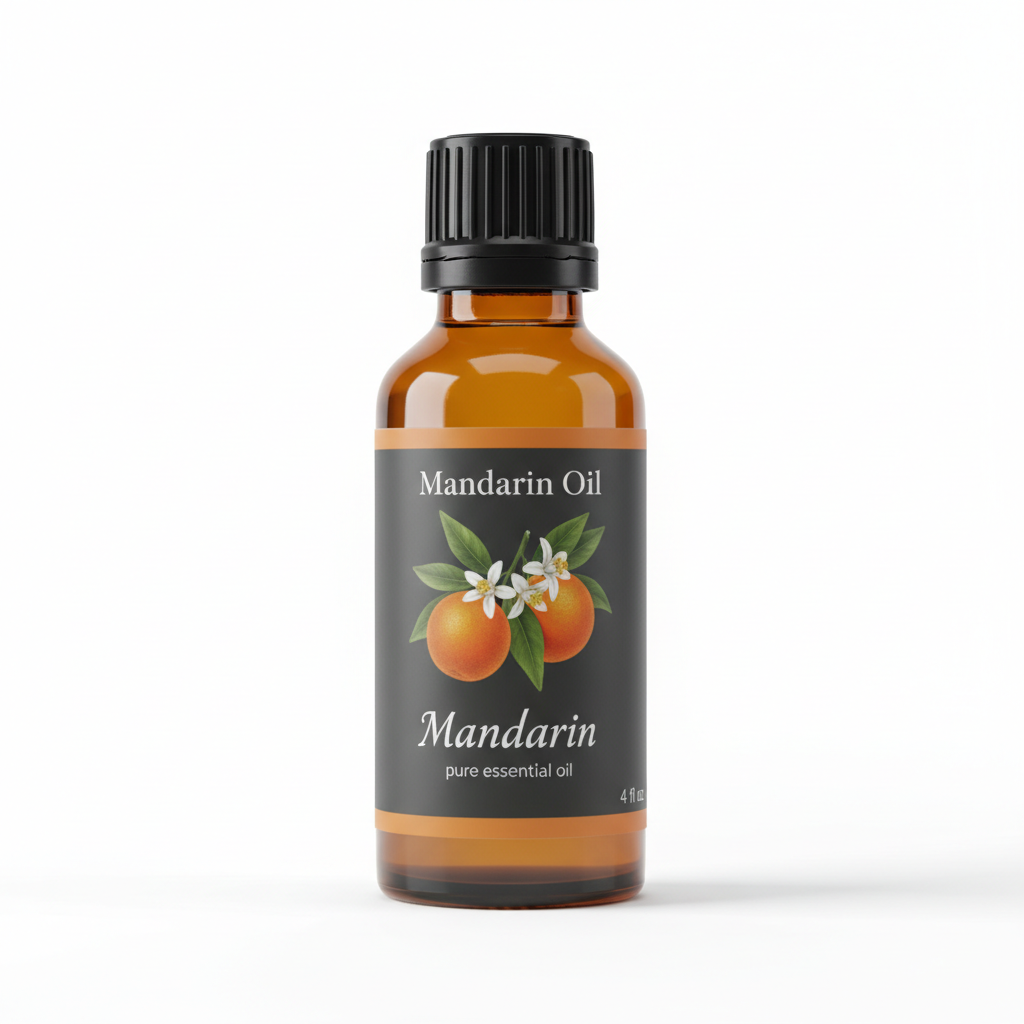
Mandarin Essential Oil
Our own Mandarin Essential Oil, in sizes from 0.5 oz to bulk.
From $12.99
Shop Now →The conversion, with the rounding stated
Our oil comes in ounces, from 0.5 oz up, and rollers are usually 10 ml, so the unit change is yours. At about 20 drops per ml (droppers vary) and a relative density of 0.852 from the batch on our COA, 10 ml of carrier at each share of our 0.5% to 2% range works out like this:
- 0.5%: 0.05 ml, 1 drop, about 0.04 g
- 1%: 0.10 ml, 2 drops, about 0.09 g
- 2%: 0.20 ml, 4 drops, about 0.17 g
At this size whole drops jump in steps of 0.5%, so 0.7% or 1.5% are out of reach. A dropper that gives 30 drops per ml, not 20, makes two drops 0.67% instead of 1%. The cure is to make a bigger batch and fill the roller from it. In one ounce of carrier (29.57 ml), one drop moves the share by only about 0.17%, so 1% is 6 drops (about 0.3 ml, 0.25 g) and 2% is 12. Better still, weigh the oil: 0.25 g is readable on a scale that reads to 0.01 g, and a 1 oz batch fills two 10 ml rollers and most of a third. For any size, batch ml times the share gives ml of oil, times 20 gives drops, and times 0.852 gives grams.
Why we stay at the low end
Tisserand's dilution guide lists rollerballs at 3% to 10% and notes the range assumes use on a small area of skin; it also suggests clothing or a jewellery diffuser if skin is sensitive (Tisserand Institute). That is far above our own line of 0.5% to 2% in a carrier, with a patch test first and the low end for anyone new to citrus oils, and we stay with ours. A roller is also a leave-on product, so freshness matters. Limonene forms hydroperoxides in contact with air, which DermNet describes as much more potent sensitisers, with about 10% of people investigated for suspected contact dermatitis reacting to them, a clinic population rather than everyone (DermNet). A case report describes a roll-on product that had darkened and a man who tested positive to limonene hydroperoxides; it is one patient and gives no frequency (Kwong and Lim, 2020). So we suggest buying small, reordering often, and keeping the bottle capped, cool and dark.
Three pairings, by drops
These are ratios for a 1 oz batch at 1% total essential oil, 6 drops in all, so mandarin sits at or below 1%. We sell only mandarin oil, so you will find the partners at other suppliers, each with its own guidance to read. Weigh where you can.
- Mandarin and lavender: 4 drops mandarin, 2 drops lavender. We recommend this pairing for its soft, familiar sweetness.
- Mandarin and frankincense: 4 drops mandarin, 2 drops frankincense. Check the species and extraction your seller lists, because the name covers several.
- Mandarin, neroli and vanilla: 3 drops mandarin, 2 drops neroli, 1 drop vanilla. Vanilla is sold as an absolute, an extract or a CO2 product in different strengths, so ask what you have before counting a drop.
We have left bergamot out. It is a lovely partner for scent, but it brings bergapten into a leave-on product: Tisserand gives bergamot as roughly 0.11% to 0.33% bergapten against a 15 ppm ceiling for leave-on use (Tisserand Institute), so it deserves its own supplier's guidance. More pairings are in what blends well with mandarin oil, and mandarin versus bergamot compares the two.
Filling and keeping the roller
Choose a glass roller bottle, ideally amber. Our oil is sold in amber glass because heat and sunlight speed oxidation in citrus oils. Our carrier oil guide covers the carrier. Citrus oils are strong solvents and some plastics may soften or swell with them, so ask the supplier which resin the ball and cap use and look at the cap after a week. Mix the oil into the carrier in a clean glass cup, pour through a small funnel, push the ball in, cap it and label the date and percentage.
A little ritual for making the batch
Set everything out before you open the oil: a clean glass cup, the funnel, a pencil and paper, and a paper towel for drips. Add the carrier first, then count the drops of mandarin slowly into the cup, saying the number out loud as you go. It sounds silly, but losing count at drop four of six is the commonest way to end up with a roller that is a different strength from the label you wrote. If you lose count, tip it out and start again; it costs very little.
Write the date, the percentage and the contents on a small label before you fill the roller, not after, because the oil on your fingertips makes labels hard to stick.
Patch test, then wear
Tisserand's roller range assumes a small patch of skin, so a roller dragged across a whole forearm or neck is a larger exposure than the number implies. Keep the first use to one small spot, away from the face and any irritated skin. Patch test the finished roller, not only the oil; the steps are in Mandarin Oil Safety Basics. Keep it away from eyes, children and pets. For a solid format, see the solid perfume balm post.
Once the roller is finished, give it a day before you decide how it smells. The first minute is all bright fruit, and the quieter, rounder scent that follows is the one you will actually be wearing.
Make the batch bigger than the bottle, weigh the oil, and date the label; that is most of a good roller.
Mandarin Essential Oil
Mandarin Essential Oil from our own shop, in sizes from 0.5 oz to bulk.
From $12.99
Shop Now →Sources & Further Reading
- Tisserand Institute. Dilution for essential oils. tisserandinstitute.org/dilution-essential-oils
- DermNet. Contact allergy to hydroperoxides of limonene and linalool. dermnetnz.org/topics/contact-allergy-to-limonene-and-linalool
- Kwong HL, Lim SPR, 2020. Pigmented contact dermatitis in the axillae caused by hydroperoxides of limonene. JAAD Case Rep. pmc.ncbi.nlm.nih.gov/articles/PMC7256231
- Tisserand Institute. Phototoxicity: essential oils, sun and safety. tisserandinstitute.org/phototoxicity-essential-oils-sun-and-safety