Mandarin Oil Origin and Grade: Reading the Label
Two words on a mandarin oil bottle carry more weight than any others, and they are the two a shopper can verify the least: the country and the grade. You cannot sniff your way to a country of origin, and "grade" is a word the sources we looked at never define for essential oils. That does not make them meaningless. It means they are worth reading the way you would read a restaurant menu's "farm to table", as an invitation to ask a better question.
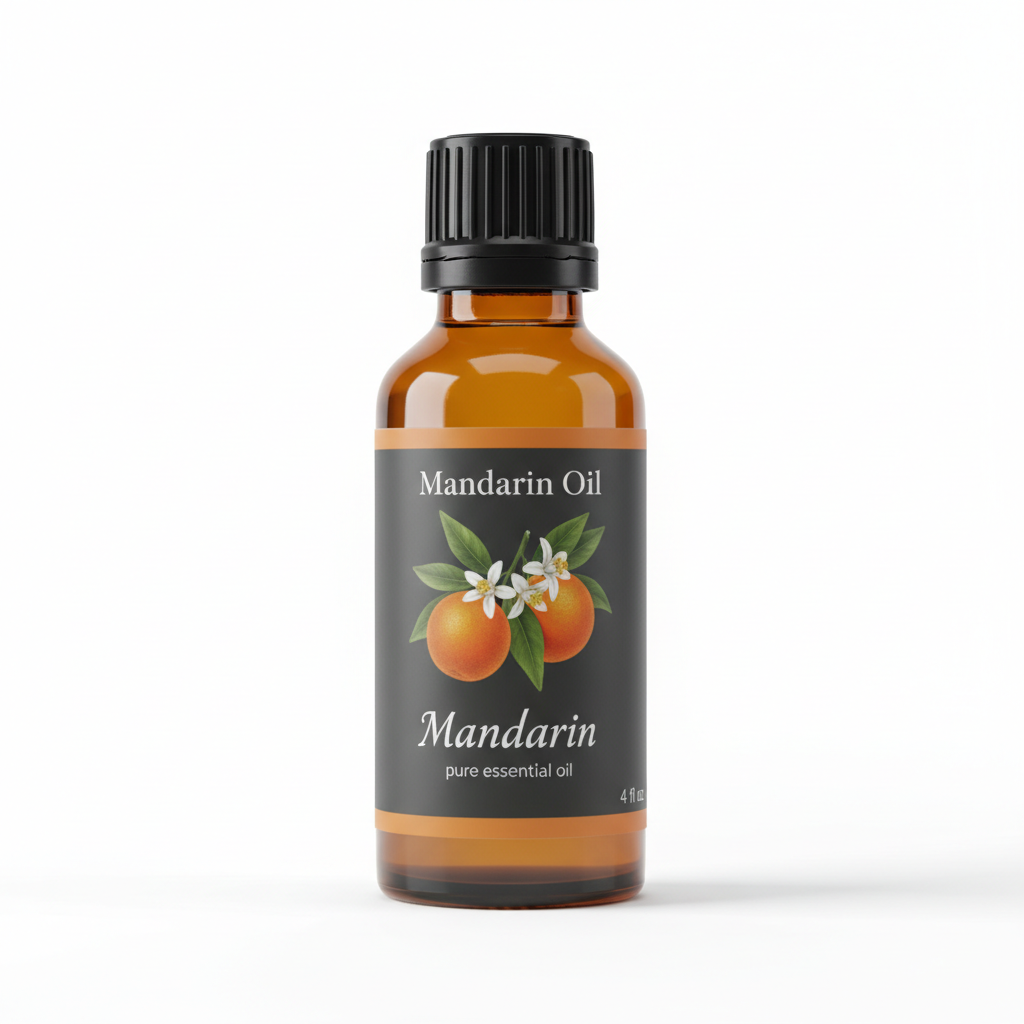
Mandarin Essential Oil
Our own Mandarin Essential Oil, in sizes from 0.5 oz to bulk.
From $12.99
Shop Now →Why origin matters, and why it is only part of the story
Origin genuinely changes an oil. A 2026 review of Citrus reticulata essential oil says that cultivar, plant part and geographical origin each produce significant differences in yield, properties and composition (Zhang et al., 2026). A 2025 study ran 63 mandarin oils described as genuine through a specialised chiral and isotope-ratio instrument and reported clear seasonal and geographical trends (Cannizzaro et al.). Notice what that means in practice: telling one origin from another took a laboratory instrument most buyers will never see. A country name on a label is a claim about the fruit's story. It is not a measurement of what is in the bottle.
Even inside one region, oils vary. When the European Food Safety Authority assessed expressed mandarin oil, it analysed ten batches, nearly all from Italy, and the main component, limonene, still ranged from about 56% to 69% of the oil across them (EFSA Panel, 2021). So "from Italy" does not pin down one composition, and a certificate for one batch tells you about that batch.
What "Italian type" actually refers to
You will see "Italian type" on some listings. In the EFSA document, the specification follows ISO 3528, whose title in the annex reads "Essential oil of mandarin, Italian type (Citrus reticulata Blanco)". We have not read the standard itself, so we will not tell you whether it restricts where fruit grows or describes a composition profile. What we can say is that the phrase names a specification, and the sensible follow-up is always the same: which batch was measured against it?
Green, red and what colour tells you
Colour is one of the few things on a mandarin label you can check with your eyes. EFSA describes the green type as a green to green-brown clear liquid and the red type as orange to red-amber. That is a type label rather than a quality ranking, and it says nothing about where the fruit grew. If you are curious how the colour classes differ, our piece on green, red and yellow mandarin oil picks that up.
"Grade" is only as good as the standard behind it
The US Food and Drug Administration sorts aromatherapy products by what they are intended to do: a product meant to cleanse or beautify is a cosmetic, one meant for a therapeutic purpose is a drug. The same page notes there are no regulations defining "natural" or "organic" for cosmetics (FDA, Aromatherapy). A grade word on a bottle is therefore a house term until a named standard sits behind it, with numbers you can look up. Where a standard is named, the numbers are useful. EFSA's specification, for example, gives relative density of 0.844 to 0.859, refractive index of 1.470 to 1.480 and optical rotation of +61.5 to +81.5 degrees for expressed mandarin oil.
The certificate of analysis we publish for one batch lists a relative density of 0.852, a refractive index of 1.471 and an optical rotation of +69.80 degrees, each inside those ranges. These are physical constants, good for confirming that an oil behaves like mandarin and not for naming a country. Our certificate walk-through goes line by line.
What we say about our own oil's origin
We sell one mandarin oil, cold-pressed from the peel and sold neat, in sizes from 0.5 oz to 400 lb. The certificate gives its botanical name, the part used and the extraction method, but no country. So in this article we make no origin claim for our oil. If origin decides your purchase, ask us in writing through the contact page and ask for the answer in writing, with the batch it applies to. The same goes for a bulk buyer who needs GC-MS data.
The bottle in your hand
Before you email anyone, turn the bottle around and read everything printed on it. Is the common name there, and the botanical name? Is there a lot code you could quote? Is the glass dark enough to keep light out? We keep ours in amber glass for exactly that reason. You'll notice that a label which tells you less is not necessarily hiding anything, but it does mean you have more questions to send.
Write down what is on the label and what is missing. That short list becomes your email, and it saves you from asking things the bottle already answers.
Six questions that work on any seller
- Which species is it? The Latin name covers a wide family, as we explain in our label guide.
- Is it expressed or distilled? They are different materials (see cold-pressed against distilled).
- Which batch does the certificate describe, and what is its best-by date?
- Which named standard were the numbers compared with?
- Is there a GC-MS report, and which method made it?
- How is the origin documented, and for which batch?
A seller who can answer all six has told you more than any origin or grade word could. Our advice is to buy a small size first, read the paperwork against that bottle, and size up once the two agree. For the full composition picture, see what the studies report.
Labels invite questions, and a few good ones are all it takes to turn a nice-sounding bottle into one you actually understand.
Mandarin Essential Oil
Mandarin Essential Oil from our own shop, in sizes from 0.5 oz to bulk.
From $12.99
Shop Now →Sources & Further Reading
- Zhang et al., 2026. Citrus reticulata Essential Oil as a Bioactive Food Ingredient: Composition Variability, Extraction, Functional Bioactivities, and Cross-Study Quantitative Analysis. Food Sci Nutr. PMC13594552
- Cannizzaro et al., 2025. Comprehensive analysis of mandarin essential oils: Simultaneous qualitative, quantitative, chiral, and isotopic profiling via enantio-selective multidimensional gas chromatography coupled to isotopic ratio mass spectrometry. University of Messina record
- EFSA Panel on Additives and Products or Substances used in Animal Feed, 2021. Safety and efficacy of a feed additive consisting of expressed mandarin oil from the fruit peels of Citrus reticulata Blanco for use in all animal species (FEFANA asbl). EFSA J. PMC8190682
- US FDA. Aromatherapy. fda.gov