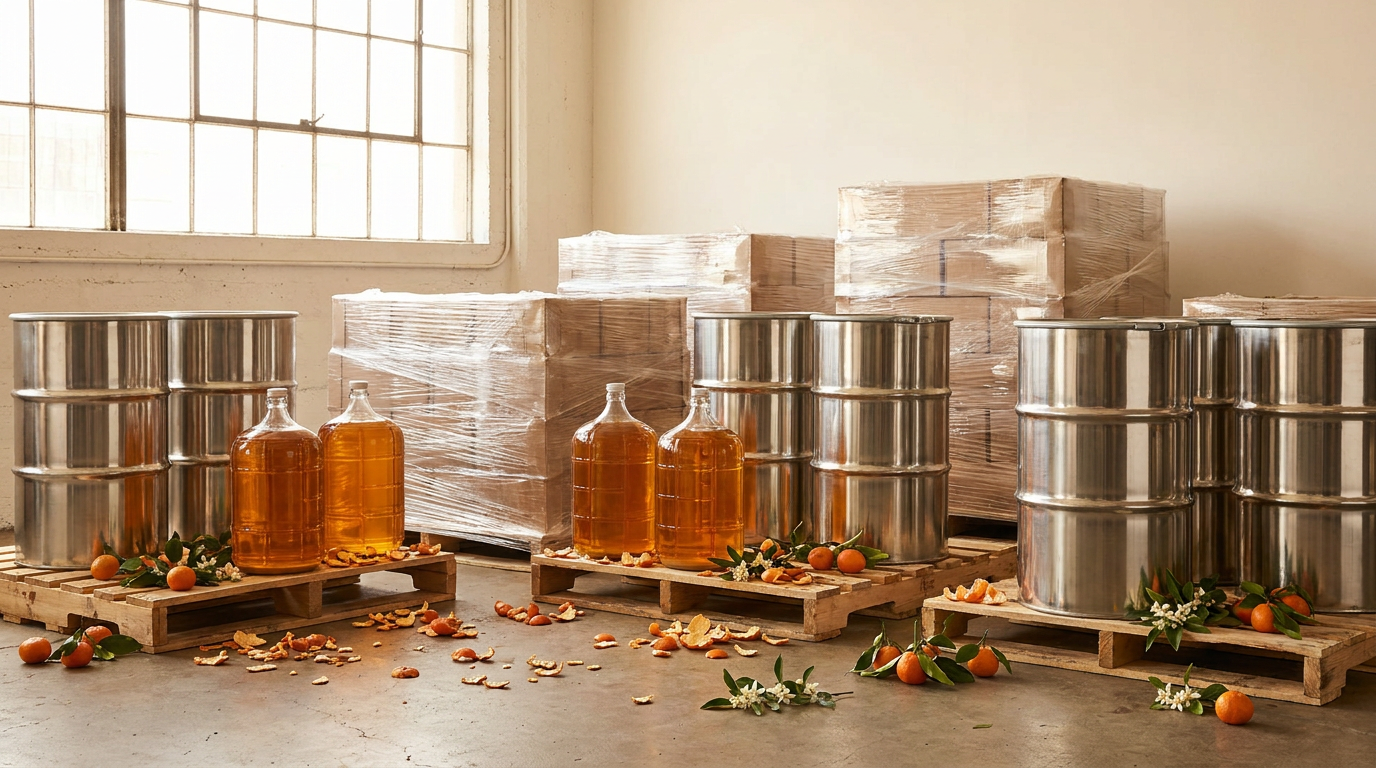
Mandarin essential oil is one of the gentlest citrus oils on the market, and one of the easiest to buy wrong. This guide walks wholesale buyers through what mandarin oil actually is, how the trade grades and sometimes mislabels it, and how to size an order that fits a real production line.
Check current per-pound rates on the bulk page or send over your formula for a quote.
Mandarin oil is pressed, not distilled, from the fresh peel of Citrus reticulata, a fruit with a long history in Chinese orchards before it spread through Italy and the wider Mediterranean, a lineage covered in A Short History of the Mandarin: From Chinese Orchards to Modern Perfumery. For a full primer on what the oil is and how it differs from other citrus peel oils, see What Is Mandarin Oil? The Complete Guide to Citrus Reticulata Peel Oil.
The pressing method matters to a buyer because it shapes both aroma and shelf behavior: cold expression keeps the peel's juicy, living top note intact, while steam distillation produces a thinner, less rounded oil, a distinction laid out in Cold-Pressed vs Steam-Distilled Mandarin Oil: Which Suits Your Craft. Origin adds a second layer of variation: China supplies the bulk of commercial volume, while Italian mandarin trades on a different reputation and price point, as explained in A Buyer's Guide to Mandarin Oil Origin and Grade: Italy vs China.
Buyers sourcing at volume for the first time do well to read Bulk and Wholesale Mandarin Oil: A Buyer's Guide for Makers and Small Brands before requesting quotes, since the wholesale market runs on different terms than a single retail bottle.
| Sold as | What it actually is | How to recognize it |
|---|---|---|
| Cold-pressed China-origin mandarin | The standard commercial grade sold worldwide, pressed from fresh Citrus reticulata peel and the most common lot type in bulk supply chains. | Label lists Citrus reticulata, notes peel pressing rather than distillation, and states China as country of origin. |
| Cold-pressed Italian mandarin | A smaller-volume lot type from Mediterranean groves, often positioned as a more delicate or prestige version of the same fruit. | Label lists Italy as origin and usually carries a noticeably higher price per pound than China-origin lots. |
| Steam-distilled mandarin | A distilled version of the same peel material, trading aroma depth for a lighter, thinner top note and a different production cost structure. | Label or spec sheet states distillation rather than cold pressing as the extraction method. |
| Mandarin sold as fragrance oil, or as tangerine | Either a synthetic or diluted product marketed loosely as mandarin, or a genuinely different citrus fruit relabeled to ride on mandarin's popularity. | No botanical name on the label, wording like fragrance oil or blend, or a spec sheet that actually names tangerine. |
The two mislabeling issues in the table are covered in more depth in Mandarin Essential Oil vs Mandarin Fragrance Oil: Which Should You Buy? and Mandarin Oil vs Tangerine Oil: Untangling Two Nearly Identical Citrus Oils, both worth sending to a new supplier before a first purchase order.
The real sourcing trap for mandarin oil is not a bad grade, it is a mislabeled one: a drum priced well below the China-origin market rate is rarely a bargain, it is usually a diluted lot, a fragrance oil, or tangerine oil sold under mandarin's better-known name.
Wholesale demand for mandarin oil comes almost entirely from people who put it into a finished product rather than sell the bottle itself: cold-process soap makers, candle and wax melt manufacturers, indie perfumers, and diffuser blend and room spray brands, with the full range of finished-good uses mapped out in a wide-ranging list of mandarin oil uses across home and skin care.
A second, steadier tier of buyer is the spa or studio that restocks its own diffuser and body oil supply on a recurring schedule rather than reselling product, and the studios and brands that hold formulas steady over time tend to be the ones asking the sharpest sourcing questions, covered from the buyer's side in Bulk and Wholesale Mandarin Oil.
Before placing a first bulk order, a buyer should confirm the following on any lot under consideration.
MandarinOilCo publishes a batch Certificate of Analysis for exactly this reason: a buyer should never have to take a seller's word for botanical name, extraction method, or origin on faith.
Mandarin oil is sold across ten sizes, from a 0.5 oz bottle meant for someone testing the scent for the first time up to 400 lbs drums for formulators running production at scale, and Best Mandarin Oil Bottle Sizes: Which One Should You Order First? walks through the retail end of that ladder.
For wholesale purposes the ladder really starts at 5 lbs: that is where per-pound pricing on the bulk page begins to reflect production-scale economics rather than retail-bottle economics, and where most of the application-specific guides below pick up the conversation.
Most buyers start with a small retail size, often 1 oz or 2 oz, to run the oil through an actual formula before committing to volume.
Once the formula holds up, request pricing at the size tier that matches expected monthly volume, typically starting at 5 lbs or 25 lbs, referencing the bulk page for current per-pound rates.
Place the first bulk order at the smallest pound tier that covers a production run, and confirm the Certificate of Analysis on that specific lot before it ships.
Move to 100 lbs or 400 lbs once demand is proven and storage allows for it, and lock in a standing reorder cadence so a fresh-pressed citrus oil does not sit past its usable window.
The application categories below cover the wholesale buyers who actually put mandarin oil to work, each with its own formulation habits, supplier expectations, and sizing pattern.
Soap makers buy mandarin oil for its bright top note, but citrus oils are notorious for fading in cured bars, which changes how a maker sizes and reorders.
Read the sourcing guide →Wax throws citrus oils differently than a diffuser does, and mandarin's soft profile behaves in ways a candle maker needs to plan for before scaling a pour.
Read the sourcing guide →Indie perfumers buy mandarin as a top note for balms and blends, and the category rewards small, frequent bulk orders over one large purchase.
Read the sourcing guide →Brands bottling ready-made diffuser blends buy mandarin as an everyday, family-friendly top note that plays well with heavier evening blends.
Read the sourcing guide →Room and linen spray brands buy mandarin for a light, everyday citrus note that reads clean on fabric without the sharpness of lemon-forward sprays.
Read the sourcing guide →Body care brands buy mandarin for scrubs and body oils where a gentle citrus scent needs to sit comfortably on skin, not just in the air.
Read the sourcing guide →Spas and studios reorder mandarin oil on a recurring schedule to keep ambient diffusers and blending bars stocked across every service room.
Read the sourcing guide →Contact us with your application and target volume and we will point you to the right size tier.