What's Inside Mandarin Oil? Limonene and Beyond
Pick any page about mandarin oil and the first number you will see is limonene. It is the headline constituent, and it is also the one that tells you least about whether an oil is really mandarin. The more interesting story is in the small compounds that give mandarin its particular character, and in how much the numbers change depending on who measured them and how.
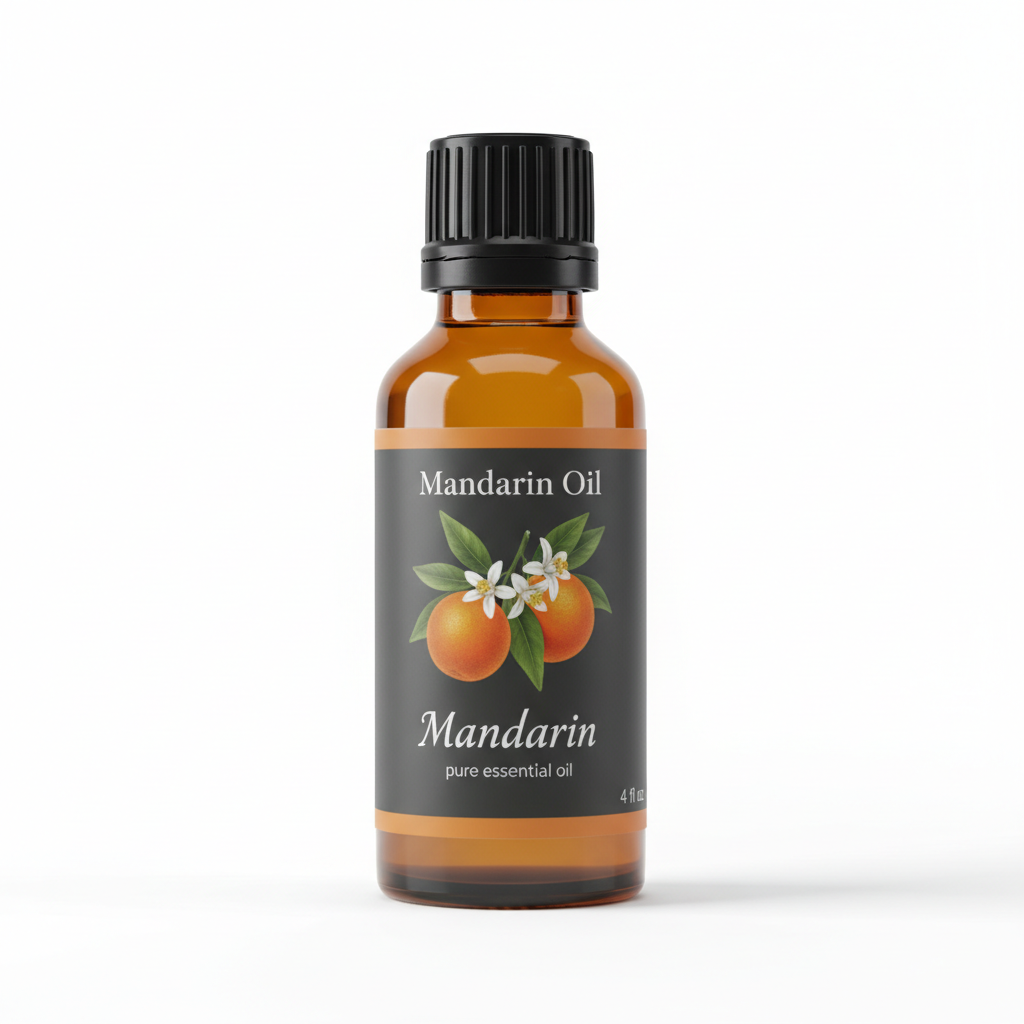
Mandarin Essential Oil
Our own Mandarin Essential Oil, in sizes from 0.5 oz to bulk.
From $12.99
Shop Now →The same species, very different numbers
Composition is reported as a percentage of gas chromatography peak area, which is close to, but not the same as, percentage by weight. Here is how widely honest figures can sit:
- EFSA's panel analysed ten commercial batches of expressed (cold-pressed) mandarin oil, five green and five red, nearly all from Italy. Limonene averaged 65.63% (range 56.4 to 68.6) and gamma-terpinene 21.85%.
- A study of cold-pressed ponkan mandarin oil reported limonene at 80.3%.
- A 2026 Egyptian study distilled the peel of five mandarin and tangerine cultivars the same way and found limonene from 32.87% to 81.13%.
A single species name can sit over limonene values from the low 30s to the 90s. Cultivar, extraction method, season and the instrument all play a part. The EFSA document shows the last one nicely: the same ten batches were checked by two methods, and the GC-FID method used for the specification found all ten compliant, while the GC-MS used for the full analysis put the average of one minor compound, methyl N-methylanthranilate, at 1.04% against a specification ceiling of 0.7%. The document also notes that GC-MS underestimates limonene. One oil and two instruments gave two slightly different pictures, so a composition figure without its method is only half a number.
Why limonene decides so little
Take an ounce of oil, about 25.2 g at the relative density of 0.852 on our published certificate. Each percentage point of peak area is very roughly a quarter of a gram, a loose conversion since area is not weight. The EFSA batches ran from 56.4 to 68.6% limonene, which is a spread of about 3 g per ounce between batches the panel accepted. The minor compound methyl N-methylanthranilate, with a range of 0.51 to 1.59%, moves by only about a quarter of a gram. The big component swings by grams; the small one that gives mandarin its distinctive orange-peel note barely shifts, and yet it is part of what marks an oil as mandarin.
The smell research agrees. A Japanese study of ponkan cold-pressed oil found that octanal and decanal were its characteristic odour components, with limonene as a background note. Limonene gives any citrus peel oil its basic fresh smell; the aldehydes and minor compounds are what make mandarin taste like mandarin to your nose. A report that gives you only limonene cannot tell one mandarin oil from another oil with a similar limonene level.
Researchers go further than percentages. A 2025 study of 63 authentic mandarin oils measured the chiral distribution and carbon isotope ratios of selected compounds and reported clear seasonal and geographic trends. Even authentic oils move with season and place, which is why any single reference range is a guide and not a verdict.
Why this is more fun than it sounds
A table of percentages can feel like the opposite of romance, but we think it is the reason a bottle of mandarin keeps surprising you. Two oils with the same name on the label can open a little differently, one rounder, one brighter, and the numbers above are a hint at why. Nobody is doing anything wrong when that happens. It is simply what a natural material does.
A simple way to notice the differences
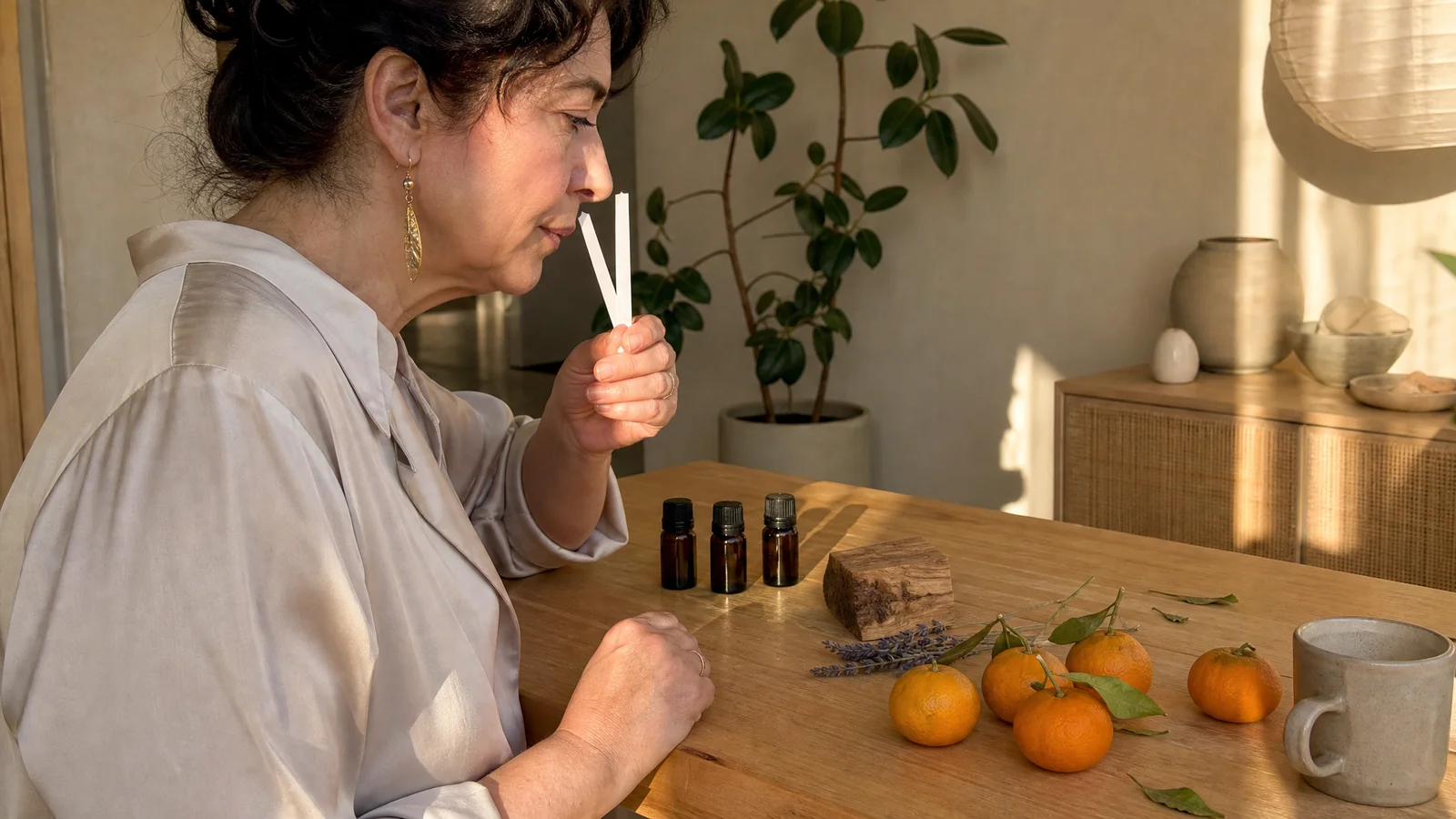
If you ever have two bottles of any citrus oil, put one drop of each on separate paper strips, label them, and sniff at arm's length. Then smell them again after five minutes, and again after an hour. You'll notice the first impression is bright and loud, and that what remains is quieter and more particular. Those later notes are the part of the smell you can only catch if you wait.
Do this before you decide a bottle is wonderful or disappointing. Smell it twice on different days. Noses tire quickly with citrus, and a second sniff after a break is more honest than the first.
If you keep a small notebook, write one line per oil: how it opened, how it faded, what it reminded you of. After a few entries you will have your own vocabulary for mandarin, which is worth more than any single percentage.
What this means for our oil
We do not state limonene, gamma-terpinene or methyl N-methylanthranilate figures for our oil. The certificate we publish for batch MANLUCCRBRC003A gives appearance, smell, a relative density of 0.852, a refractive index of 1.471 and an optical rotation of +69.80 degrees at 20 C. Those three constants describe the oil as a bulk liquid, and our COA reading guide walks through each line. They do not break the oil down into its constituents.
If your use needs composition, for instance a regulated product, an IFRA calculation or an allergen declaration, ask us in writing through the contact page about a GC report for the lot you are buying, and ask for the method, the minor compounds and the analysis date to be named. Ask before you order and keep the answer. The minor compound matters for compliance too, since IFRA restricts it by name.
For the bigger picture, see what mandarin oil is, what it smells like and the quality checks a buyer can make.
Read the method before the number, and be wary of any report that offers limonene alone. The small compounds are where mandarin keeps its secrets.
Mandarin Essential Oil
Mandarin Essential Oil from our own shop, in sizes from 0.5 oz to bulk.
From $12.99
Shop Now →Sources & Further Reading
- EFSA FEEDAP Panel, 2021. Safety and efficacy of a feed additive consisting of expressed mandarin oil from the fruit peels of Citrus reticulata Blanco for use in all animal species (FEFANA asbl). https://pmc.ncbi.nlm.nih.gov/articles/PMC8190682/
- Sawamura M et al., 2004. Characteristic odor components of Citrus reticulata Blanco (ponkan) cold-pressed oil. Biosci Biotechnol Biochem. https://pubmed.ncbi.nlm.nih.gov/15322352/
- Elmaidomy et al., 2026. Volatile composition of essential oils from major Egyptian Citrus cultivars: a multivariate chemometric approach. Sci Rep. https://pmc.ncbi.nlm.nih.gov/articles/PMC13338266/
- Cannizzaro F et al., 2025. Comprehensive analysis of mandarin essential oils: Simultaneous qualitative, quantitative, chiral, and isotopic profiling via enantio-selective multidimensional gas chromatography coupled to isotopic ratio mass spectrometry. J Chromatogr A. https://iris.unime.it/handle/11570/3342437