Does Mandarin Oil Affect Mood? What Studies Say
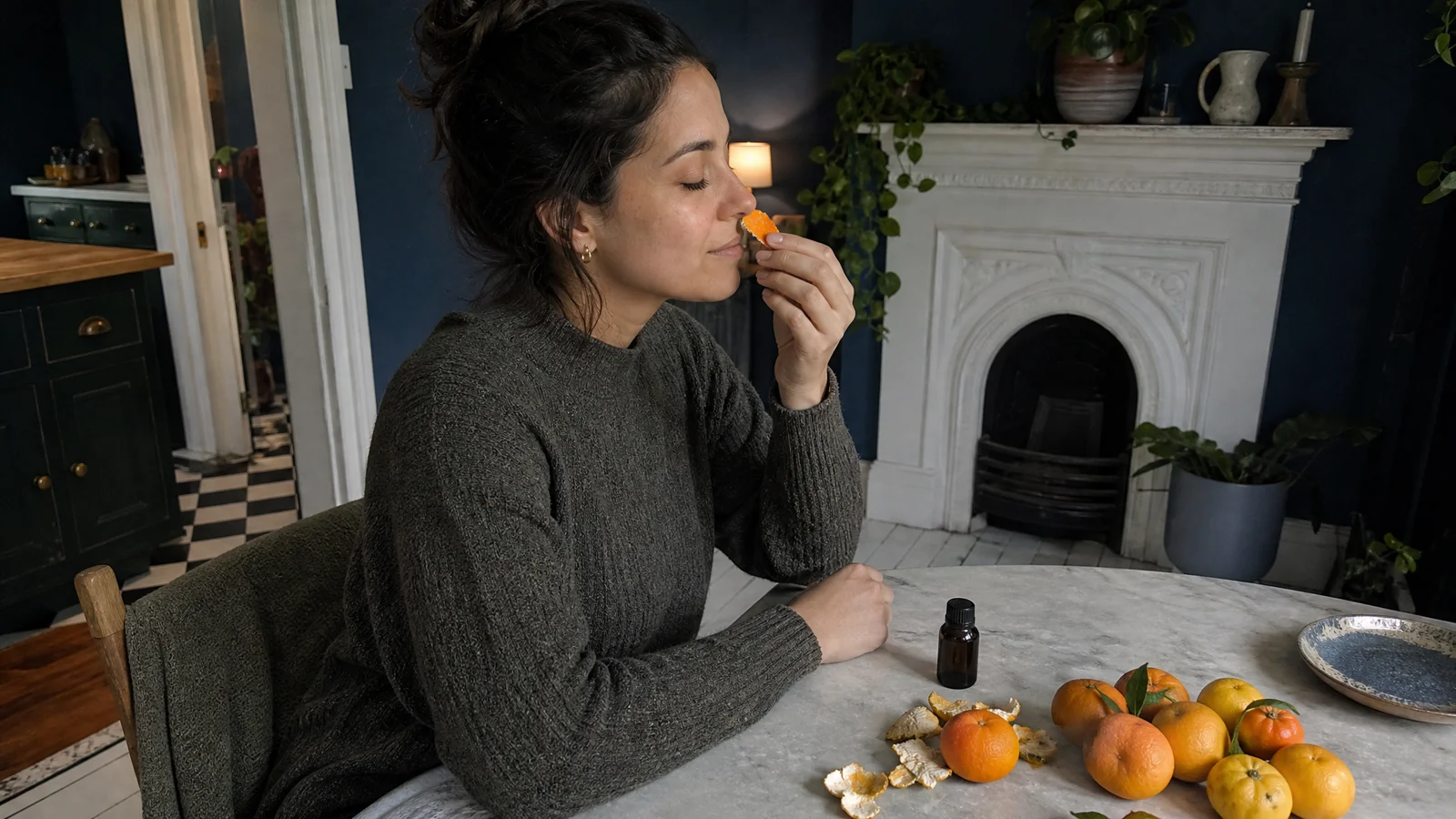
Mandarin has a reputation as a happy, sunny smell, and it is easy to see why: sweet, juicy, with a floral hum underneath. That is a scent description, and a very enjoyable one. Whether the aroma does anything measurable to anxiety or mood is a different question, and the research is thinner than the marketing around it.
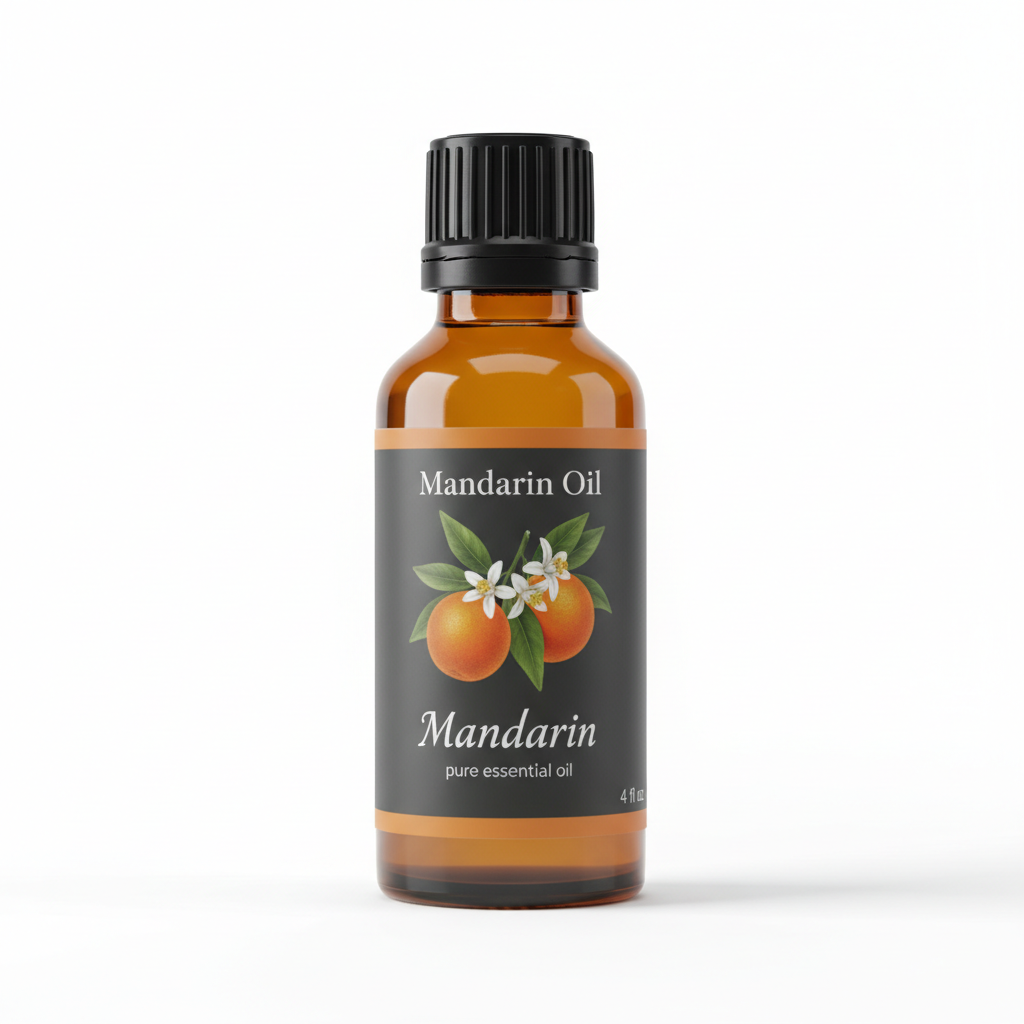
Mandarin Essential Oil
Our own Mandarin Essential Oil, in sizes from 0.5 oz to bulk.
From $12.99
Shop Now →What the human studies include
A PubMed search for mandarin, tangerine or Citrus reticulata with anxiety, mood or relaxation turned up five records with the oil in the title, and all five used animals. The human work that mentions mandarin is mostly indirect.
The one randomised trial where mandarin was its own arm looked at 60 children aged 3 to 36 months after craniofacial surgery. Massage with mandarin oil, massage with carrier oil and usual care were compared, and the researchers found no significant difference between groups. Infants cannot say how they feel, and the authors suggested the massage may have come too soon after anaesthesia, so it tells us little about adults at home. A Korean trial of 60 women after hysterectomy used a blend of lavender, mandarin and marjoram, and some outcomes favoured the blend, but with three oils in the bottle mandarin cannot be singled out.
Studies of other citrus smells are where the encouraging results sit. In a dental waiting room, 200 patients were exposed to orange or lavender odour, music or nothing, and the orange and lavender groups reported lower anxiety and better mood than the control group. A 2023 network meta-analysis pooled 44 randomised trials of essential oils for anxiety, though its abstract names other oils and not mandarin. So the honest summary is that citrus aromas in general have been studied, mandarin alone barely at all.
The animal studies
A few studies name mandarin or tangerine directly, in rats, mice and fish. A rat study exposed animals to a CO2-extracted C. reticulata peel oil (95.7% limonene) and recorded brain waves and sleep, not anxiety. A zebrafish light-dark test found roman chamomile oil reduced anxious behaviour while tangerine oil showed only a tendency that was not statistically significant. These are interesting to scientists, but the doses are per kilogram of animal or oil on cotton wool in a cage, and a mouse behaviour test is not a person's worry. They do not transfer to what happens in your living room.
Why smell studies are hard to read
This part is our reasoning. In almost any odour trial, people know whether they are smelling citrus. A control group smelling nothing differs in more than the molecule, and a self-rated anxiety score is the kind of outcome that responds to expectation and enjoyment. So even a favourable result may reflect how pleasant the room is. The NCCIH aromatherapy page is similarly cautious in tone.
That does not make a lovely scent worthless. Enjoying an aroma is a perfectly good reason to buy an oil.
What a scent can still do for an afternoon
Most of us already know that a smell can bring a place back: a kitchen, a market, a holiday morning. Mandarin has that kind of familiar sweetness for many people, because it smells like fruit they have peeled at a table. You may find that a few drops in a diffuser simply make a room smell like somewhere you like to be. That is a pleasure of the nose, and we are happy to leave it there.
Enjoying it with a light touch
- Start with less than you think you need. Citrus is bright and a little goes a long way.
- Open a window or run it in an airy room. Fresh air keeps the scent pleasant rather than heavy.
- Keep sessions short. You can always add more later, but you cannot take a strong smell back out of a room.
- Notice how you feel about the smell, not what it is supposed to do. If you do not like it, switch it off. There is no obligation to love an oil.
If you like to keep notes, write down when you used it, what you thought of the smell and how long the room held it. Over a few weeks you will learn whether mandarin is a morning oil or an evening oil for you, and that kind of personal preference is the only thing a scent really needs to settle.
A fair way to try any scent
If you are curious how a scent sits with you, give it a fair trial without expectations. Smell it on a few different days, in different rooms, and see whether you look forward to it. If you do, wonderful. If you do not, nothing is lost, and there are plenty of other oils in the world to try.
Where we stand
We sell mandarin oil as an external cosmetic oil for its fragrance, and our evening diffuser article and everyday routines article describe scent use in that spirit. We make no medical claim. The FDA decides whether a product is a cosmetic or a drug from the claims made for it in labelling and advertising, and mood and anxiety claims fall on the drug side of that line, which is why you will not find them here. If anxiety or low mood is getting in the way of your life, a physician or mental health professional is the right person to talk to.
If you simply like the smell, the usual care applies: dilution, a patch test and sun sense are in our safety guide, and diffuser setup is in the home use guide. The oil is not for internal use.
A bright orange smell on a grey afternoon needs no clinical trial to be a pleasure, and that is all we ask of it.
Mandarin Essential Oil
Mandarin Essential Oil from our own shop, in sizes from 0.5 oz to bulk.
From $12.99
Shop Now →Sources & Further Reading
- de Jong M et al., 2012. Does postoperative 'M' technique massage with or without mandarin oil reduce infants' distress after major craniofacial surgery? J Adv Nurs. https://pubmed.ncbi.nlm.nih.gov/22050553/
- Choi J, Kim YM, 2013. Effects of Aromatherapy on Stress, Sleep, Nausea and Vomiting during Patient Controlled Analgesia Treatment of Patients with Hysterectomy. Korean J Women Health Nurs. https://pubmed.ncbi.nlm.nih.gov/37684766/
- Lehrner J et al., 2005. Ambient odors of orange and lavender reduce anxiety and improve mood in a dental office. Physiol Behav. https://pubmed.ncbi.nlm.nih.gov/16095639/
- Tan L et al., 2023. Essential oils for treating anxiety: a systematic review of randomized controlled trials and network meta-analysis. Front Public Health. https://pubmed.ncbi.nlm.nih.gov/37325306/
- Kwangjai J et al., 2021. Modification of brain waves and sleep parameters by Citrus reticulata Blanco. cv. Sai-Nam-Phueng essential oil. Biomed J. https://pmc.ncbi.nlm.nih.gov/articles/PMC8847839/
- Silveira V et al., 2022. Anxiolytic effect of Anthemis nobilis L. (roman chamomile) and Citrus reticulata Blanco (tangerine) essential oils using the light-dark test in zebrafish (Danio rerio). J Ethnopharmacol. https://pubmed.ncbi.nlm.nih.gov/35926778/
- NCCIH. Aromatherapy. https://www.nccih.nih.gov/health/aromatherapy
- US FDA. Is It a Cosmetic, a Drug, or Both? (Or Is It Soap?) https://www.fda.gov/cosmetics/cosmetics-laws-regulations/it-cosmetic-drug-or-both-or-it-soap