
How to Buy Mandarin Oil: The Ultimate Quality and Value Guide
- Mandarin oil comes in three color types (red, yellow, green) with meaningfully different scent profiles and price points.
- Cold-pressed peel oil and steam-distilled versions serve different purposes; knowing which you need prevents costly mistakes.
- Country of origin, harvest timing, and extraction method are the three variables that most predict quality.
- GC/MS testing reports are the single most reliable quality signal a supplier can provide.
- Price alone is a poor quality indicator: both the cheapest and some mid-range bottles can be adulterated.
- A clear label with full botanical name, origin, and lot number is a baseline requirement, not a bonus.
What Is Mandarin Oil (and Why Does It Matter for Buying Decisions)?
Mandarin oil is cold-pressed or steam-distilled from the peel of Citrus reticulata, the mandarin orange. It is one of the gentler citrus oils in commercial use, recognized for its soft, rounded sweetness and a brightness that stops short of the sharp edge you get from lemon or grapefruit. Perfumers prize it. Cosmetic formulators reach for it when they want a citrus note that blends without dominating.
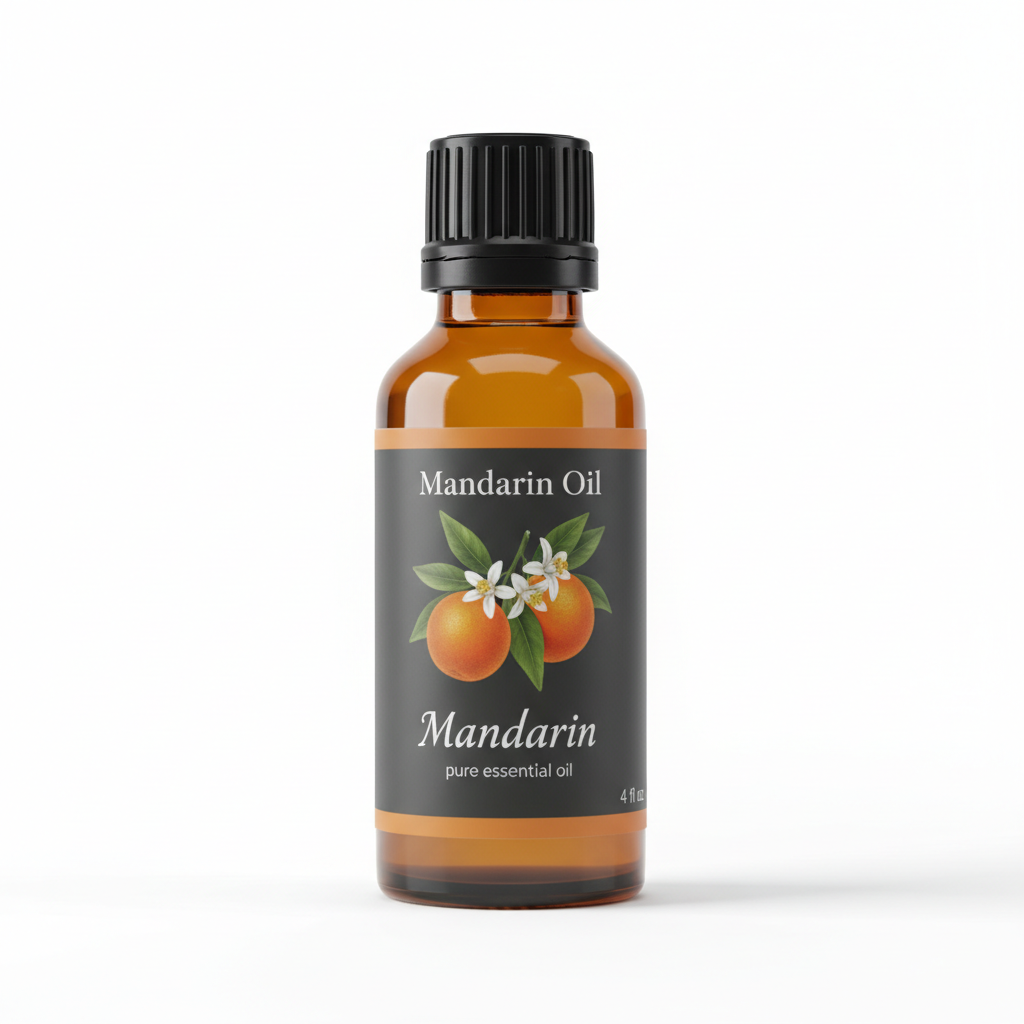
Mandarin Essential Oil
Our own Mandarin Essential Oil, in sizes from 0.5 oz to bulk.
From $12.99
Shop Now →For buyers, the challenge is that "mandarin oil" covers a genuinely wide range of products. The same two-word label can describe a premium Italian cold-pressed red mandarin from a single estate and a blended commodity product assembled from multiple origins. Both are legal. Both are sold. Knowing the difference is the entire point of this guide.
A quick note on naming before we go further: mandarin, tangerine, and clementine oils are related but distinct. If you have ever wondered whether you are buying the right fruit, our comparison of mandarin oil vs. tangerine oil untangles the botanical and aromatic differences in detail. Similarly, if someone has offered you mandarin oil as a substitute for sweet orange oil, the mandarin vs. orange oil breakdown will clarify where they overlap and where they diverge.
Why Getting This Purchase Right Matters
If you are a home aromatherapy enthusiast buying a 10 ml bottle for personal use, a poor purchase costs you a few dollars and some disappointment. If you are a cosmetic formulator or a candle maker buying in bulk, a quality error costs you reformulation time, wasted materials, and potentially product recalls. The stakes scale with the quantity. This guide is written to serve both audiences, with the sourcing and testing sections being especially relevant for professional buyers.
Types and Grades: Red, Yellow, Green, and Beyond
One of the first things that surprises new buyers is that mandarin oil is not a single, uniform product. Harvest timing and fruit ripeness produce meaningfully different oils, conventionally labeled by color.
Red Mandarin Oil
Red mandarin is pressed from fully ripe fruit, typically harvested in late autumn through early winter. It carries the warmest, sweetest, most rounded scent of the three types. The oil itself ranges from amber to a deep reddish-orange. It has a higher concentration of limonene alongside floral and slightly honeyed facets that develop as the fruit matures.
Red mandarin is the most widely available type in retail aromatherapy. It is also the type most often blended with cheaper citrus oils or extended with synthetic limonene, so supplier transparency matters here more than with the other varieties.
Yellow Mandarin Oil
Yellow mandarin sits in the middle of the ripeness spectrum. It has a brighter, slightly sharper character than red, with more of the classic citrus lift and less of the warm, honeyed depth. Formulators who want citrus presence without a heavy sweetness often prefer yellow. The color is a clear golden-yellow to pale amber.
Green Mandarin Oil
Green mandarin is pressed from unripe or very young fruit. The scent is distinctly tart, fresh, and herbaceous, with a green-citrus quality that reads almost bitter in high concentrations. It is a specialist ingredient. Perfumers use it in chypre compositions and fresh aromatic blends where they need citrus without sweetness. It is less commonly stocked by general retailers, so expect to pay a premium and to order from specialist suppliers.
Green mandarin's rarity also means less risk of adulteration with cheap orange oil, simply because fewer suppliers bother to fake a product with limited consumer recognition.
Steam-Distilled Mandarin Oil
Beyond the color types, some suppliers offer steam-distilled mandarin. Because heat is involved, some of the more volatile top notes are altered or lost. The result is an oil with softer citrus brightness and occasionally a slightly cooked or jammy quality. It is also free of furanocoumarins, which are the compounds in cold-pressed citrus oils that can cause skin sensitivity when the skin is then exposed to sunlight.
For leave-on cosmetic applications, steam-distilled mandarin is worth considering. For fragrance work where you want the full aromatic profile, cold-pressed is the professional standard.
Extraction Method and Country of Origin
Two variables do more to determine the character of a mandarin oil than almost anything else: how it was extracted and where the fruit was grown. These factors interact. An excellent Italian cold-pressed mandarin will behave differently from a cold-pressed Moroccan or Chinese mandarin, even if both labels say "pure mandarin essential oil."
Cold Pressing: The Industry Standard for Citrus
Cold pressing, sometimes called expression or cold expression, uses mechanical pressure to rupture the oil glands in the peel. No heat is applied. The result preserves the full aromatic complexity of the fresh peel, including volatile top notes that would be damaged or lost under steam distillation.
Most premium mandarin oils on the market are cold-pressed. When a label does not specify the extraction method, it is worth asking the supplier directly. Reputable sellers know this information and share it freely.
Steam Distillation
Steam distillation passes steam through the plant material. The steam carries volatile aromatic compounds, which are then condensed and separated from the water. For most botanicals, this is the only practical extraction method. For citrus, it is a secondary option with specific applications, as noted above.
Origins: Italy, Spain, Brazil, China, and Morocco
Italy has the longest established reputation for mandarin oil, particularly Sicily, where the cool winters and volcanic soil of the Etna foothills are said to produce fruit with exceptional aromatic complexity. Sicilian cold-pressed mandarin commands premium prices, and with reason: the supply is limited and the quality is consistently high. Some sources note that genuine Italian mandarin oil from named estates or cooperatives represents the benchmark against which other origins are assessed by experienced formulators.
Spain, particularly the Valencia region, produces significant volumes of mandarin oil at slightly lower price points. Spanish mandarin tends to be bright and clean, a solid mid-tier choice for formulators who need consistent supply at scale.
Brazil has become a major supplier of citrus oils broadly, including mandarin. Brazilian mandarin oil is typically competitively priced. Quality varies more than with European origins; lot-to-lot consistency can be an issue, making GC/MS testing especially important when buying Brazilian origin material.
China produces mandarin oil in large quantities, often at the lowest price points. The quality range is very wide. Some Chinese suppliers provide excellent, clean material with full documentation. Others offer material of uncertain composition. For Chinese-origin mandarin oil, third-party testing is not optional; it is the baseline requirement.
Morocco supplies smaller volumes of mandarin oil, often blended or redistilled. It is less commonly specified on retail labels but appears in commodity channels.
How Origin Affects Your Decision
If you are buying for personal use and your primary goal is a pleasant citrus scent at a fair price, Spanish or Brazilian origin with a solid supplier reputation and available test reports is a reasonable choice. If you are formulating a premium product where provenance is part of your brand story, or if your sensory evaluation process requires a specific aromatic benchmark, Italian origin material is worth the additional cost. We cover the cost difference in detail in our mandarin oil price guide.
How to Read a Mandarin Oil Label Like a Pro
A label tells you a great deal, if you know what to look for. It also tells you something by what it omits. Here is what to expect from a properly labeled pure mandarin essential oil, and what to do when information is missing.
Our full guide on reading a mandarin oil label goes deeper on every point below, but this section gives you the practical fast-track version.
Botanical Name
A pure mandarin oil label should state the full Latin botanical name. For mandarin, that is Citrus reticulata. Some suppliers add the cultivar in parentheses, such as Citrus reticulata var. Blanco, which is more specific and a positive sign.
A label that says only "mandarin" or "mandarin essential oil" without the Latin name is not automatically suspect, but it provides less information. If the rest of the label is detailed and testing documentation is available, the missing Latin name is a minor issue. If the label is sparse across the board, it suggests a supplier who has not invested in documentation.
Country of Origin
This should be printed on the label or easily available from the supplier. "Country of origin" means where the fruit was grown and processed, not where the company is headquartered or where the bottle was filled. If a supplier conflates these, push back and ask for clarification.
Extraction Method
Look for "cold pressed" or "cold expressed" for standard citrus oil, or "steam distilled" if that is what you need. If the label says only "essential oil" with no method noted, ask.
Part of Plant
For mandarin oil, this should read "peel" or "rind." Some suppliers write "expressed peel" as a combined field covering both method and plant part, which is fine.
Lot Number and Best-Before Date
A lot number connects your bottle to a specific production batch, which in turn connects to batch-specific GC/MS testing. Without a lot number, you cannot verify that the test report you are looking at relates to the oil you actually received. Citrus oils oxidize over time; a best-before date (typically 1 to 2 years from pressing for cold-pressed mandarin) tells you where you are in the oil's shelf life.
Purity Statement
Labels often say "100% pure" or "undiluted." This is a claim, not a proof. Its value depends entirely on whether the supplier backs it with third-party testing. The phrase itself is easy to print; the evidence behind it is what matters.
What to Do When Label Information Is Missing
Contact the supplier before purchasing. A reputable supplier will provide botanical name, country of origin, lot number, extraction method, and a link to the corresponding GC/MS report without hesitation. Suppliers who respond vaguely, who say this information is proprietary, or who simply do not respond are not suppliers worth using for pure mandarin essential oil.
Quality Signals, Red Flags, and Purity Testing
This is the section that separates informed buyers from everyone else. Quality assessment for mandarin oil involves a combination of supplier evaluation, documentation review, sensory evaluation, and, for professional buyers, analytical testing. Here is how to use each layer.
GC/MS Testing: The Gold Standard
Gas chromatography-mass spectrometry (GC/MS) analysis separates an oil into its constituent chemical compounds and identifies each one. A GC/MS report for mandarin oil should show limonene as the dominant component, typically between 65% and 75%. You would also expect to see gamma-terpinene, alpha-pinene, myrcene, and small amounts of linalool and methyl N-methylanthranilate (the compound largely responsible for mandarin's distinctive floral-orange character).
A report that shows an unusually high limonene percentage (above 80%), with the supporting minor compounds largely absent, may suggest that the oil has been extended with synthetic or isolated limonene. A report with methyl N-methylanthranilate absent or very low may indicate blending with cheaper citrus oils that lack this marker.
For our detailed guide on using documentation and sensory assessment to evaluate oil purity before you purchase, see how to spot pure mandarin oil: quality checks before you pay.
Organoleptic Evaluation: What Your Nose Tells You
Before GC/MS was accessible, perfumers and buyers relied on their senses. Sensory evaluation is still valid, though it requires a reference point. If you have access to a sample of genuinely high-quality mandarin oil from a trusted source, use it as your benchmark when evaluating new suppliers.
Pure cold-pressed red mandarin should smell: bright and unmistakably citrus in the opening seconds, then settle into a rounder, slightly floral-sweet character, with a soft warmth in the dry-down. Green mandarin should be tart and fresh with an almost grassy edge. Yellow sits between the two.
Red flags by nose:
- A flat, one-dimensional citrus note with no depth or evolution (suggests heavy adulteration with isolated limonene or synthetic orange terpenes)
- A soapy or slightly chemical finish (suggests synthetic extenders or off-spec material)
- An unusual sweetness that reads as candy-like rather than fruit-like (can indicate fragrance oil blending)
- Rapid fading on a smell strip with almost no dry-down (may indicate very high dilution)
Physical Appearance
Cold-pressed red mandarin ranges from pale golden-orange to amber. Yellow mandarin is clearer and paler. Green mandarin may have a faint greenish tinge or appear as a pale yellow. All types should be clear without cloudiness (unless stored cold, in which case temporary cloudiness is normal and clears on warming).
Extreme darkness or murkiness that does not clear with gentle warming can suggest age, poor filtration, or contamination.
Supplier Transparency and Company Background
Beyond the oil itself, evaluate the supplier as a business. Questions worth asking or researching:
- Do they publish GC/MS reports publicly, or only on request?
- Do they disclose their sourcing regions?
- Can they provide a certificate of analysis (COA) for each lot?
- Do they have a physical address and a reachable customer service team?
- How long have they been selling essential oils?
- Do industry professionals or recognized formulation communities speak positively of them?
A supplier who answers all of these satisfactorily is far more likely to deliver mandarin oil quality you can rely on batch after batch.
Essential Oil vs. Fragrance Oil: A Critical Distinction
Some products labeled "mandarin oil" are fragrance oils, not essential oils. Fragrance oils are synthetically compounded or are blends of natural and synthetic aromatic materials designed to smell like mandarin. They have their place in candle making and some soap applications. They are not suitable for cosmetic formulations that claim to use essential oils, and they behave very differently on the skin and in diffusers.
The key distinction, and how to spot it on packaging or in supplier descriptions, is covered fully in our guide on mandarin essential oil vs. mandarin fragrance oil. The short version: if the price seems impossibly low for the volume, or if the label does not include a botanical name and extraction method, there is a meaningful chance you are looking at a fragrance oil.
Red Flags at a Glance
| Red Flag | What It May Indicate | What to Do |
|---|---|---|
| No botanical name on label | Fragrance oil or very low-grade supplier | Ask directly; if no clear answer, skip |
| Price far below market average | Adulteration, dilution, or fragrance oil | Request GC/MS; compare to known price ranges |
| No lot number available | Cannot verify test reports match your bottle | Ask for lot-specific COA before ordering |
| GC/MS report undated or not lot-specific | Report may not relate to current stock | Request current lot report or avoid |
| Supplier unwilling to share sourcing details | Possible commodity blending or unclear provenance | Find a supplier who discloses freely |
| Scent flat, chemical, or candy-like | Adulteration or poor quality source material | Request sample before bulk order; compare to benchmark |
| "Therapeutic grade" or similar trademark claims | Marketing language with no industry-standard meaning | Focus on documentation, not grade labels |
Understanding Price: What Fair Value Looks Like
Mandarin oil sits in the affordable-to-mid-range segment of the essential oil market. It is far less expensive than rose or neroli, roughly comparable to most other citrus oils, and generally cheaper than lavender from premium origins. But within mandarin oil itself, prices vary significantly based on origin, type, and supplier tier.
Retail Price Ranges (Approximate)
| Volume | Economy Range | Mid-Tier Range | Premium Range |
|---|---|---|---|
| 10 ml | $4 to $8 | $9 to $16 | $17 to $30+ |
| 30 ml | $10 to $18 | $19 to $35 | $36 to $65+ |
| 100 ml | $25 to $45 | $46 to $80 | $81 to $140+ |
| 500 ml (bulk) | $90 to $150 | $151 to $260 | $261 to $400+ |
These are approximate retail ranges as of the time of writing and will vary by region, supplier, and market conditions. For a thorough breakdown of why prices differ and how to assess whether a specific price is fair for a specific origin and grade, see our dedicated mandarin oil price guide.
Why the Cheapest Is Often Not the Best Deal
A 10 ml bottle priced at $3 is almost certainly not pure cold-pressed mandarin essential oil from a quality origin. At that price point, the economics simply do not work: cold pressing requires significant fruit input (roughly 1 kg of peel to produce 3 to 5 ml of oil, depending on season and variety), plus testing, bottling, and margin across the supply chain.
Buying at the economy end means accepting real uncertainty about what is in the bottle. For personal casual use in a diffuser, that may be a conscious, acceptable trade-off. For skin application, cosmetic formulation, or any professional use, it is not.
When Premium Pricing Is Justified
Premium mandarin oil pricing reflects several real cost factors: named Italian origin from small-scale producers, fully documented supply chain with lot-specific testing, small-batch cold pressing with careful quality control, and certified organic agricultural practices. If your application demands consistent, documented quality, the premium is not a mark-up. It is the cost of reliability.
Bulk Buying Considerations
For formulators buying in larger volumes, the per-milliliter price drops substantially. However, bulk buying introduces its own risks: a larger financial commitment to a single lot means a testing error or quality shortfall costs more. Always request a sample for sensory and, where possible, analytical evaluation before committing to a bulk purchase of pure mandarin essential oil. A supplier who will not provide samples for bulk buyers is a supplier worth reconsidering.
Where to Buy Mandarin Oil: Channel Comparison
The channel through which you purchase matters as much as the price you pay. Different buying environments offer different levels of transparency, documentation access, and recourse if something goes wrong.
Specialist Essential Oil Suppliers (Online and Direct)
This is the recommended starting point for serious buyers. Specialist suppliers who focus on essential oils and aromatherapy ingredients typically offer the most comprehensive documentation: lot-specific GC/MS reports, certificates of analysis, clear origin information, and knowledgeable customer support.
Well-regarded specialist suppliers include both large companies with wide ranges and smaller, niche operations that source a narrower selection with exceptional depth of knowledge. Neither size is inherently better. Evaluate each supplier on documentation quality, sourcing transparency, and reputation in formulator communities rather than on catalog size or website design.
Natural and Health Food Retailers
Physical and online health and natural product retailers carry mandarin oil from multiple brands. The advantage is convenience and often a lower barrier to trying a new brand (smaller sizes at accessible prices). The disadvantage is that documentation is rarely available in-store, and staff expertise varies widely. For home use with modest quality requirements, this channel is fine. For professional use, go direct to specialist suppliers.
Large Marketplace Platforms
Platforms like Amazon or similar large marketplaces carry mandarin oil from a large range of sellers, including some reputable specialist brands who sell there as an additional channel. The challenge is that product detail pages often carry minimal information, GC/MS reports are almost never linked, and counterfeit or mislabeled products exist on these platforms.
If you buy mandarin oil through a marketplace, buy from the brand's own storefront rather than a third-party seller, and verify that the product description matches what you know to look for in a properly labeled oil. Consider it a convenience channel for repurchasing known brands, not a research channel for discovering new ones.
Wholesale and Trade Suppliers
For professional formulators and manufacturers, trade-only or minimum-order wholesale suppliers offer the best per-unit economics at scale. These suppliers typically serve the cosmetic, fragrance, and food industries and are accustomed to providing full technical documentation. Minimum order quantities can be high (often 1 kg or above), so they are not appropriate for home use, but they are the natural home for formulators working at any meaningful commercial scale.
Local Farmers, Cooperatives, and Direct Estate Sources
A small number of buyers source directly from citrus growing regions, working with estate owners or cooperatives in Italy, Spain, or other origins. This approach offers maximum supply chain transparency and the possibility of customized pressing schedules (for example, specifying early harvest for greener character). It is practical only for buyers with existing relationships in those regions, relevant language skills, or the resources to build those relationships. For most buyers, a reputable specialist importer who does this legwork is more practical.
Channel Comparison Summary
| Channel | Documentation Access | Price | Best For |
|---|---|---|---|
| Specialist online suppliers | High | Mid to premium | All buyers; best default choice |
| Natural retailers | Low to medium | Mid | Home use, casual buyers |
| Marketplace platforms | Low | Economy to mid | Repurchasing known brands only |
| Wholesale trade suppliers | High | Lower per unit at scale | Commercial formulators |
| Direct estate/cooperative | Very high | Variable | Buyers with trade relationships |
Putting It All Together: Making Your Purchase Decision
By this point you have the framework. The final step is applying it to your specific situation, because the best mandarin oil to buy is not one universal answer. It depends on your application, your volume, your budget, and how much quality certainty you need.
Decision Path for Home and Personal Use Buyers
If you are buying mandarin oil for home diffusing, personal blending, or small DIY projects, your priority order is: scent quality, supplier transparency, and price. You do not need to commission your own testing. A reputable specialist supplier who publishes GC/MS reports and clearly labels origin and extraction method is sufficient. Start with a small size from two or three suppliers, evaluate the scent, and commit to the one whose oil you prefer.
For any skin application, note that cold-pressed mandarin oil is phototoxic. It contains furanocoumarins. Always dilute properly in a suitable carrier oil (a maximum of 0.5% to 1% for leave-on applications is a commonly referenced starting point; consult current industry safety guidelines for your specific use case), avoid sun exposure on treated skin for at least 12 hours, and perform a patch test before first use. Steam-distilled mandarin eliminates the phototoxicity concern if that is relevant to your routine.
Always consult a qualified healthcare provider with any personal health questions. Essential oils, including mandarin, are not substitutes for professional medical guidance.
Decision Path for Cosmetic Formulators
Your requirements are more stringent. You need lot-specific documentation, consistent batch-to-batch quality, and a supplier who can scale with your production. Build your evaluation process around these steps:
- Identify three to five candidate suppliers with clear sourcing transparency and published GC/MS reports.
- Request samples and lot-specific COAs from each.
- Conduct sensory evaluation against your benchmark.
- If budget allows, commission independent GC/MS analysis of your samples from an accredited laboratory.
- Evaluate supplier responsiveness and documentation quality as part of your assessment (this predicts how easy they will be to work with at scale).
- Start with a modest order from your preferred supplier before committing to full production volumes.
For your finished product labeling and ingredient declarations, the botanical name and origin information you have gathered from your supplier feeds directly into compliance requirements. Keep your supplier documentation on file.
Decision Path for Candle and Fragrance Makers
For candle making specifically, the distinction between essential oil and fragrance oil matters less for safety (since the scent disperses via combustion) but matters significantly for marketing claims. If your product is positioned as using pure essential oils, you need genuine cold-pressed or steam-distilled mandarin, with documentation to back that claim.
Flash point is also relevant for candle making: cold-pressed mandarin has a relatively low flash point (typically around 46 to 50 degrees Celsius), which affects safe usage rates in wax formulations. Always consult current safety data sheets from your supplier and work within your wax system's tested parameters.
Questions to Ask Every Supplier Before You Buy
- What is the full botanical name and variety of this mandarin oil?
- What country and region was the fruit grown in?
- What is the extraction method: cold pressed or steam distilled?
- What is the lot number of current stock, and can you provide the GC/MS report for that lot?
- What is the press date or best-before date?
- Is this organically certified, and if so, which certification body?
- Can I order a sample before committing to a larger quantity?
A supplier who answers all seven questions clearly and promptly has earned your serious consideration. A supplier who deflects, answers only partially, or makes vague claims about quality without providing documentation has told you something important.
Building a Long-Term Supplier Relationship
Once you find a mandarin oil source that consistently delivers quality you trust, invest in that relationship. Long-term customers of specialist suppliers often get early access to new harvest stock, priority service during supply constraints (citrus harvests can be affected by weather events, and supply tightens in those years), and sometimes preferential pricing at volume.
Supply consistency matters. An oil that performs beautifully in one lot and then arrives noticeably different in the next creates real problems for formulators. Asking suppliers how they manage lot-to-lot consistency, and whether they offer blended lots specifically designed for consistency, is a worthwhile conversation to have before you depend on them for production volumes.
A note on "therapeutic grade" and similar trademarked quality claims: No independent, government-recognized grading system for essential oil quality currently exists. Terms like "therapeutic grade," "clinical grade," or "certified pure" are trademarked marketing designations created by individual companies. They are not verifiable by a third party and carry no legally defined meaning. When evaluating mandarin oil quality, rely on GC/MS documentation, sourcing transparency, and supplier reputation. These provide real information. Grade labels do not.
A Final Word on Confidence and Curiosity
Buying pure mandarin essential oil well is a skill that develops with practice. Your first purchase will teach you something. Your fifth will teach you more. The more you engage with the aromatic difference between a well-sourced Sicilian red mandarin and a commodity blend, the faster your ability to evaluate new oils will develop.
Keep notes. Request samples whenever you can. Build a small reference collection of oils from known suppliers so you always have a sensory benchmark. And use the documentation framework in this guide every time: botanical name, origin, extraction method, lot number, GC/MS report. These five data points will carry you through the vast majority of purchase decisions with confidence.
Mandarin oil quality is knowable. The information exists. You just have to know where to look for it, and now you do.