
Mandarin Oil vs Tangerine Oil: Untangling Two Nearly Identical Citrus Oils
Pick up a bottle of mandarin essential oil and a bottle of tangerine essential oil, hold them side by side, and you will notice something immediately: even the labels look similar. Both list Citrus reticulata as the botanical name. Both smell like fresh-peeled citrus. Both are cold-pressed from the peel. So what exactly is the difference, and does it matter enough to change what you buy?
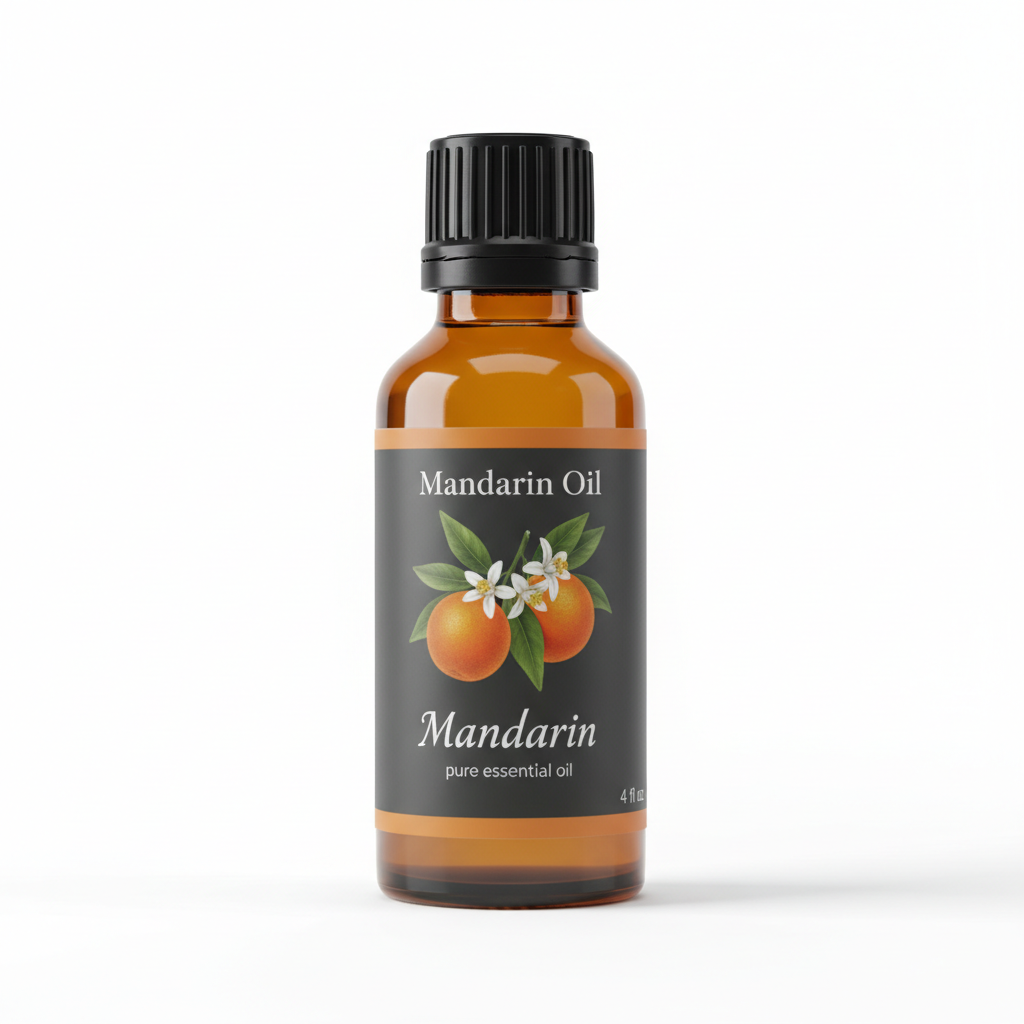
Mandarin Essential Oil
Our own Mandarin Essential Oil, in sizes from 0.5 oz to bulk.
From $12.99
Shop Now →The short answer is: sometimes yes, sometimes no. The longer answer depends on what you want from the oil and how closely you read a label. This guide lays out everything you need to know to make a confident, informed choice.
Are They Actually the Same Plant?
Botanically, mandarin and tangerine are both cultivars within the Citrus reticulata species. Tangerine is, loosely speaking, a North American commercial name for a group of mandarin cultivars that tend to have deeper orange, slightly thicker skin. The name stuck in the grocery industry and eventually carried over into the essential oil trade.
This botanical overlap is the root of almost all the confusion. When you see Citrus reticulata on a label, it does not automatically tell you whether the oil came from a classic Mediterranean mandarin, a Dancy tangerine, or a Satsuma-type cultivar. For a deeper look at how to decode what is actually in the bottle, the guide on reading a mandarin oil label, botanical names, and origin is worth bookmarking before you shop.
Some suppliers do distinguish further, using names like Citrus reticulata var. mandarin or appending the cultivar name to the common name. Many do not. That inconsistency is a practical reality of the citrus oil market, not a sign of fraud. It does, however, mean that two bottles with different front-label names may contain oil from nearly identical source material.
How the Scent Profiles Differ
Side by side, there is a perceivable difference, though it is subtle. Mandarin oil tends to sit a little softer and rounder. Its sweetness has a mild floral edge, sometimes described as almost honeyed, and the brightness fades into a gentle warmth rather than a sharp burst. Red mandarin, cold-pressed from fully ripened fruit, often carries the most complex version of this profile.
Tangerine oil leans brighter and more candied. The top notes hit faster and more assertively. Where mandarin lingers, tangerine announces itself. Neither is better in an absolute sense. The preference depends entirely on whether you want something that whispers or something that opens a room.
For blending, mandarin's softer quality makes it easier to layer without overwhelming other notes. Tangerine's brightness makes it a strong choice when citrus needs to carry the blend rather than support it.
Chemistry: Where the Similarities Run Deep
Both oils are dominated by limonene, typically accounting for 65 to 75 percent of the total chemical composition, sometimes higher. Gamma-terpinene is the next significant component in both, followed by smaller amounts of alpha-pinene, myrcene, and linalool. The aromatic esters, particularly methyl N-methylanthranilate, appear in both and contribute to that characteristic mandarin-family sweetness.
The differences in chemistry are a matter of degree rather than kind. Some analyses show tangerine oil carrying slightly higher concentrations of the compounds responsible for brighter top notes. Mandarin, particularly red mandarin, may show a somewhat higher proportion of the ester compounds that soften the overall effect. These are tendencies, not rules. The specific cultivar, growing region, harvest timing, and extraction method all shift the numbers.
For most cosmetic and aromatic applications, this chemical similarity means the two oils are genuinely interchangeable in many contexts. The cases where it matters are narrower than the marketing around these products sometimes suggests.
Side-by-Side Comparison Table
| Attribute | Mandarin Oil | Tangerine Oil |
|---|---|---|
| Botanical name | Citrus reticulata (various cultivars) | Citrus reticulata (various cultivars) |
| Common varieties | Red, green, yellow mandarin; Satsuma | Dancy, Clementine (marketed as tangerine) |
| Scent character | Soft, rounded, slightly floral-sweet | Brighter, more candied, assertive top notes |
| Dominant chemistry | Limonene-heavy; higher ester notes in red variety | Limonene-heavy; slightly elevated bright-note compounds |
| Typical origin | Italy, Spain, Brazil, China | USA (Florida, California), Brazil, China |
| Extraction method | Cold-pressed peel | Cold-pressed peel |
| Phototoxicity risk | Low to none (cold-pressed, non-steam-distilled) | Low to none (cold-pressed, non-steam-distilled) |
| Typical price range | Moderate; red mandarin often priced higher | Slightly lower on average; widely available |
| Availability | Widely available; seasonal variation possible | Widely available; consistent year-round supply |
| Common cosmetic uses | Skincare blends, diffuser, perfumery base note support | Diffuser, bath and body products, candle fragrance |
Pros and Cons
Mandarin Oil
- Pro: More nuanced scent profile, particularly in the red variety, which suits sophisticated perfume and skincare blending.
- Pro: Strong sourcing tradition in Italy and Spain, with well-established quality benchmarks and GC/MS documentation more commonly available.
- Pro: The softer character plays well in supporting roles within a blend without dominating.
- Con: Red mandarin in particular can be pricier. For context on what fair pricing looks like, the mandarin oil price guide breaks down what drives cost variation.
- Con: Label terminology is inconsistent across suppliers, which can make direct comparisons difficult without further research.
- Con: Seasonal supply fluctuations can affect availability and consistency between batches.
Tangerine Essential Oil
- Pro: Bright, vivid scent that performs well in consumer products where citrus needs immediate impact.
- Pro: Generally reliable year-round supply from commercial growing regions, which supports consistent batch-to-batch quality.
- Pro: Often priced slightly lower than premium mandarin varieties, making it a practical choice for high-volume applications.
- Con: The brighter, more one-dimensional top note can feel less interesting in complex blends where depth matters.
- Con: The name "tangerine" covers a wide range of cultivars, so quality and scent can vary considerably between suppliers.
- Con: Some suppliers use "tangerine" and "mandarin" interchangeably on labels, which makes it genuinely hard to know what you have purchased without third-party documentation.
Best For: Matching the Oil to the Use Case
Diffuser and Atmosphere Blending
If you are diffusing for a lively, uplifting atmosphere during the day, tangerine essential oil delivers that bright, immediate citrus presence efficiently. For a softer evening diffuser blend, particularly one layered with lavender, sandalwood, or cedarwood, mandarin oil integrates more gracefully. Its lower intensity supports rather than competes with deeper base notes.
Skincare Formulations
Both oils can be used in properly diluted skincare blends. Mandarin oil, especially the red variety, is a long-standing choice for facial serums and body oils because its scent profile complements floral and earthy botanicals without pulling focus. Always dilute to 1 percent or below for facial applications and perform a patch test before full use. Neither oil should be applied undiluted to skin.
Candles and Home Fragrance
Tangerine's brighter, punchier character tends to hold better in candle wax and room sprays, where some of the subtler aromatic complexity of mandarin can be lost to the heat or carrier. For cold-process applications like reed diffusers, the difference narrows again.
Perfumery and Fine Blending
Mandarin oil, particularly Italian red mandarin from a documented source, has a place in serious perfumery that tangerine rarely occupies. The mild floral-ester quality adds a dimension that matters when you are building something layered. If budget is a factor, tangerine is a reasonable citrus modifier, but it is a different tool.
First-Time Buyers and General Use
If you are new to citrus oils and want one versatile option to start with, either works. Tangerine is slightly more forgiving in terms of price and availability. Mandarin offers a bit more range as your blending interests develop. The guide on how to buy mandarin oil covers what to look for regardless of which citrus variety you choose, including what documentation to ask for and which red flags to avoid.
A Note on Safety for Both Oils
Cold-pressed citrus reticulata oils have a low phototoxicity profile compared to expressed bergamot or lime. That said, best practice is to avoid applying any undiluted citrus oil to skin that will be exposed to direct sunlight within 12 to 24 hours. Standard dilution guidelines apply: 1 to 2 percent for leave-on skin products, up to 3 percent for rinse-off applications. Keep both oils out of reach of children and away from pets. If you are expecting, nursing, or managing a health condition, consult a qualified healthcare provider before incorporating any new aromatic product into your routine.
The Verdict
For most people, most of the time, the difference between mandarin oil and tangerine essential oil is smaller than the marketing suggests. Both are Citrus reticulata oil. Both smell like citrus. Both work well diluted in skin-safe carriers or diffused into a room.
Where mandarin earns a distinct edge is in nuance. Red mandarin from a well-documented Italian or Spanish source is genuinely more complex, better suited to serious blending, and worth the modest premium if scent quality is a priority for you. Tangerine oil earns its place through reliability, price, and a brighter character that performs consistently in high-impact applications like candles and room sprays.
The most important step, whichever you choose, is buying from a supplier who provides third-party GC/MS testing and clear sourcing information. A beautiful label and a low price tell you almost nothing about what is actually inside the bottle. Quality documentation tells you everything.