How to Use Mandarin Essential Oil at Home: The Ultimate Diffusing and DIY Guide
Key Takeaways
- Mandarin essential oil is cold-pressed from the peel of Citrus reticulata and is one of the gentlest citrus oils available.
- Red, yellow, and green mandarin variants differ in harvest timing and scent character, not just color.
- Diffusing is the easiest entry point, but mandarin oil also shines in room sprays, body scrubs, body oils, candles, and skincare.
- Always dilute to 1-2% for skin application (roughly 6-12 drops per 30 ml of carrier oil).
- Mandarin oil is photosensitive. Avoid direct sun exposure for at least 12 hours after applying it to skin.
- Red mandarin is the warmest and sweetest variant; green mandarin is the brightest and most tart; yellow mandarin sits between both.
- Mandarin pairs beautifully with vanilla, cedarwood, neroli, lavender, frankincense, and other citrus oils.
What Is Mandarin Essential Oil? A Quick Orientation
Mandarin essential oil comes from one of the most approachable fruits in the citrus family. It is cold-pressed from the outer peel of Citrus reticulata, a small, thin-skinned citrus that originated in China and spread across the Mediterranean over centuries. The oil is almost entirely a product of the peel itself: tiny oil sacs rupture under pressure during expression, releasing a concentrated aromatic liquid that smells like a riper, softer version of the fruit.
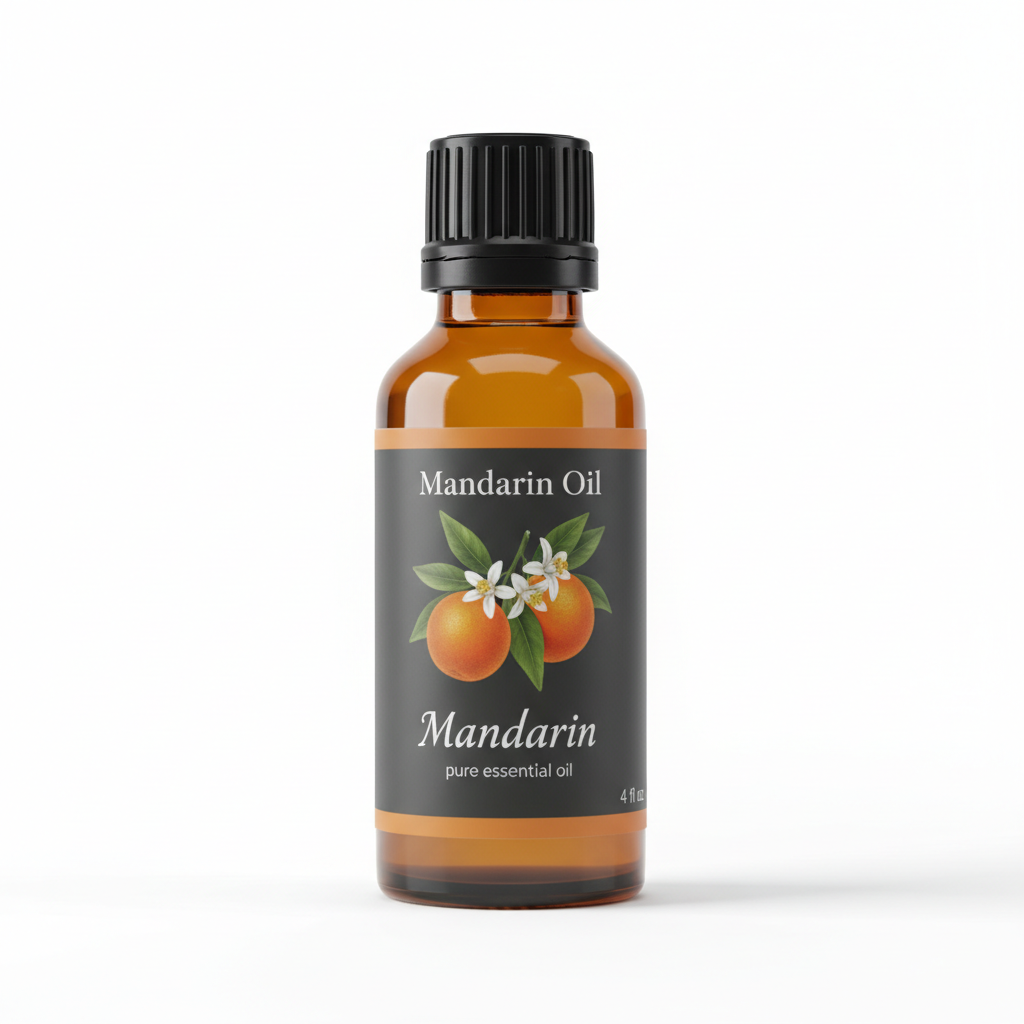
Mandarin Essential Oil
Our own Mandarin Essential Oil, in sizes from 0.5 oz to bulk.
From $12.99
Shop Now →That softness matters. Among citrus oils, mandarin stands out for its round, slightly floral quality. Sweet orange (Citrus sinensis) is brighter and more candied. Lemon is sharp and aldehydic. Bergamot carries a distinctive lavender-like facet. Mandarin occupies its own warm, approachable register, which is part of why it works so well in both home fragrance and personal care.
Red, Yellow, and Green Mandarin: What the Differences Actually Mean
If you have spent any time sourcing mandarin oil, you have probably noticed that the same bottle is sometimes labeled red, sometimes yellow, and sometimes green. These are not marketing flourishes. They reflect real differences in harvest timing.
- Green mandarin is pressed from unripe fruit, harvested early in the season. The oil is the brightest and most tart, with a sharper citrus top note and a subtle green, almost herbal quality. It has the highest limonene content of the three.
- Yellow mandarin comes from fruit harvested mid-season, as it begins to ripen. The scent is more balanced: citrusy but warmer, with softer edges than green.
- Red mandarin is pressed from fully ripe fruit. The oil is the sweetest and most floral, with a depth that hints at orange blossom. It is the most widely used variant in perfumery and is the one most people picture when they think of mandarin oil.
For most home diffusing and DIY work, red mandarin is the easiest starting point. Its sweetness blends readily with a wide range of other oils, and its scent is immediately likeable. Green mandarin is worth seeking out if you want a crisper, more invigorating quality in your blends.
A Note on the Chemistry
Mandarin oil is dominated by limonene, a monoterpene that gives all citrus oils their characteristic brightness. Red mandarin also contains meaningful amounts of gamma-terpinene, which contributes a slightly herbal, warm note, and methyl N-methylanthranilate, a compound responsible for the distinctive floral depth that sets mandarin apart from sweet orange. Knowing these components helps explain why the oil behaves the way it does: limonene evaporates quickly, which is why mandarin reads as a top note in fragrance work, while the anthranilate lingers slightly longer and ties the scent together.
Sourcing and Quality: What to Look for Before You Buy
The quality gap between a well-sourced mandarin oil and a poorly sourced one is not subtle. You will notice it the moment you open the bottle. Good mandarin oil smells like freshly zested peel: vivid, nuanced, and alive. A low-quality or adulterated oil often smells flat, sharp in a chemical way, or simply like generic citrus fragrance. Here is what to check before you buy.
The GC/MS Report
Gas chromatography-mass spectrometry (GC/MS) testing is the standard way to verify an essential oil's chemical composition. Reputable suppliers publish these reports for every batch. For red mandarin, look for limonene in the range of 65-75%, gamma-terpinene around 14-20%, and a detectable presence of methyl N-methylanthranilate (typically 0.5-1.5%). If a supplier does not offer batch-specific GC/MS reports, that is a reason to look elsewhere.
Country of Origin
Sicily produces some of the most prized mandarin oil in the world, particularly from the Tardivo di Ciaculli variety grown around Palermo. Spanish and Calabrian (southern Italian) mandarins also yield excellent oils. Chinese mandarin oil is widely traded and can be good quality, but the market is larger and more variable. When possible, look for single-origin oils that name the region specifically rather than just the country.
Organic Certification
Because mandarin oil is cold-pressed from the peel rather than distilled from the interior of the fruit, pesticide residues on the outer skin can potentially concentrate in the oil. An organic certification from a recognized body (USDA, ECOCERT, or similar) provides meaningful assurance. It is not always available for every origin, but it is worth prioritizing when you plan to use the oil on skin.
Packaging and Freshness
Citrus oils oxidize faster than most other essential oils. Limonene is particularly susceptible to oxidation, and an oxidized citrus oil can cause skin sensitization. Buy mandarin oil in dark glass bottles (amber or cobalt), check the bottling date if the supplier lists it, and store your oil in a cool, dark place. Refrigeration extends the shelf life considerably. Most mandarin oils are best used within 12-18 months of pressing.
The Mandarin Oil Diffuser Guide: Blends, Ratios, and Timing
Diffusing is where most people begin their relationship with mandarin oil, and for good reason. It requires no dilution, no mixing, and very little equipment. An ultrasonic diffuser disperses micro-droplets of oil into the air without heat, which preserves the aromatic profile. Nebulizing diffusers are even more efficient but use oil faster. Reed diffusers and passive clay diffusers work well for smaller spaces.
Basic Diffusing Ratios
For a standard ultrasonic diffuser with a 100 ml water reservoir, start with 5-7 drops of mandarin oil. Adjust up or down based on room size and your personal preference. Larger rooms and open-plan spaces may need 8-12 drops. A small bedroom or office typically does well with 4-6 drops. Diffuse for 30-60 minutes at a time rather than continuously: this prevents olfactory fatigue and is gentler on everyone in the space, including pets.
Mandarin Diffuser Blends by Mood and Time of Day
Mandarin oil is unusually versatile in the diffuser. It reads as uplifting in the morning, pleasant and convivial in the afternoon, and warm and winding-down in the evening, depending on what you blend it with. The following blends are organized by the atmosphere they create.
Morning Brightness
This blend is designed to fill a kitchen or living space with an energizing, sun-warmed citrus atmosphere.
- 4 drops red mandarin
- 2 drops lemon
- 2 drops grapefruit
- 1 drop peppermint
Afternoon Focus
A quieter blend suited to a home office or study space during work hours.
- 4 drops green mandarin
- 3 drops rosemary
- 2 drops frankincense
Evening Wind-Down
Warm and slightly floral, this blend creates a calm atmosphere for the hours before bed.
- 5 drops red mandarin
- 3 drops lavender
- 2 drops cedarwood
- 1 drop ylang ylang
Cozy Gathering
A richer, more complex blend suited to living rooms when you want the space to feel welcoming and warm.
- 4 drops red mandarin
- 3 drops sweet orange
- 2 drops vanilla oleoresin or absolute (or 1 drop vanilla CO2)
- 2 drops clove bud (use sparingly; clove is potent)
For a more elaborate version of this warm mandarin-vanilla-cedarwood combination, take a look at our Sunlit Grove signature blend profile.
Fresh Linen
Light and clean, this works well in bedrooms and hallways.
- 4 drops green mandarin
- 3 drops bergamot
- 3 drops neroli or petitgrain
Tips for Getting the Most from Your Diffuser
- Clean your diffuser every 3-5 uses. Citrus oils can leave residue that affects the scent of future blends.
- Add water first, then the drops of oil. This prevents the oil from sitting directly on the ultrasonic disc.
- In a very large or drafty space, place the diffuser at mid-height (on a shelf or a table) rather than on the floor, so the mist disperses into the breathing zone rather than dissipating upward immediately.
- Pets, particularly cats, are sensitive to essential oils in the air. Ensure the room is well-ventilated and that your pet can leave the space freely.
DIY Recipes: Sprays, Scrubs, Body Oils, and More
The diffuser is only one way to use mandarin oil at home. The oil also performs beautifully in a wide range of handmade products, from quick room sprays to luxurious body care. This section walks through the most practical categories, with complete recipes for each.
Before you begin any DIY recipe: Always perform a patch test before applying any new product to a larger area of skin. Apply a small amount to the inside of your wrist or elbow, wait 24 hours, and check for any reaction. If you are pregnant, nursing, or have a known skin sensitivity, consult a qualified healthcare provider before using essential oils on skin. Follow all dilution guidelines exactly. More oil is not better.
Room and Linen Sprays
A mandarin room spray is one of the fastest DIY projects you can make. It requires no special equipment and delivers instant results. The key to a good citrus spray is solubilizing the oil properly so it disperses evenly rather than floating on top of the water.
The essential ratio: use a small amount of polysorbate 20 or a plant-derived solubilizer (such as Caprylyl/Capryl Glucoside) to bind the oil and water before combining them. A simple starting formula is 1 part solubilizer to 1 part essential oil, stirred together before adding water.
Sweet Citrus Linen Mist (100 ml)
- Combine 15 drops red mandarin, 8 drops bergamot, and 5 drops neroli in a small glass bowl.
- Add 1 ml of polysorbate 20 or your chosen solubilizer and stir until combined.
- Pour into a 100 ml glass spray bottle.
- Fill to the shoulder with distilled water.
- Add a pinch of citric acid or a few drops of vitamin E oil to help extend shelf life.
- Cap, shake well before each use, and label with the date.
Shelf life without a preservative: 2-4 weeks. With a broad-spectrum cosmetic preservative at the correct usage rate: up to 3 months. For three full variations on this recipe, visit our dedicated mandarin room spray guide.
Mandarin Sugar Scrubs
A sugar scrub is a satisfying project and one of the most forgiving DIY formulas for beginners. The basic structure is always the same: an exfoliant (sugar), an oil base, and the essential oil at a safe dilution.
Mandarin and Sweet Almond Sugar Scrub (240 ml jar)
- 1 cup fine white cane sugar
- 1/3 cup sweet almond oil (or fractionated coconut oil for a lighter feel)
- 1 tablespoon jojoba oil
- 20 drops red mandarin essential oil
- 10 drops bergamot essential oil
- Optional: 1 teaspoon vitamin E oil as an antioxidant
Combine the oils in a bowl, stir well, then pour over the sugar and mix until evenly combined. Pack into a clean jar. Use within 6-8 weeks. This dilution (30 drops in approximately 80 ml of carrier oil plus sugar) falls within safe cosmetic guidelines for a rinse-off product.
Safety note: Mandarin oil is photosensitive (see the safety section below). Use this scrub in the evening or on areas of skin that will not be exposed to direct sunlight for at least 12 hours afterward, or rinse very thoroughly. Our full guide to mandarin sugar scrubs and body oils includes a body polish and a dry body oil variation.
Mandarin Body Oil
A body oil is one of the most elegant ways to use mandarin oil on skin. The scent lingers softly after application, and a well-chosen carrier oil makes skin feel genuinely nourished.
Sunlit Skin Body Oil (60 ml)
- 40 ml jojoba oil
- 15 ml rosehip seed oil
- 5 ml squalane
- 18 drops red mandarin essential oil (1% dilution)
- 6 drops frankincense essential oil
- 6 drops neroli essential oil
Combine all ingredients in an amber glass bottle. Cap and roll gently to mix. Apply to damp skin after bathing for best absorption. Because this is a leave-on product, the 1% dilution is important to maintain. Do not increase the essential oil drops without recalculating the dilution. Again, apply in the evening or to areas that will not see direct sun.
Mandarin Candles and Wax Melts
Mandarin oil performs well in soy wax and coconut wax candles at a fragrance load of 6-10% by weight. In candle making, the main challenge with citrus oils is their relatively low flash point: always check the flash point of your specific oil batch before adding it to hot wax. Add the oil when the wax has cooled to around 60-65°C (140-149°F), not while the wax is at its hottest. Stir thoroughly for two full minutes to ensure even distribution.
For wax melts, which use no wick and have a lower volume of material, a fragrance load of 8-10% is typical. The lower surface area of a melt means you want a slightly higher concentration to get good scent throw. Our complete guide to mandarin candles and wax melts covers wax selection, wick sizing, and troubleshooting common issues like sinkhole and fragrance separation.
Using Mandarin Oil on Skin and Hair
Mandarin oil has a long history of use in cosmetic formulations, and with good reason. Its scent is genuinely pleasant on skin, it blends easily with a wide range of carrier oils, and it is considered one of the milder citrus oils in terms of potential skin sensitization. That said, it is still a concentrated extract and must be diluted correctly.
Dilution Guidelines for Skin Use
| Application Type | Dilution Rate | Drops per 30 ml Carrier |
|---|---|---|
| Facial serum or oil | 0.5-1% | 3-6 drops |
| Body oil (leave-on) | 1-2% | 6-12 drops |
| Body scrub (rinse-off) | 2-3% | Up to 18 drops |
| Bath blend (in carrier) | 2-3% | 6-9 drops in 5 ml carrier before adding to bath |
| Spot application | 1-2% | 6-12 drops per 30 ml carrier |
For a full breakdown of how mandarin oil interacts with different skin types, including guidance on carrier oil pairing for oily, dry, and combination skin, visit our article on using mandarin oil for skin.
Photosensitivity: The Most Important Thing to Know
Cold-pressed mandarin oil is photosensitive. It contains compounds, primarily furocoumarins (also called psoralens), that react with ultraviolet light and can cause phototoxic reactions on skin. These reactions range from temporary darkening of the skin to more significant irritation. The reaction can occur even on cloudy days, because UV radiation penetrates cloud cover.
The practical rule: if you apply mandarin oil (diluted in a carrier) to skin, avoid direct sun or UV tanning beds for at least 12-18 hours. Alternatively, use only on areas of skin covered by clothing, or formulate products for evening use only.
Some suppliers offer steam-distilled mandarin oil rather than cold-pressed. The distillation process removes the furocoumarin compounds, making the oil non-photosensitive. However, distilled mandarin oil also has a noticeably different (and generally less complex) scent profile. For candles and room sprays, photosensitivity is irrelevant. For leave-on skin products, it is worth considering whether a steam-distilled version suits your needs.
Mandarin Oil in Hair Products
Mandarin oil shows up frequently in hair care formulations, primarily for its fragrance contribution. It can be added to unscented conditioners, hair masks, and scalp oils at a dilution of around 1-2%. Jojoba oil is a particularly well-suited carrier for scalp use because its composition is similar to the skin's own sebum. A simple scalp-massage oil can be made by combining 30 ml jojoba oil with 6-10 drops of red mandarin and 4 drops of rosemary essential oil.
Avoid applying any essential oil directly to the scalp undiluted. This is a common mistake and one that can cause sensitization over time, even with mild oils.
What Blends Well with Mandarin Oil
Mandarin oil's greatest strength as a blending ingredient is its willingness to cooperate with almost any other oil. Its sweetness softens sharper notes. Its brightness lifts heavier bases. Understanding which pairings to reach for first will save you a lot of trial and error.
By Fragrance Family
| Pairing Category | Oils That Work Well | What They Create Together |
|---|---|---|
| Other citrus | Sweet orange, bergamot, grapefruit, lemon, lime | Layered, complex citrus blends; brightness builds on brightness |
| Florals | Neroli, ylang ylang, rose absolute, geranium | Soft, luminous, perfumery-style combinations |
| Woody and earthy | Cedarwood, sandalwood, vetiver, patchouli | Grounding the citrus brightness; adds warmth and staying power |
| Resins and balsams | Frankincense, benzoin, copaiba, myrrh | Rich, meditative blends; mandarin adds lift to heavy resinous notes |
| Spice | Cardamom, black pepper, ginger, clove (use sparingly) | Warm citrus-spice; works well in autumn and winter diffuser blends |
| Herbals | Lavender, rosemary, basil, chamomile | Fresh, garden-like atmosphere; mandarin keeps the blend from feeling medicinal |
| Vanilla and sweet | Vanilla CO2, tonka absolute, benzyl benzoate | Dessert-like, cozy, crowd-pleasing combinations |
A few combinations deserve special mention. Mandarin and neroli is a classic pairing in French perfumery: both come from the citrus family (neroli is distilled from the blossoms of the bitter orange tree), and they share an underlying floral sweetness that makes the combination feel coherent and sophisticated. Mandarin and cedarwood is perhaps the most versatile pairing for home fragrance: the wood gives the citrus something to lean against, and the mandarin prevents the cedar from feeling austere.
For a full exploration of pairing principles, including ratios and some more experimental combinations, see our complete mandarin oil pairing guide.
Blending by Note Structure
In fragrance work, oils are often categorized as top notes (the first impression, which fades quickly), heart notes (the body of the blend), and base notes (the lasting foundation). Mandarin oil is a top note. This means it gives your blend an immediate vivid opening but will fade first. To make the most of it in a diffuser blend or a perfume-style body oil, balance it with heart and base note oils that will carry the scent forward after the citrus has lifted away.
A practical formula for a balanced mandarin diffuser blend: 40-50% top notes (mandarin plus perhaps one other citrus), 30-40% heart notes (floral or herbal), and 15-25% base notes (woody, resinous, or earthy). Start with this structure and adjust from there.
Safety, Dilution, and Who Should Take Extra Care
Mandarin oil has a strong safety record when used correctly. It is considered one of the gentlest essential oils available, which is one reason it is commonly cited as suitable for use in households with children and during pregnancy (though specific guidance from a qualified healthcare provider is always recommended before use in either of those contexts). That gentleness does not mean it can be used carelessly.
Core Safety Rules
- Never apply undiluted essential oil to skin. No exceptions. Even a mild oil can cause sensitization when applied neat, and sensitization is a cumulative process: you may have no reaction the first time but develop a significant one later.
- Perform a patch test before first use. Apply your diluted product to a small area of skin (inner wrist or elbow crease), wait 24 hours, and check for redness, itching, or irritation before broader use.
- Observe photosensitivity precautions. As covered above: 12-18 hours of sun avoidance after applying cold-pressed mandarin oil to skin.
- Keep essential oils away from eyes and mucous membranes. If accidental contact occurs, flush with a fatty oil (like olive or sunflower oil) rather than water, as essential oils do not mix with water.
- Keep bottles out of reach of children. Essential oils are highly concentrated and should never be ingested.
- Ventilate the room when diffusing. Even pleasant-smelling oils can be irritating with prolonged, concentrated exposure in a poorly ventilated space.
Specific Populations to Consider
People with known citrus allergies should approach mandarin oil with significant caution and consult a healthcare provider before using it. Those with highly reactive or sensitized skin should start at the lowest end of the dilution range (0.5% for leave-on products) and test carefully. Individuals who are pregnant or nursing should speak with a qualified healthcare provider before using essential oils in any application.
Pets, particularly cats, metabolize compounds in essential oils differently than humans do. Diffusing in a well-ventilated space where cats can exit freely is a reasonable precaution. Avoid applying diluted oils to pets at all without specific guidance from a veterinarian.
Storage for Safety and Longevity
Oxidized citrus oils are more likely to cause skin sensitization than fresh ones. Store your mandarin oil in a tightly capped dark glass bottle, away from heat and light. The refrigerator is ideal for long-term storage. Allow the bottle to come to room temperature before use if it has been refrigerated. Most cold-pressed mandarin oils are best used within 12 months of opening, and within 18 months of the pressing date.
Frequently Asked Questions
How many drops of mandarin oil should I use in my diffuser?
For a standard 100 ml ultrasonic diffuser, start with 5-7 drops. Scale up for larger rooms (8-12 drops) or down for small spaces (3-5 drops). Diffuse for 30-60 minute intervals rather than continuously.
Can I use mandarin oil directly on my skin?
No essential oil, including mandarin, should be applied to skin without dilution in a carrier oil, lotion, or other cosmetic base. For leave-on products like body oils, use a 1-2% dilution (6-12 drops per 30 ml of carrier). Always patch test first, and observe photosensitivity precautions after any application of cold-pressed mandarin oil.
Is mandarin essential oil the same as orange essential oil?
No. Both come from the Citrus genus, but mandarin (Citrus reticulata) and sweet orange (Citrus sinensis) are different species with different chemical compositions and different aromatic characters. Mandarin is warmer, softer, and more floral than sweet orange. In blending, they complement each other beautifully but are not interchangeable.
What is the shelf life of mandarin essential oil?
Cold-pressed mandarin oil is best used within 12-18 months of the pressing date. Store it in a dark glass bottle in a cool place (the refrigerator is ideal) and keep it tightly capped. Signs of oxidation include a sharp, slightly rancid or "off" note that differs from the fresh, vivid scent of a new bottle. Oxidized oil should not be used on skin.
Is red or green mandarin better for diffusing?
It depends on the atmosphere you want to create. Red mandarin is sweeter and warmer, making it the more versatile choice for most home environments. Green mandarin is brighter and more tart, which works especially well in morning blends or when you want a crisp, lively quality. Many people keep both on hand and choose based on the blend they are making.
Can I use mandarin oil in a candle?
Yes. Mandarin oil works well in soy and coconut wax candles at a fragrance load of 6-10% by weight. Add it to the wax after it has cooled to around 60-65°C to protect the aromatic compounds and stay within the safe working range for the oil's flash point. See our mandarin candle and wax melt guide for complete instructions.
Does mandarin oil blend well with lavender?
Very well. Mandarin and lavender is a classic pairing that appears in both commercial perfumery and home fragrance. The citrus brightness of mandarin lifts the sometimes heavy herbal quality of lavender, while lavender gives the blend greater staying power and a softer landing. In a diffuser, try 5 drops red mandarin to 3 drops lavender as a starting point and adjust from there.
How is mandarin oil used in professional perfumery?
In perfumery, mandarin functions primarily as a top note, providing an immediately appealing, fresh citrus opening. It appears in many classic eau de cologne formulas alongside neroli and bergamot. Red mandarin's methyl N-methylanthranilate content gives it an unusual floral depth for a citrus oil, which is why it sometimes appears in heart note positions in more complex constructions. For home fragrance purposes, this depth is what makes red mandarin feel more interesting than a simple bright citrus and why it pairs so well with floral and resinous materials.