What Does Mandarin Oil Smell Like? A Full Scent Profile of the Sweetest Citrus
Mandarin oil has a reputation for being the gentlest, most approachable member of the citrus essential oil family. But if you've never smelled it outside of a candy wrapper or a fizzy drink, the actual oil from a cold-pressed peel can be a genuine surprise. It's rounder, softer, and far more complex than anything a food flavourist has managed to recreate.
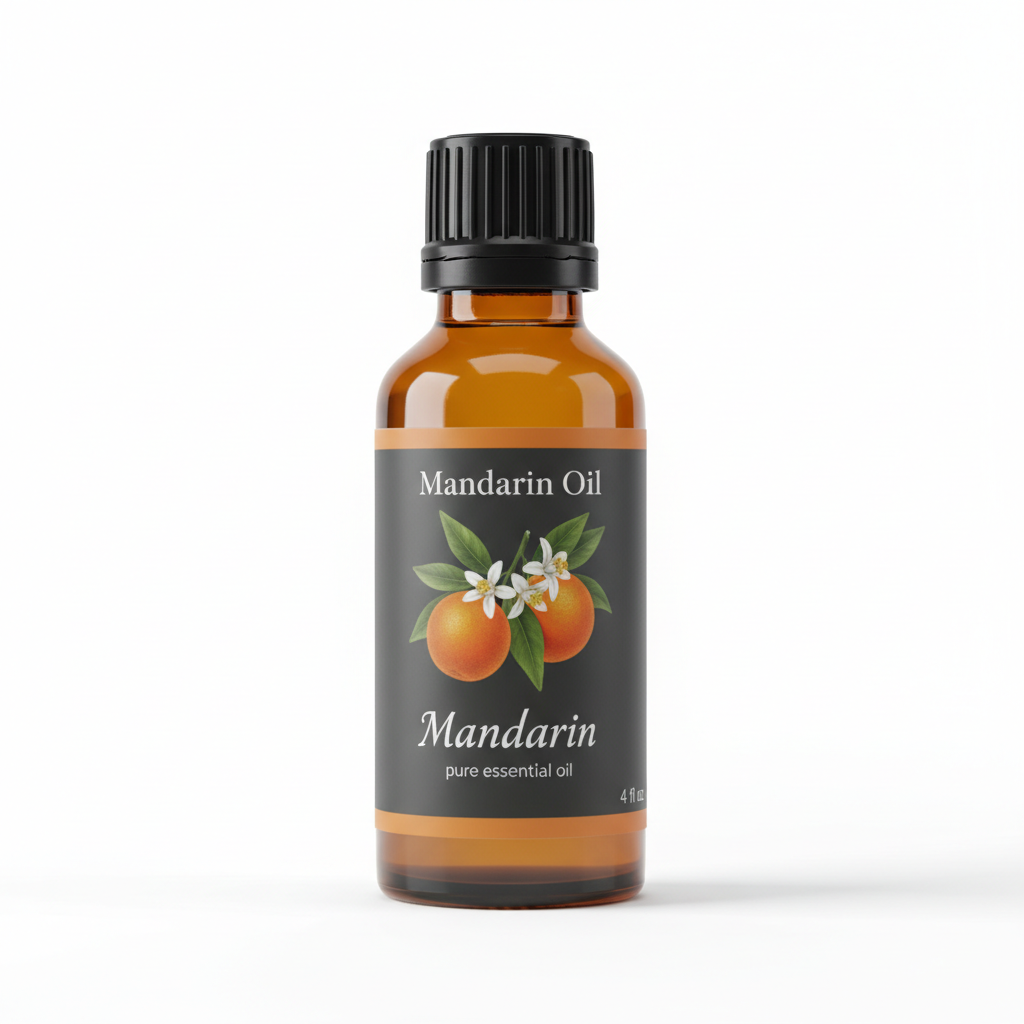
Mandarin Essential Oil
Our own Mandarin Essential Oil, in sizes from 0.5 oz to bulk.
From $12.99
Shop Now →This article breaks down the mandarin oil smell from a chemical perspective: which compounds are responsible for each note, what the research literature observes about those compounds, how sourcing affects the final scent profile, and what you need to know before working with this oil safely. If you're looking for a broader introduction first, the complete guide to mandarin oil is a good starting point.
The Baseline Scent: What Mandarin Oil Actually Smells Like
The short answer: sweet, soft, and unmistakably citrusy, but with a floral undertone and a faint herbal warmth that most citrus oils simply don't have.
The mandarin scent profile sits somewhere between orange and tangerine, but it isn't quite either. Compared to sweet orange oil, mandarin reads as lighter and more delicate, with noticeably less of that sharp, zesty top note. Compared to tangerine, it's a little less candy-bright and a little more complex on the dry-down. There's a honeyed quality to the mid-note, and some cold-pressed expressions carry a subtle rose-like or neroli-adjacent undertone that perfumers genuinely prize.
Red mandarin oil (pressed from fully ripe red-skinned fruit) tends toward the richest, most candy-like sweetness. Green mandarin (pressed from unripe or early-harvest fruit) skews more tart, more herbal, and noticeably more green. Yellow mandarin sits between the two. These aren't just marketing categories. They reflect measurable differences in chemical composition, which we'll get to shortly.
The Chemistry Behind the Scent
Essential oil scent is determined by its volatile organic compounds, and in mandarin oil, a relatively small number of molecules do most of the aromatic heavy lifting.
Limonene: The Dominant Compound
Limonene typically makes up somewhere between 65 and 75 percent of cold-pressed mandarin oil, depending on cultivar and harvest timing. It is the molecule most responsible for that immediately recognisable bright, clean citrus opening note. Limonene is found across nearly all citrus essential oils, but its concentration and the surrounding compound matrix both affect how it registers in a finished oil. In mandarin, the supporting cast is what sets it apart.
Gamma-Terpinene: The Herbal Warmth
Gamma-terpinene is present in mandarin oil at concentrations of roughly 14 to 22 percent, which is notably higher than in sweet orange oil. This compound contributes a warm, slightly herbal, almost woody undertone that sits beneath the sweetness. It's a significant reason why mandarin smells less one-dimensional than a lot of other citrus oils. In green mandarin particularly, gamma-terpinene levels tend to be at the higher end of that range, which is why the green expression smells more herbaceous.
Methyl N-Methylanthranilate: The Floral Signature
This is the compound that makes mandarin oil genuinely distinctive. Methyl N-methylanthranilate (sometimes abbreviated as MMAA) is a nitrogen-containing ester found at relatively low concentrations, usually around 0.2 to 0.8 percent, but it punches well above its weight. It is responsible for the subtle floral, slightly grape-like, neroli-adjacent quality that perfumers describe when they talk about mandarin's complexity. Sweet orange oil contains very little of it. This single compound is a major reason why mandarin and orange, despite sharing most of their other constituents, smell so different in practice.
Alpha-Pinene and Beta-Pinene
Present in smaller quantities, the pinenes contribute a faint resinous, fresh note that adds lift to the overall profile. They're not prominent in the scent of mandarin oil, but their absence would be noticeable.
Linalool and Geranial
Trace amounts of linalool (a soft, floral-woody compound also found in lavender) and geranial (a fresh, lemony aldehyde) round out the mid-note and contribute to that honeyed quality in ripe red mandarin expressions. These compounds appear at low percentages but meaningfully influence the overall character of the scent.
What the Research Observes
A body of published research has examined the chemical composition of mandarin peel oils across different cultivars, harvest times, and geographic origins. A few observations from that literature are worth noting here, framed honestly as what researchers have observed rather than established fact.
Studies analysing Italian Citrus reticulata oils (the Sicilian crop is considered a benchmark) consistently find that MMAA concentration is a reliable marker of mandarin authenticity. Some research suggests that adulterated or synthetic mandarin oils frequently show abnormally low MMAA levels, which is one reason why gas chromatography-mass spectrometry (GC-MS) testing can be informative when evaluating sourcing quality.
Research published in journals focused on food and flavour chemistry has observed that gamma-terpinene oxidises more readily than limonene, meaning that in an aged or improperly stored mandarin oil, the herbal warmth may diminish and the profile can become flatter and more harshly citrusy. This has practical implications for how you store and purchase the oil, which we cover below.
Some researchers have also noted that the scent profiles of red, green, and yellow mandarin are distinct enough to be statistically separable by compound ratio, which confirms what working perfumers and aromatherapy formulators have long observed empirically.
For a detailed look at how the extraction process itself shapes these compound ratios, see our article on how mandarin oil is made through cold pressing.
Sourcing and Quality Indicators
The mandarin oil smell you encounter from one supplier to the next can vary considerably, and that variation is almost always traceable to sourcing and production decisions.
Geographic Origin
Sicily and Calabria in southern Italy produce what many perfumers and evaluators consider the reference-standard red mandarin oil. The combination of soil, climate, and long-established cultivation practices consistently yields oils with well-developed MMAA levels and a clean, round sweetness. Brazilian mandarin oils are widely available and often competitively priced, but independent GC-MS testing more frequently reveals dilution or blending with cheaper citrus oils. Spanish and North African origins sit somewhere in between in terms of price and consistency.
Cold-Pressed vs. Steam Distilled
Almost all commercially available mandarin oil is cold-pressed from the peel, which preserves the full volatile profile including heat-sensitive compounds. Steam distillation of mandarin is possible but results in a noticeably flatter, more alcohol-like scent with diminished MMAA character. If a supplier doesn't specify the extraction method, it's worth asking. For more context on why this matters, our piece on cold pressing citrus peels covers the process in detail.
What to Look for When Buying
- A supplier who provides GC-MS reports for each batch, ideally from a third-party lab.
- Clear disclosure of cultivar type (red, green, or yellow) and country of origin.
- A harvest or batch date. Mandarin oil is best used within one to two years of pressing when stored correctly.
- Dark glass amber or cobalt blue bottles. Light exposure accelerates oxidation and degrades the scent profile.
- A price point that reflects real production. Genuine Italian cold-pressed red mandarin is not cheap. An unusually low price is often a signal worth investigating.
Signs of Degraded or Adulterated Oil
An oxidised mandarin oil smells noticeably sharper, more turpentine-adjacent, and loses most of its characteristic floral softness. Adulterated oils often smell convincingly citrusy at first, but the MMAA-driven floral undertone is absent and the scent fades quickly on a blotter. Neither type is suitable for cosmetic formulation or blending work, and degraded oils in particular carry an elevated sensitisation risk.
Safety Profile and Contraindications
Mandarin oil has a relatively straightforward safety profile compared to many essential oils, but that doesn't mean it should be used without care.
Phototoxicity
This is the most important safety consideration. Cold-pressed mandarin oil contains furanocoumarins, compounds that can cause a photosensitisation reaction when the skin is exposed to UV light after application. The result can range from temporary darkening of the skin to more significant irritation. The recommendation from most professional safety references, including Robert Tisserand and Rodney Young's widely cited essential oil safety text, is to avoid UV exposure (including sunbeds) for at least 12 hours after applying cold-pressed mandarin oil to skin that will be uncovered. Steam-distilled mandarin oil does not carry the same risk because furanocoumarins are largely removed during distillation, but as noted above, steam distillation significantly changes the scent profile.
Dilution
For leave-on cosmetic applications (body lotions, facial serums, massage blends), the generally accepted maximum dilution for cold-pressed mandarin is 0.7 percent in products used on sun-exposed skin. For rinse-off products, or body applications on covered skin, a 1 to 2 percent dilution is commonly cited. A 2 percent dilution works out to approximately 12 drops of essential oil per 30 ml (one ounce) of carrier. Always start lower and assess before increasing concentration.
Patch Testing
Patch testing before any new topical application is good practice. Apply a small amount of your diluted blend to the inner forearm, cover loosely, and wait 24 hours before checking for any reaction. Our full guide to mandarin oil safety, dilution ratios, and patch testing covers this in more detail.
Populations That Should Consult a Healthcare Provider First
Anyone who is pregnant, nursing, or managing a chronic health condition should speak with a qualified healthcare provider before incorporating new essential oils into their routine. The same applies to use on or around young children. Essential oils are potent concentrations of plant chemistry and deserve the same considered approach you'd apply to any active cosmetic ingredient.
How the Scent Behaves in Blends
Mandarin oil is classified as a top note in perfumery, meaning it's among the first things you smell and among the first to fade. Expect about 30 to 60 minutes of perceptible top-note presence on skin, with the softer MMAA-driven floral quality lingering longer than the limonene-forward opening.
In blends, mandarin oil plays unusually well with florals (jasmine, neroli, ylang ylang), with soft resins (benzoin, labdanum), and with other citruses. It can bridge a gap between a sharp bergamot and a rich base note in a way that sweet orange sometimes can't, precisely because of that floral softness from MMAA. Perfumers working in the Eau Fraiche and Eau de Cologne space use red mandarin extensively for that reason.
At higher concentrations in a blend (above about 10 percent), the gamma-terpinene character becomes more prominent and the sweetness can tip toward something more medicinal-smelling, which is generally not the goal in a cosmetic or home fragrance context. Most working formulators keep mandarin at 5 to 8 percent of a blend's total volume.
A Scent That Earns Its Reputation
The mandarin scent profile rewards close attention. What reads at first as simple citrus sweetness reveals, on examination, a genuinely layered set of compounds working together: the brightness of limonene, the herbal depth of gamma-terpinene, and the rare floral complexity of MMAA that makes mandarin unlike anything else in the citrus family. Understanding the chemistry doesn't diminish the pleasure of the scent. It usually increases it.
Source carefully, store well, dilute properly, and this is one of the more rewarding oils to work with.