
How Mandarin Oil Is Made: Cold Pressing Citrus Peels from Grove to Bottle
Pull the peel from a ripe mandarin and hold it near your nose. That immediate, sparkling burst of scent is not coming from the fruit itself. It is coming from tiny oil sacs embedded in the peel's outer layer, called the flavedo. Those sacs contain the volatile aromatic compounds that become cold pressed mandarin oil. Understanding how mandarin oil is made means following those oil sacs from the grove through a surprisingly low-tech extraction process and into the small amber bottle on your shelf.
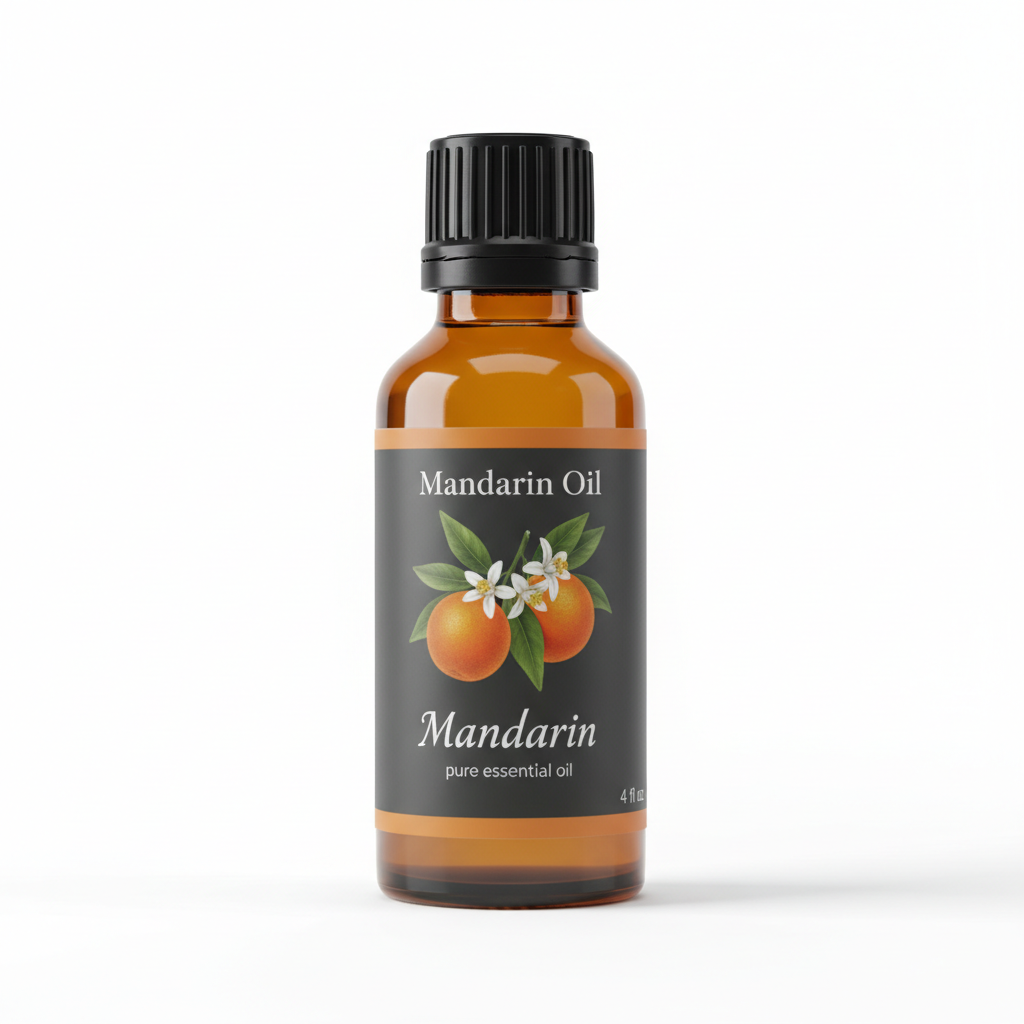
Mandarin Essential Oil
Our own Mandarin Essential Oil, in sizes from 0.5 oz to bulk.
From $12.99
Shop Now →This guide walks through the full production process step by step, covering the materials involved at each stage, the practical decisions producers make, and the quality markers that separate a well-made mandarin peel oil from a mediocre one. For a broader overview of the oil's character and uses, see our complete guide to mandarin oil.
Why Cold Pressing, Not Steam Distillation?
Most essential oils are made by pushing steam through plant material, collecting the vapor, and condensing it back into liquid. That method works beautifully for flowers, roots, and leaves. Citrus peels are different. The delicate top-note compounds that give mandarin its characteristic brightness, particularly the terpene limonene and the esters responsible for its soft, almost floral sweetness, are sensitive to heat. Steam distillation would alter or destroy many of them.
Cold pressing (also called expression or cold expression) physically ruptures the oil sacs without applying heat. The oil is released mechanically, collected with water, and then separated. The result is a scent profile far closer to the living fruit. It is one reason cold pressed mandarin peel oil smells so immediate and fresh compared to distilled citrus oils.
Materials and Equipment at the Production Scale
Commercial cold pressing requires specific equipment, but understanding that equipment helps you evaluate the quality of any bottle you buy. Here is what the process actually involves at each stage:
- Whole ripe mandarins or sorted peels: Some facilities process whole fruits; others receive peels separated as a byproduct of juicing operations. Whole-fruit pressing generally yields cleaner oil with less risk of contamination from juice pulp.
- A rasping or scarifying machine (écuelle à piquer or rasping roller): This device punctures or abrades the peel surface to rupture the oil sacs.
- A centrifuge or gravity separator: Used to separate the essential oil from the water-and-pulp mixture (called the emulsion) collected after pressing.
- Filtration equipment: Fine filters remove residual wax, pulp particles, and sediment from the raw oil.
- Dark glass or food-grade stainless holding vessels: For storage before bottling, protecting the oil from light and oxygen.
- Testing equipment: Reputable producers use gas chromatography-mass spectrometry (GC-MS) analysis to verify the oil's chemical composition before release.
Step-by-Step: How Mandarin Oil Is Made
Step 1: Harvest at the Right Moment
Everything begins in the grove. Mandarin oil quality is deeply tied to harvest timing. Fruit harvested early in the season (green mandarins, typically September through October in the Northern Hemisphere) produces an oil with a greener, sharper scent profile and a higher concentration of certain compounds. Fruit harvested later produces the softer, sweeter red mandarin oil most people recognize. Yellow mandarin falls somewhere between the two.
This is not a minor distinction. The same grove, the same tree, and the same pressing process will yield noticeably different oils depending on when the fruit is picked. Producers who are transparent about harvest timing are telling you something meaningful about their sourcing. For a closer look at how these seasonal differences play out in the finished oil, our article on green, red, and yellow mandarin oil covers the topic in detail.
Step 2: Washing and Sorting
Before any pressing begins, the fruit is washed thoroughly. This step matters more than it might seem. Pesticide residues, surface molds, and environmental contaminants sit on the peel's outer surface, and that surface is exactly where the oil comes from. Certified organic fruit eliminates the pesticide concern at the source. Conventional fruit requires more rigorous washing protocols.
Sorting removes damaged, moldy, or overripe fruit. Damaged skin means compromised oil sacs, which means lower yield and a higher risk of off-notes in the finished oil. Quality-focused producers sort by hand as well as by machine.
Step 3: Rupturing the Oil Sacs
This is the heart of cold pressing. There are two main mechanical approaches used in commercial production:
- The sfumatrice (or rotary rasp) method: Whole fruits are fed into a rotating drum lined with sharp spikes or rasps. The spikes puncture the peel, releasing oil into a spray of water that continuously washes the drum. The fruit is tumbled and abraded rather than crushed, which keeps juice contamination low. This is the preferred method for high-quality mandarin peel oil because it minimizes the mixing of juice (which can ferment and alter the oil's character) with the essential oil fraction.
- The écuelle à piquer (scarification) method: An older technique where the fruit is pressed and rolled against a surface studded with small spikes. Less common in modern large-scale production but still used by some smaller traditional producers in Sicily and Calabria, two of the most important mandarin-growing regions for oil production.
At no point in either method is heat applied. The temperature of the process matters: if friction or ambient conditions raise the temperature significantly during this stage, volatile top-note compounds begin to evaporate before they can be collected. Responsible producers monitor temperatures carefully.
Step 4: Collecting the Emulsion
The oil released by rupturing the sacs does not come out as pure oil. It comes out mixed with water, small fragments of peel tissue, and juice residue. This mixture is called an emulsion. It is collected continuously during the rasping or scarifying stage and held in a collection vessel before separation.
Speed matters here. The emulsion should move to the separation stage promptly. Letting it sit allows fermentation to begin in the aqueous fraction, which can introduce off-notes that carry into the finished oil.
Step 5: Centrifugal Separation
The emulsion is fed into a high-speed centrifuge. Because essential oil and water have different densities, centrifugal force separates them efficiently. The heavier aqueous fraction (sometimes called the hydrosol or floral water, though mandarin's aqueous byproduct is rarely of great aromatic value compared to, say, rose or lavender) is drawn off. The essential oil fraction rises and is collected separately.
A well-operated centrifuge cycle leaves the essential oil with minimal water content. Residual water encourages microbial growth during storage, which shortens shelf life and can alter the oil's scent over time.
Step 6: Filtration
The raw oil coming out of the centrifuge still contains fine particulate matter: peel waxes, pulp micro-fragments, and trace sediment. These are removed through filtration, typically using a series of progressively finer filters. Some producers do a final polish filtration at low temperatures (cold filtration) to remove waxes that would otherwise cloud the oil or precipitate as sediment in the bottle.
A small amount of cloudiness in cold pressed mandarin oil is not necessarily a defect. It can indicate the presence of natural waxes that were not fully filtered out, which some buyers actually prefer as a marker of minimal processing. Clarity alone does not equal quality.
Step 7: Testing and Quality Verification
Before a batch is approved for sale, reputable producers submit samples for GC-MS analysis. This test identifies the specific chemical compounds present in the oil and their relative concentrations. It can detect adulteration (for example, synthetic limonene added to stretch a small yield), confirm that the oil matches the expected profile for the variety and harvest period, and identify any contamination.
When you buy mandarin peel oil from a quality-focused supplier, a GC-MS report should be available, either included with the product or accessible on request. If a supplier cannot or will not provide one, that is worth noting.
Step 8: Bottling and Storage
Cold pressed mandarin oil is light-sensitive and oxidizes with prolonged air exposure. Responsible bottling uses dark amber or cobalt glass to block ultraviolet light. Bottles are filled with minimal headspace (the air gap above the oil) to reduce oxidation. Storage conditions before sale should be cool and away from direct light.
At the consumer level, the same principles apply. Store your mandarin oil in its original dark bottle, keep the cap tightly closed, and keep it away from heat sources. Properly stored cold pressed mandarin oil typically maintains its best scent character for 12 to 24 months.
What Affects Quality: Key Variables to Understand
| Variable | Why It Matters | What to Look For |
|---|---|---|
| Fruit origin | Soil, climate, and variety shape the oil's base character | Named origin (Sicily, Calabria, Spain, Brazil) |
| Harvest timing | Determines green, yellow, or red profile | Supplier specifies color type and harvest window |
| Organic certification | Peel is the oil source; surface residues matter | USDA Organic or equivalent third-party certification |
| Pressing method | Sfumatrice minimizes juice contamination | Supplier describes cold press process, not steam distillation |
| GC-MS testing | Confirms purity and detects adulteration | Report available on request or included with purchase |
| Packaging | Light and air degrade volatile compounds | Dark glass, minimal headspace, tight seal |
Common Mistakes to Avoid When Evaluating Cold Pressed Mandarin Oil
- Assuming all citrus oils are the same: Mandarin, sweet orange, and tangerine are related but distinct. Their oil profiles differ meaningfully. A bottle labeled simply "citrus" tells you very little.
- Ignoring the color type: If a supplier lists only "mandarin oil" without specifying green, yellow, or red, ask. The scent difference between a green mandarin oil and a red one is significant enough to matter for any serious aromatic or cosmetic application.
- Choosing by price alone: Cold pressing citrus peels is relatively economical compared to extracting oils from flowers or roots. Mandarin oil should not be extremely expensive, but very cheap mandarin oil is often adulterated with synthetic limonene or blended with lower-quality citrus fractions. A middle price point with documentation is generally a better sign than the lowest price point with none.
- Skipping storage basics: Leaving mandarin oil in a clear bottle on a sunny windowsill will degrade it within weeks. The bright top notes go first, leaving a flat, somewhat musty-smelling oil that no longer represents the quality of the original pressing.
A Note on Phototoxicity and Safe Use
Cold pressed mandarin peel oil contains naturally occurring compounds called furanocoumarins, the same class of compounds responsible for the phototoxic potential of bergamot and grapefruit oils. Mandarin's furanocoumarin content is generally considered lower than bergamot's, but it is not zero, particularly in cold pressed (rather than steam-distilled) versions.
Phototoxicity means that applying the undiluted or improperly diluted oil to skin and then exposing that skin to sunlight or UV light may cause a reaction. Proper dilution before any skin application is essential, and sun exposure should be avoided on skin where undiluted cold pressed mandarin oil has been recently applied. For full guidance on dilution ratios, patch testing, and sun safety, see our article on mandarin oil safety basics. Please also consult a qualified healthcare provider before incorporating any new ingredient into your skincare routine, particularly if you have sensitive skin or are pregnant.
From Peel to Bottle: What the Process Tells You
Knowing how mandarin oil is made gives you a practical framework for reading supplier information critically. A producer who names the fruit's origin, specifies the harvest period, confirms the cold press method, provides GC-MS documentation, and packages in dark glass is showing you their work at every stage. That transparency is usually a reliable signal of quality.
The process itself is elegant in its simplicity. No solvents, no heat, no chemical transformation. Just mechanical pressure applied to a ripe peel, the careful separation of oil from water, and attentive storage. The grove and the timing do most of the work. The pressing just releases what is already there.