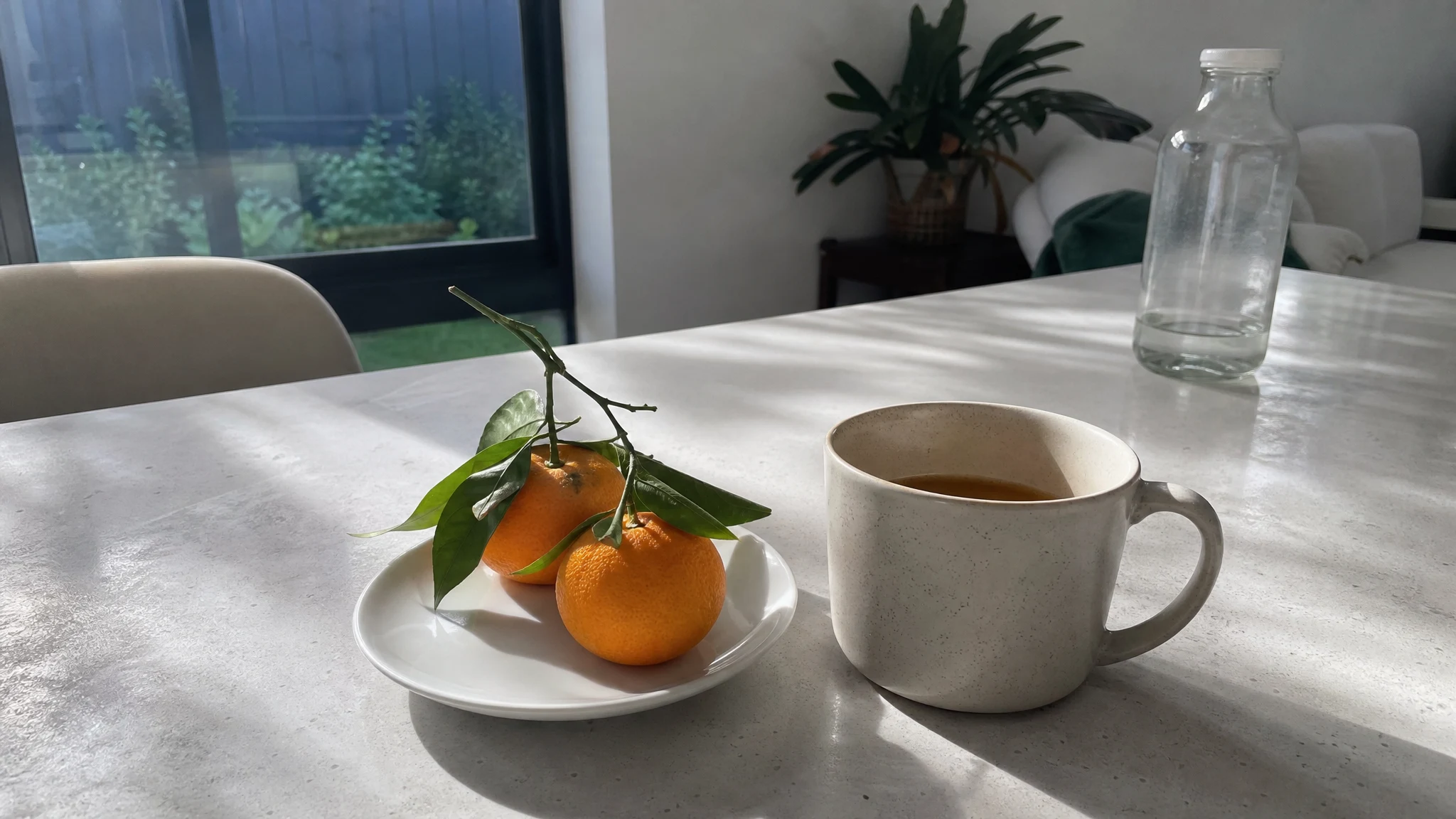
Mandarins and Lunar New Year: What the Sources Say
The mandarin is a Lunar New Year fruit mainly because of a pun that works in Cantonese, and the pun is stronger than most explainers admit. The sound-alike for gold is solid. The sound-alike for luck is patchy and depends on which dialect you speak. This article separates what the sources I could open actually say from the tidy version that circulates, and then draws one modest line from the fruit to the oil made from its peel.
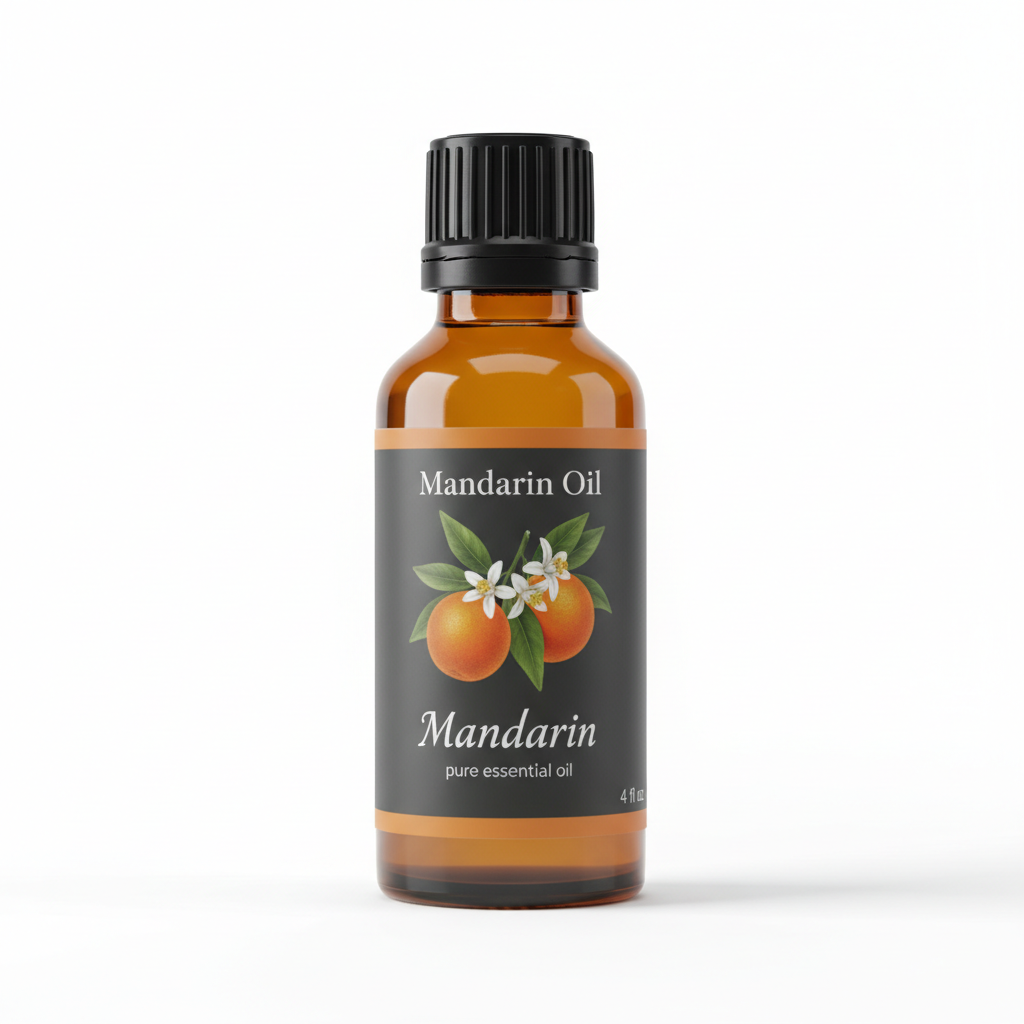
Mandarin Essential Oil
Our own Mandarin Essential Oil, in sizes from 0.5 oz to bulk.
From $12.99
Shop Now →Start with what the custom is, and what I could not confirm
Two sources I could read agree on the basic picture. The Horniman Museum in London catalogues a paper offering from Hong Kong (object 2008.148.21) and states that "mandarin oranges are the most popular and abundant fruit during Chinese New Year"; the offering's four auspicious phrases sit inside an orange-shaped frame. David K. Jordan, Professor Emeritus of Anthropology at UC San Diego, writes on his China resources site that at New Year "pretty much any round, yellowish fruit is thought to look like money", so oranges, tangerines and kumquats are used as decoration.
Popular accounts add rules: that fruit is given in pairs, that leaves stay on, that you should not buy your own. I could not open a museum, university or archival source that states those rules, so I do not present them as the custom. If you follow a family or regional practice, that practice is the authority, not this page.
The wordplay, by dialect
| Word | Sound-alike | What the source says | Caveat |
|---|---|---|---|
| Cantonese gam (柑, mandarin or tangerine) | gam, gold | Jordan: "exactly homonymous" with the Cantonese word for gold; kumquats are the "money oranges" | Specific to Cantonese |
| Mandarin ju (橘 or 桔) | zhu (祝, wish) | Jordan: so, a wish of blessings, but only "in the mouths of some speakers" | He notes ju has no colloquial cognate in Taiwanese Hokkien and little currency in Taiwan Mandarin |
| Teochew gik (orange) | luck or fortune | Horniman catalogue: the Teochew word for orange sounds like the word for luck or fortune | One museum record, not a linguistic study |
| A Cantonese tree named for "luck" | gut, or similar | Jordan was told of it and wrote that he has not knowingly found one | Reported, unverified |
The pattern is a family of puns that live in particular dialects. Repeating "mandarin means luck" as one fact collapses three different claims. Jordan is candid about the confusion: he writes that Chinese speakers "seem almost as confused as I am" about which word names which fruit, and offers a hedged rule of thumb that where the skin peels off easily the character gan (柑) probably belongs in the name. The pun on gold has the cleanest evidence among those I read.
Where the sources disagree
Commercial lifestyle pages in the search results often present the Mandarin word ju as echoing "auspicious" (ji), and they treat gold and luck as one pun. Jordan, the scholarly source I could read, ties ju to zhu (wish), says only some speakers hear it, and keeps the gold pun separate and Cantonese. The Horniman record gives a third, Teochew, version for luck. These are not contradictions so much as different languages being flattened into one story. Where they differ, I follow the source that states its own limits, and I say which dialect each pun belongs to.
What the museum object adds
The Horniman record is useful because it is a physical object, not an explainer. The paper offering carries the deities Fu, Lu and Shou and two bats, and its frame is shaped like an orange. The catalogue notes that it was held with 26 other paper offerings for Hungry Ghosts, though it may not have been used for that purpose. In other words, the orange appears as a design element of luck in printed material from Hong Kong, not only as something to eat. It supports the claim that the fruit is a symbol with a visual life of its own. It does not tell you how any particular household gives, counts or displays fruit.
Which fruit is it, botanically
The English words mandarin and tangerine blur a family of related fruit. The EFSA panel's 2021 document on mandarin oil uses Citrus reticulata Blanco for the species, and states that tangerines and satsumas are hybrids of it. The genetics are messier than the names. Wu and colleagues (Nature, 2018) analyzed 60 citrus accessions, described ten natural species, and found widespread pummelo admixture in mandarins that correlated with fruit size and acidity. Their suggestion was that pummelo introgression helped breeders select more palatable mandarins. So the sweet, easy-peeling fruit on the table is itself a mixture, which is one more reason the common name tells you less than it seems.
The bridge to scent, and its limit
The oil is made from the same peel. EFSA's document says expressed mandarin oil is obtained by cold expression from the fruit peel of Citrus reticulata Blanco. A 2004 study of cold-pressed ponkan oil (Sawamura et al.), a mandarin type grown across China and Japan, used gas chromatography with sniffing and named octanal and decanal as the characteristic odor components, with limonene a background. That is a statement about one cultivar's oil, not about every mandarin oil and not about our bottle. For our own oil the shop describes the aroma as sweet, mellow and juicy, with a faint floral hum, and it is sold neat, cold-pressed from the peel; the published COA gives appearance, smell, relative density, refractive index and optical rotation for one batch and nothing about composition.
I found no source describing essential oil in any Lunar New Year custom. The tradition is about the fruit: its color, its name, the act of giving it. An oil does not carry the pun, and the scent of a bowl of peeled fruit is not the same as the scent of a bottle. What the oil can plausibly do is echo one piece of the room's smell if you diffuse a little. We make no claim that it brings luck, wealth or anything else; we sell a scent.
If you want the scent in the house
- Put out the fruit. The custom is the fruit, and it scents a room by itself while you peel it.
- If you want more, use our oil in a diffuser. The drop counts and run times are in the home diffuser guide, which owns that question; I do not repeat them here.
- Follow our own safety copy: keep the oil away from eyes, children and pets, it is not for internal use, and for skin it is diluted to 0.5 to 2 percent in a carrier with a patch test first. The safety basics cover the steps.
- Do not give a bottle of oil as a stand-in for the fruit. A gift of fruit is the point of the custom; a bottle of undiluted oil is a different object with its own handling rules.
For the longer story of where the fruit came from, read the history of the mandarin; for what the scent is like, the scent profile; and for cold-season blends, the winter blends.
Mandarin Essential Oil
Mandarin Essential Oil from our own shop, in sizes from 0.5 oz to bulk.
From $12.99
Shop Now →Sources & Further Reading
- Horniman Museum and Gardens. Hong Kong votive offering, object 2008.148.21 (catalogue record). horniman.ac.uk/2008.148.21
- Jordan D.K., UC San Diego (Professor Emeritus of Anthropology). Orange excursus, China-related resources. pages.ucsd.edu/~dkjordan
- Wu G.A. et al., 2018. Genomics of the origin and evolution of Citrus. Nature 554:311-316 (abstract via Europe PMC). europepmc.org/10.1038/nature25447
- EFSA FEEDAP Panel, 2021. Safety and efficacy of mandarin oil (Citrus reticulata Blanco), EFSA Journal 19(6):e06625. pmc.ncbi.nlm.nih.gov/PMC8190682
- Sawamura M. et al., 2004. Characteristic odor components of Citrus reticulata Blanco (Ponkan) cold-pressed oil. Biosci Biotechnol Biochem 68(8):1690-1697. jstage.jst.go.jp/bbb/68/8/1690