
Mandarin Oil and Pregnancy: What Sources Say and Don't
Whether to use mandarin oil during pregnancy is a decision for your midwife or obstetric clinician, and this page does not make it for you. What it can do is report precisely what the published authorities say, what the few trials that included mandarin actually measured, and where every source goes quiet. We sell the oil neat for aroma and skin use at 0.5% to 2% in a carrier, and we make no claim that it does anything for pregnancy.
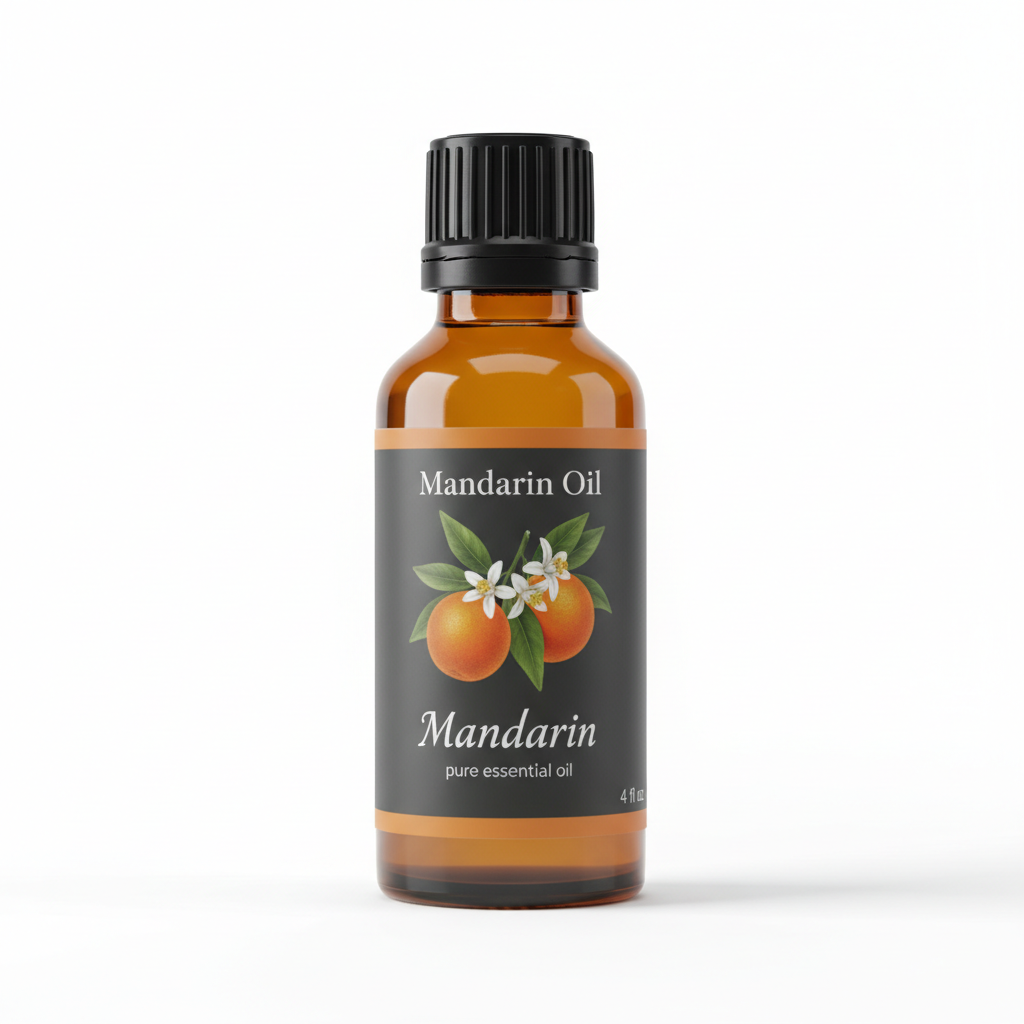
Mandarin Essential Oil
Our own Mandarin Essential Oil, in sizes from 0.5 oz to bulk.
From $12.99
Shop Now →What the authorities publish, and what they leave out
Start with the most useful sentence in the literature I could fetch. MotherToBaby, a teratogen information service, wrote in a 2016 post by its Arizona genetic counselor that for many products "there is no information at all", and that a lack of studies does not mean an oil is safe or harmful, only that it has not been studied. The same post says skin products usually do not lead to large absorption, but that absorption rises with constant use, use on broken or diseased skin, use over large body areas, and use on certain body parts. It names no oil, and it does not address inhalation. Its advice is to ask your healthcare provider before using any product.
The NIH's National Center for Complementary and Integrative Health has an aromatherapy page last updated in January 2020. On pregnancy it says nothing, and it sends decisions to your health care provider. The poison center article from poison.org also does not mention pregnancy. So for a US reader, the national-level pages I could read are silent on mandarin oil in pregnancy specifically.
The one place I found mandarin named in a maternity setting is an NHS hospital trust. The York and Scarborough Teaching Hospitals page on aromatherapy during pregnancy (undated; the footer shows 2026) lists five oils its service uses: lavender, clary sage, frankincense, mandarin and peppermint. It then sets conditions. Women in the first trimester "are not to have direct contact with essential oils". Women with threatened pre-term labour should not use oils. Eligibility excludes allergy to essential oils or citrus fruits, moderate or severe hypertension in pregnancy, and several medical conditions, among them epilepsy, kidney or liver dysfunction, cardiac disease and clotting disorders. The page also warns that women buying oils for themselves "may purchase and apply them with no training or education regarding risks and benefits".
Read that for what it is: one trust's service policy, delivered by trained staff, not national guidance and not a statement about a bottle bought online. The practical lesson is the shape of the conditions. A service that does use mandarin still screens for citrus allergy and trimester before anyone opens the bottle.
What the trials that included mandarin measured
I searched PubMed on 28 October 2026 for mandarin, tangerine or Citrus reticulata together with pregnancy, labour or postpartum and oil or aroma, in titles and abstracts. It returned two records, a 2019 systematic review and a 2004 Korean postpartum trial. I found no trial of mandarin oil alone in pregnant women. That is a statement about my searches, not about the world.
The Cochrane review "Aromatherapy for pain management in labour" (Smith, Collins and Crowther, 2011) included two randomised trials with 535 women. In the larger one (513 women), aromatherapy was compared with standard care using Roman chamomile, clary sage, frankincense, lavender or mandarin, applied in several ways, from acupressure points to a birthing pool. Neither trial found a difference for pain intensity, assisted vaginal birth, caesarean section or epidural use. The reviewers called the evidence insufficient. Two limits matter here. Mandarin was one of five oils in a single trial, so its effect cannot be separated out. And the page reports nothing on adverse effects, so it speaks to benefit only.
A later systematic review by Ghiasi and colleagues (2019, Journal of Caring Sciences) covered aromatherapy and anxiety in the first stage of labour: 16 studies (14 published, 2 unpublished) from Iran, Egypt, Korea and Italy, synthesised in words rather than pooled. Mandarin orange was the oil in one article; lavender led with five. Most studies suggested lower anxiety, and the authors themselves wrote that methodologically rigorous studies are needed. The abstract does not report bias ratings.
For contrast, the best-studied oil in pregnancy is lavender, and even that is thin. A 2024 systematic review in Healthcare found six studies and 413 participants (samples of 13 to 141), all from the second trimester onward, none reporting adverse effects; the authors say safety in the first trimester is unknown, and two studies blended lavender with petitgrain and bergamot. If lavender is that uncertain, an oil with fewer trials is no better established. Nothing in this paragraph transfers to mandarin; it shows how little a "no adverse effects" line from small trials is worth.
Three routes, three different questions
Diffusing. I found no fetched source that gives a pregnancy-specific time limit or room size for diffusing a citrus oil, so I will not invent one. Ask your midwife whether to diffuse at all, and in which trimester. Our general diffuser notes are in the home-use guide.
On skin. Our own copy says to dilute to 0.5% to 2% in a carrier oil, patch test first, start at the low end if you are new to citrus oils, and keep the oil away from eyes, children and pets. At the 1 oz scale that is roughly 3 to 12 drops (about 0.13 to 0.5 g) in 1 oz of carrier, which is about 25 g. Those numbers are our general skin copy. They are not a pregnancy dose, and a clinician may set a lower ceiling or tell you to skip skin use. Patch-test steps and the generic dilution table are in the safety basics post.
Swallowing. Never. Our label says not for internal use; the reasoning is on the ingestion page.
Why the citrus-allergy line matters
The York exclusion for citrus allergy is not arbitrary. Citrus peel oils are largely limonene (95.7% in one CO2-extracted mandarin peel oil analysed in a 2021 rat study, a different extraction from a cold-pressed oil). Limonene exposed to air forms hydroperoxides, which a 2020 case report from Singapore describes as a potent sensitizer. We cover that chemistry on the hair and scalp page. It is one reason our own advice is to buy small, reorder often and keep the bottle capped, cool and dark. The COA we publish for the batch MANLUCCRBRC003A lists appearance, smell, relative density 0.852, refractive index 1.471 and optical rotation +69.80 degrees. It carries no composition, allergen or oxidation data, so a buyer who needs those figures for a clinician should ask us in writing before ordering and get the answer in writing.
A sensible order of operations
- Tell your midwife or obstetric clinician the exact oil by name, how it would be used, and how often. Ask about your trimester and any citrus or fragrance allergy.
- If you have already used a product without knowing, MotherToBaby's published advice is not to panic and to call your provider. MotherToBaby also lists a helpline for questions on exposures in pregnancy.
- If a clinician says yes to a route, use the lowest dilution they accept and patch test first.
- If you develop a rash, headache, nausea or breathing symptoms, stop using the oil and contact your provider. That is our recommendation, not a quotation from a source.
Why we say nothing about benefits
The US FDA decides whether a product is a cosmetic or a drug by its intended use (page current as of 11 September 2024), and gives as a drug example a fragrance with "aromatherapy" claims such as that the scent will help the consumer sleep. A shop that told pregnant customers its oil calms nerves or eases labour would be making that kind of claim. We do not. Our oil is sold for fragrance and skin use under the direction on the label.
For the related skin question, see mandarin oil and stretch marks, which stays with the trial evidence. If you are weighing any oil in pregnancy, your midwife, obstetrician or a MotherToBaby specialist is the right next call, and the shop page lists current sizes if you decide to buy later.
Mandarin Essential Oil
Mandarin Essential Oil from our own shop, in sizes from 0.5 oz to bulk.
From $12.99
Shop Now →Sources & Further Reading
- MotherToBaby (Colón), 2016. A Slippery Topic: The Use of Essential Oils during Pregnancy. mothertobaby.org
- NCCIH, updated January 2020. Aromatherapy. nccih.nih.gov/health/aromatherapy
- National Capital Poison Center. Essential oils. poison.org/articles/essential-oils
- York and Scarborough Teaching Hospitals NHS Foundation Trust (undated). Aromatherapy during pregnancy. yorkhospitals.nhs.uk
- Smith CA, Collins CT, Crowther CA, 2011. Aromatherapy for pain management in labour. Cochrane Database Syst Rev. cochrane.org/CD009215
- Ghiasi A, Bagheri L, Haseli A, 2019. A systematic review on the anxiolytic effect of aromatherapy during the first stage of labor. J Caring Sci. PMID 30915314
- Vidal-Garcia E et al., 2024. Efficacy of lavender essential oil in reducing stress, insomnia, and anxiety in pregnant women: a systematic review. Healthcare. PMC11641599
- US FDA, current as of 11 September 2024. Is it a cosmetic, a drug, or both? (Or is it soap?). fda.gov
- Kwangjai J et al., 2021. Modification of brain waves and sleep parameters by Citrus reticulata Blanco cv. Sai-Nam-Phueng essential oil. Biomed J. PMC8847839
- Kwong HL, Lim SPR, 2020. Pigmented contact dermatitis in the axillae caused by hydroperoxides of limonene. JAAD Case Rep. PMC7256231