Mandarin Oil for Hair and Scalp: Evidence, Risks and Maths
Scent is the only thing we offer for hair. We found no study of mandarin oil on hair or scalp, we make no growth, dandruff or itch claim, and the documented risk on a scalp is contact allergy, which is hard to spot because the rash often shows up away from the scalp. If you still want a lightly scented hair oil, this page gives the arithmetic for 30 ml at the low end of our skin copy, a formulation we have not made or tested, and the reasons to stop early.
Mandarin Essential Oil
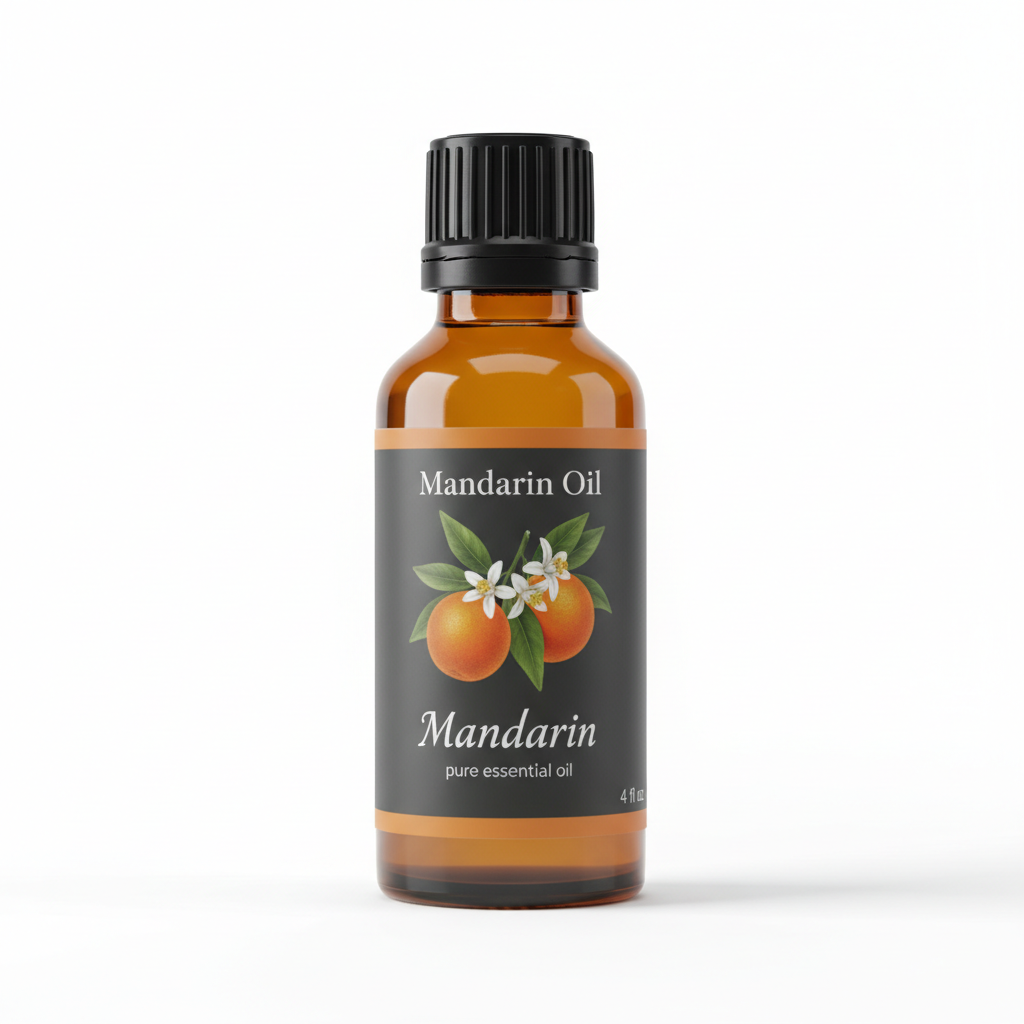
Our own Mandarin Essential Oil, in sizes from 0.5 oz to bulk.
From $12.99
Shop Now →First decision: do you want a scent or a result?
FDA decides whether a product is a cosmetic or a drug by its intended use, judged from labelling, advertising and other promotion (page current as of 11 September 2024). Its examples include claims to "restore hair growth", and an antidandruff shampoo counts as a drug because of what it is meant to do about dandruff. So an oil sold with hair-growth or dandruff claims is a drug, whatever it is made of. Ours is sold for fragrance and skin use, and no page of ours promises a result on hair.
If your actual aim is thinning hair, shedding, flaking or an itchy scalp, the right person is a dermatologist. The American Academy of Dermatology's hair loss diagnosis page says "it helps to see a board-certified dermatologist" for an accurate diagnosis, describes a history, a scalp exam and a test of how your hair pulls and breaks, and says a blood test or scalp biopsy may follow if a disease, nutrient deficiency, hormone problem or infection is possible. It also notes that some shedding, such as after childbirth, illness or surgery, can resolve on its own, and that a person can have more than one cause at once. A bottle of oil cannot sort out which one you have.
What studies exist, and they are about other oils
On 28 October 2026 I searched PubMed titles and abstracts for mandarin, tangerine or Citrus reticulata with hair, scalp or alopecia and oil. Zero records. That is a statement about this search only.
The trials people quote involve other oils, and both carry a lesson for scented scalp products. Hay, Jamieson and Ormerod (1998, Archives of Dermatology) randomised 86 people with alopecia areata to daily scalp massage with thyme, rosemary, lavender and cedarwood oils in jojoba and grapeseed carriers, or carrier oils alone, for seven months. Two dermatologists judged photographs: improvement in 19 of 43 analysed in the active group (44%) against 6 of 41 controls (15%). The result cannot be pinned on one oil, mandarin was not in the blend, and alopecia areata is an autoimmune condition, not ordinary thinning. Panahi and colleagues (2015, Skinmed) compared rosemary oil with 2% minoxidil in 100 people with androgenetic alopecia over six months (50 per group). Hair counts did not change at three months and rose at six in both groups, with no difference between them. Scalp itching, one of the safety measures, increased from baseline in both groups at three and six months, and was more frequent with minoxidil. The authors drew an efficacy conclusion, but the comparator was minoxidil 2% and the summary I read describes no placebo arm, which limits what it shows. An itch that rises in a trial of a scented oil is the same signal this page is about.
The documented risk: allergy that hides
A 2024 review in the International Journal of Women's Dermatology, "Allergic contact dermatitis of the scalp: an underdiagnosed entity" (Hwang and colleagues), says typical red plaques are uncommon on the scalp. Reactions more often appear on runoff areas: around the ears, along the hairline, on the face and neck. It is often misdiagnosed as seborrheic dermatitis, and standard patch series can miss allergens in personal products; one study it cites found 83% of people who reacted to their own hair tints did not react on the standard series. Fragrance mix I, fragrance mix II and balsam of Peru are frequently identified scalp allergens, and the review cites one study in which a third of patients reacted to at least one of three fragrances. The review does not discuss essential oils or compare leave-on with rinse-off products.
The mechanism specific to citrus oils is oxidation. Limonene on its own is a weak sensitizer; exposed to air it forms hydroperoxides. A 2020 case report from Singapore calls the hydroperoxides a potent sensitizer, says limonene can oxidize during manufacturing or storage, and cites an earlier study reporting that hydroperoxide levels in essential oils rise over time regardless of storage or handling; its authors did not test essential oils themselves. Bråred Christensson and colleagues (2014) patch tested oxidized limonene in 2,900 consecutive dermatitis patients in six countries and judged exposure probably relevant in 36% of the limonene-allergic ones. In a repeat-application study (Bennike et al., 2019) of 11 people allergic to limonene hydroperoxides, 100%, 64% and 27% reacted at 3.0, 0.99 and 0.33 micrograms per square centimetre, and none of 17 healthy controls reacted at the highest dose. That is the point that matters for dilution: a low dose still triggered a reaction in more than a quarter of already-allergic people. And Francis and Bui (2015) showed that commercial lemon, sweet orange and tangerine oils change substantially as they evaporate, with the most volatile components lost first.
What that means for our oil: the COA we publish for batch MANLUCCRBRC003A has no peroxide, oxidation or allergen data, and we publish no IFRA certificate or allergen declaration, so I cannot calculate a usage limit for it and will not guess one. Our own copy is the only ceiling we state: 0.5% to 2% in a carrier, patch test, start low if you are new to citrus oils. And our shop advice, to buy small, reorder often, keep it capped, cool and dark, and decant a small working amount, is the practical answer to the oxidation point. Read the limit as a ceiling for a fresh bottle, not a licence for an old one.
Leave-on or rinse-off
No source I fetched ranks them for scented oils, so this is reasoning. A pre-shampoo oil that stays for a short time and is then washed out has less contact time than an oil left in, and an oil worked into the ends only touches less scalp skin than one massaged into it. If you are going to try it at all, the lower-contact version is the one to start with. If a rash appears at the hairline, ears or neck, think of the product as a suspect even if the scalp itself feels fine; that is the runoff pattern the review describes.
The arithmetic for 30 ml
Thirty ml is a hair over 1 oz (29.57 ml), so the 1 oz figures apply. At about 20 drops per ml (weigh instead if you can), 0.5% is roughly 3 drops or 0.13 g, 1% roughly 6 drops or 0.25 g, and 2% roughly 12 drops or 0.5 g, since 1 ml of our oil weighs about 0.852 g. For hair we would begin at 0.5%.
A formulation, untested
We have not made or tested this. It is a formulation worked out from our own safety copy and the arithmetic above. Buy a carrier oil you already tolerate at a supply shop or grocery (we do not sell carriers; the carrier page compares them). In a clean 30 ml amber bottle put the carrier and 3 drops of mandarin oil, cap it and shake. Patch test first, using the steps in the safety basics post, and make only a small batch. Start on a few damp ends, wash it out, and stop at the first sign of itching, redness or a rash along the hairline, ears or neck. Skip it entirely if you have a scalp condition, a known fragrance or citrus allergy, or are pregnant (ask your clinician; see the pregnancy page). Keep it out of eyes and away from children and pets. The skin-use background is on our skin page.
The oil is not for internal use. If you want it for the scent alone, the shop page lists current sizes.
Mandarin Essential Oil
Mandarin Essential Oil from our own shop, in sizes from 0.5 oz to bulk.
From $12.99
Shop Now →Sources & Further Reading
- US FDA, current as of 11 September 2024. Is it a cosmetic, a drug, or both? (Or is it soap?). fda.gov
- American Academy of Dermatology. Hair loss: diagnosis and treatment. aad.org hair loss diagnosis
- Hay IC, Jamieson M, Ormerod AD, 1998. Randomized trial of aromatherapy: successful treatment for alopecia areata. Arch Dermatol. PMID 9828867
- Panahi Y et al., 2015. Rosemary oil vs minoxidil 2% for the treatment of androgenetic alopecia: a randomized comparative trial. Skinmed. PMID 25842469
- Hwang JC et al., 2024. Allergic contact dermatitis of the scalp: a review of an underdiagnosed entity. Int J Womens Dermatol. PMC11286252
- Kwong HL, Lim SPR, 2020. Pigmented contact dermatitis in the axillae caused by hydroperoxides of limonene. JAAD Case Rep. PMC7256231
- Bråred Christensson J et al., 2014. Positive patch test reactions to oxidized limonene: exposure and relevance. Contact Dermatitis. PMID 25099087
- Bennike NH et al., 2019. Allergic contact dermatitis caused by hydroperoxides of limonene and dose-response relationship: a repeated open application test study. Contact Dermatitis. PMID 30378136
- Francis GW, Bui YT, 2015. Changes in the composition of aromatherapeutic citrus oils during evaporation. Evid Based Complement Alternat Med. PMID 26161120