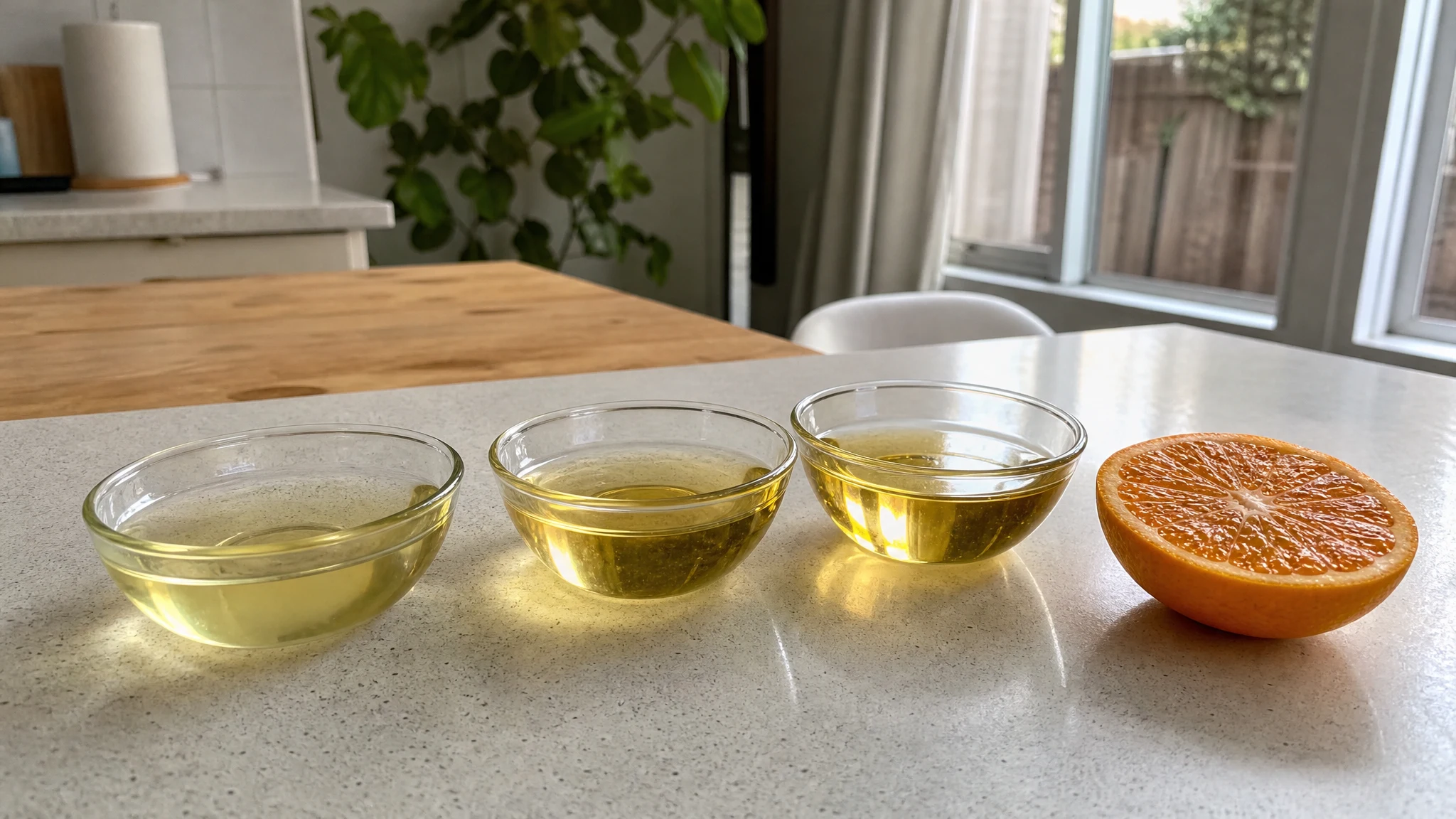
Best Carrier Oils for Mandarin Oil: Choose by Stability First
The carrier oil matters more for how long a blend stays usable than for how it smells. Mandarin oil is the minor ingredient, a few drops in an ounce, so the carrier is 98% or more of what touches the skin and what sits in the bottle. We sell no carrier oils, so this is a buying guide for a product you will get elsewhere, with the arithmetic for the mandarin side.
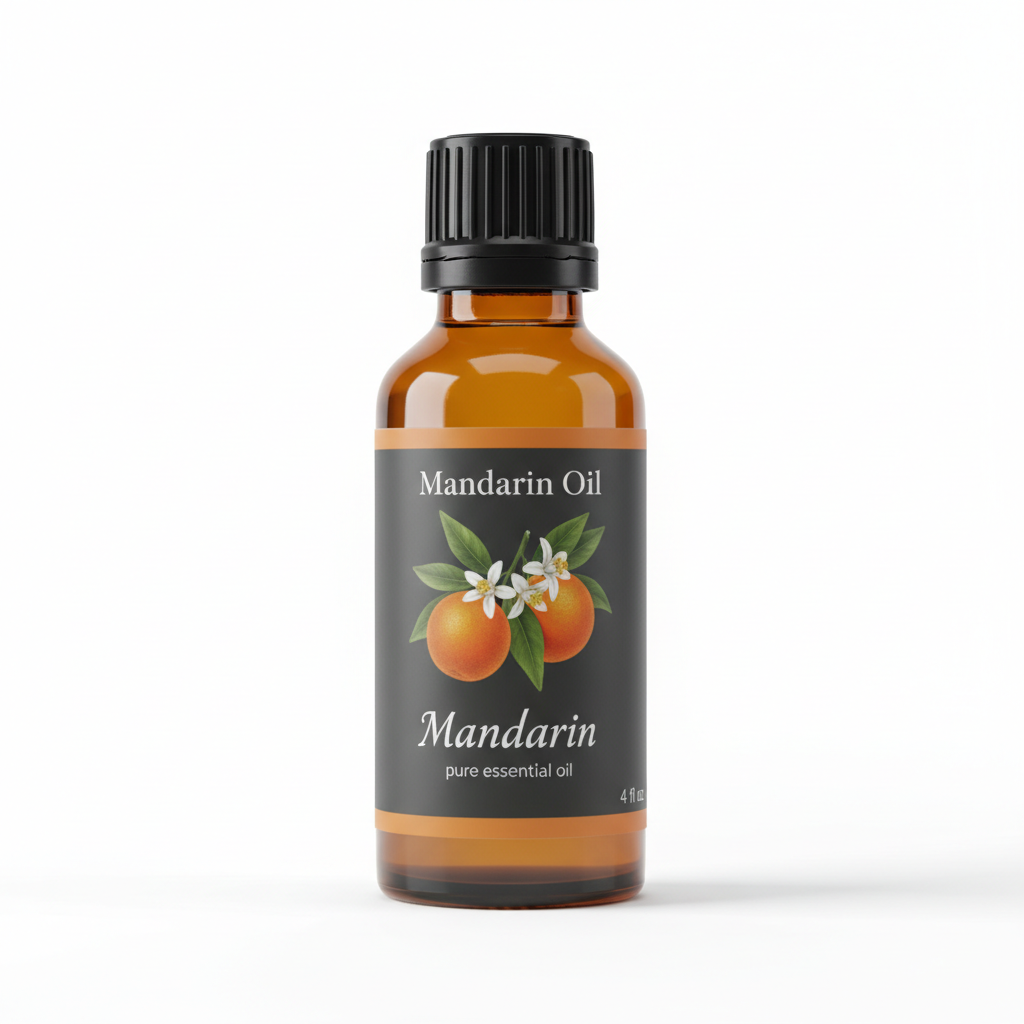
Mandarin Essential Oil
Our own Mandarin Essential Oil, in sizes from 0.5 oz to bulk.
From $12.99
Shop Now →Start from the amount of mandarin oil
Our own safety copy for skin use is 0.5% to 2% in a carrier, roughly 3 to 12 drops per ounce, with a patch test first and the low end for anyone new to citrus oils. The oil is sold neat, so the dilution is yours to calculate. One ounce is 29.57 ml and about 591 drops of oil, so the figures work out like this.
| Share of mandarin oil | Per 1 oz carrier | Per 10 ml carrier | Oil by weight, per 1 oz |
|---|---|---|---|
| 0.5% | about 3 drops | about 1 drop | about 0.13 g |
| 1% | about 6 drops | about 2 drops | about 0.25 g |
| 2% | about 12 drops | about 4 drops | about 0.5 g |
The weights use 0.852 g per ml from the batch on the COA we publish. Droppers vary, so for repeat batches weigh the oil. These are our stated range for our oil, not a ceiling for any other material you add. Another authority gives wider ranges: Robert Tisserand's published guide lists 1% to 3% for body oils and lotions and 0.5% to 1.2% for facial products and deodorants, and describes them as guidelines, not rules (Tisserand Institute, undated). Where the two overlap, we repeat only our own numbers, because no IFRA limit can be calculated for our oil: no allergen declaration or certificate is published for it. For the full dilution and patch-test steps, see Mandarin Oil Safety Basics.
A worked batch
Say you want 4 oz of body oil, about 118 ml, at 1%. That is 1.18 ml of mandarin oil, about 24 drops, or about 1.0 g by weight. Weighing matters more at this scale than it looks: a dropper that delivers 25 drops per ml instead of 20 puts roughly 30 drops where you meant 24, which is about a quarter over your target, and at the 2% end of our range that drift is the difference between a number we publish and one we do not. Use a scale that reads to 0.01 g where you can, and write the grams on the label with the date.
Which problem are you choosing for
Stability: the carrier must outlast the citrus oil
Citrus oil degrades in air, and the degraded product is the one that matters to skin: limonene forms hydroperoxides that a dermatologist's summary calls much more potent sensitisers than limonene itself (DermNet, Coulson, 2021). That is the reason for the shop's advice to buy small and reorder often. A carrier that goes rancid first spoils the blend by a different route, and, reasoning from how rancid fats smell, a few drops of citrus oil are unlikely to cover it. The one direct test we read is a 2022 paper that heated jojoba oil, olive oil and squalene at 60 C for 60 days and found jojoba had the lowest peroxide and carbonyl values and an unchanged acid value, concluding it was the most stable of the three (Tsuchimoto, Sakai and Fukui, BPB Reports, 2022). It used crude jojoba. It did not test sweet almond, fractionated coconut or grapeseed, so those comparisons are not made here.
What the paper does let us reason: jojoba is described there as a liquid wax monoester, not a triglyceride, and the triglyceride in the test, olive oil, oxidised more. A carrier made mostly of unsaturated fatty acids has more places for oxygen to attack. Sweet almond oil is listed by a European cosmetic ingredient database as mainly oleic acid (about 60 to 90%) with linoleic acid (about 20%) (COSMILE Europe), so it is a high-unsaturation oil. Treat that as reasoning that almond will age faster than jojoba, not as a measured result.
Allergy: nut oils and nut allergy
If anyone using the blend has a tree nut allergy, sweet almond oil needs a question before it needs a recipe. An allergist's answer on the AAAAI site says refined nut oils are made with chemical agents or high heat and generally lack protein, that unrefined (cold-pressed) nut oils do contain it, that "natural" products increasingly use unrefined nut oils, and that patients should ask the manufacturer whether a nut oil ingredient is refined or not; the author adds that topical exposure is poorly studied (AAAAI, Pongracic, question dated 2020). The practical consequence: do not buy a nut oil for someone with a nut allergy without that answer in writing from the seller, and take the question to the person's allergist.
Feel and fit
Thin oils spread and soak in quickly; thick ones stay on the surface. Jojoba, fractionated coconut oil, sweet almond, grapeseed and squalane are the usual candidates. We have fetched stability data only for jojoba and composition only for almond, so the table below lists what the sources support and says where we have nothing.
| Carrier | What we can cite | What we cannot |
|---|---|---|
| Jojoba | Liquid wax monoester; lowest peroxide and carbonyl values of three oils after 60 days at 60 C (crude jojoba, 2022 paper) | Shelf life as sold, any refined grade |
| Sweet almond | Mostly oleic acid, about 20% linoleic (database); nut-protein question applies to unrefined oil (AAAAI) | Oxidation data |
| Fractionated coconut | Nothing fetched | Stability, composition, comedogenicity |
| Grapeseed, squalane | Nothing fetched | Everything |
Comedogenicity lists circulate widely and disagree with one another; we do not use them here, since we found no primary study to cite for the numbers.
What to ask the seller
- Is it refined or unrefined, and does the sheet say so?
- Is there a harvest or bottling date, and a certificate of analysis showing a peroxide value?
- How should it be stored once opened? Buy the smallest size you will finish.
These are the same questions we would put to ourselves about the mandarin oil: the batch on our published COA lists density, refractive index and optical rotation only, so a buyer who needs more should ask in writing before ordering.
Our recommendation
On the evidence read here, jojoba is the safer starting point for a blend you intend to keep, and it avoids the nut question. Take a different oil if you have a reason, such as price or feel, and then make the blend small and use it up. Whichever carrier you choose, patch test the finished blend, not the carrier alone. For blends that are not simple oils, see the lotion and body butter formulation, and for recipes using a carrier, sugar scrub and body oil and using mandarin oil for skin.
Pick the carrier for stability and allergy first, and let feel decide between the ones that pass. Mix a small amount, label the date, and keep it cool and dark.
Mandarin Essential Oil
Mandarin Essential Oil from our own shop, in sizes from 0.5 oz to bulk.
From $12.99
Shop Now →Sources & Further Reading
- Tisserand R. Dilution for essential oils. Tisserand Institute. tisserandinstitute.org/dilution-essential-oils
- Coulson I, 2021. Contact allergy to limonene and linalool. DermNet. dermnetnz.org
- Tsuchimoto S, Sakai H, Fukui K, 2022. Oxidative stability and antioxidant activity of crude jojoba oil. BPB Reports 5(6). jstage.jst.go.jp/article/bpbreports/5/6/5_121
- COSMILE Europe. Prunus Amygdalus Dulcis Oil (INCI entry). cosmileeurope.eu/inci/detail/13265
- Pongracic JA. Food allergy: nut oils in topical products. AAAAI Ask the Expert. aaaai.org