Mandarin Oil and Stretch Marks: What the Evidence Shows
No study I could find tested mandarin oil on stretch marks, and the broader evidence for any oil, cream or butter is weak. So the honest description of a mandarin belly oil is a scented body oil, and its scent is what we sell. We make no claim that it prevents, fades or repairs stretch marks. This page lays out what the trials on other products found, so you can judge any bottle's label, ours included.
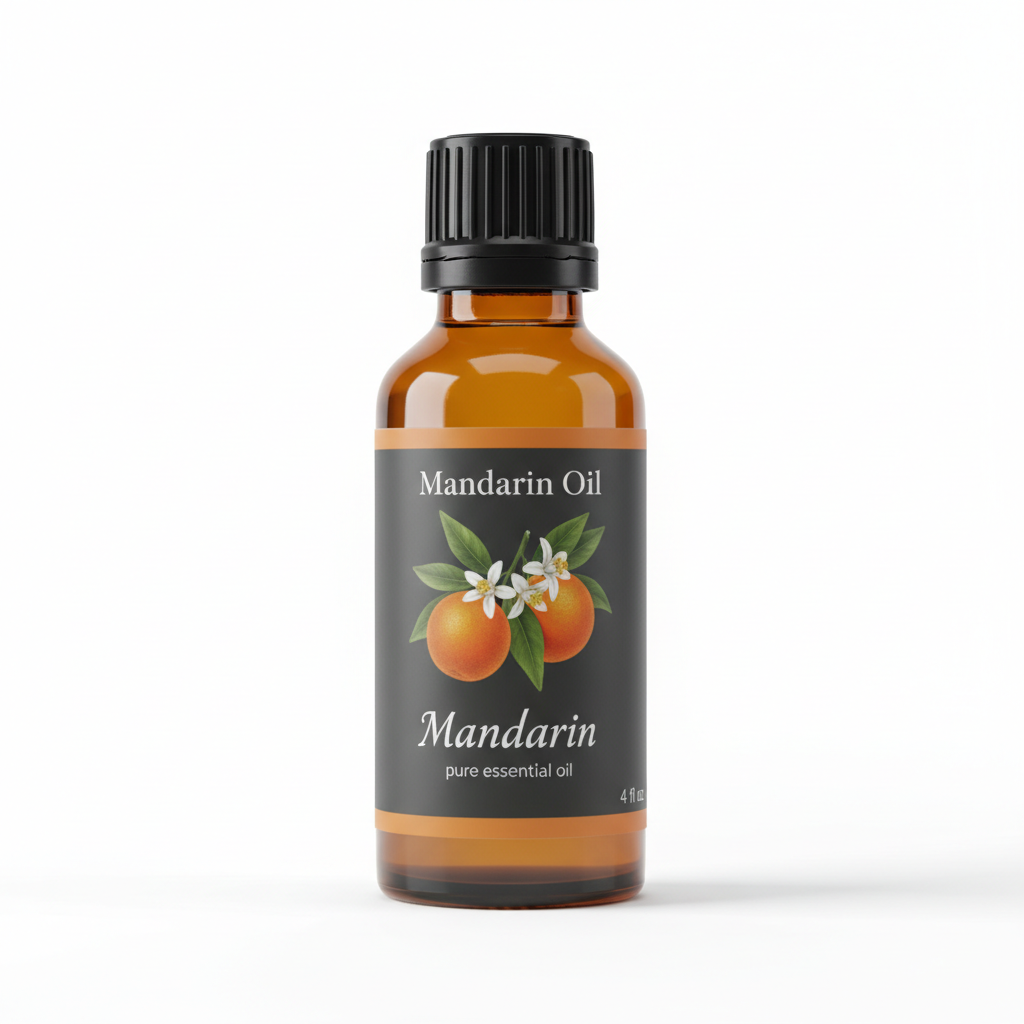
Mandarin Essential Oil
Our own Mandarin Essential Oil, in sizes from 0.5 oz to bulk.
From $12.99
Shop Now →What the main review found
The Cochrane review "Topical preparations for preventing stretch marks in pregnancy" (Brennan, Young and Devane) is listed as Issue 4 of 2022, with its literature search running to 31 October 2011. It included six trials with 800 women. Five trials (474 women) reported whether stretch marks developed, and two trials (255 women) reported severity. The preparations tested were three branded creams (Alphastria, Trofolastin and Verum, which contain vitamin E, the first and third also hyaluronic acid), plus olive oil and cocoa butter.
The numbers: compared with placebo or no treatment, the average risk ratio for developing stretch marks was 0.74 with a 95% confidence interval of 0.53 to 1.03. A risk ratio below 1 points toward fewer stretch marks, but an interval that reaches 1.03 means the data are compatible with no effect, and the authors did not call it significant. Severity gave a standardised mean difference of -0.31 (95% CI -1.06 to 0.44), also not significant. Three of the six trials were judged at low risk of bias. The authors concluded there is no high-quality evidence for any topical preparation for preventing stretch marks in pregnancy, and asked for larger, more rigorous trials. None of the tested products was a citrus oil.
The American Academy of Dermatology says the same thing in plainer words on its stretch marks page: "In studies, neither almond oil, cocoa butter, olive oil, nor vitamin E prevented stretch marks." The page treats centella or hyaluronic acid products as a "Maybe", says stretch marks are permanent but treatment can make them less noticeable, names hyaluronic acid and tretinoin as prescription options with some support mainly for early marks, and tells pregnant or breastfeeding readers to check with a doctor first because some ingredients, including retinol, can harm a baby. It carries no publication date.
The one oil trial that points the other way, and why it does not rescue a scent
The study people cite for oils is Timur Tasan and Kafkasli (2012, Journal of Clinical Nursing). It was a posttest-only quasi-experiment, not a randomised trial, in 141 first-time mothers in eastern Turkey, split into bitter almond oil with massage (n = 47), bitter almond oil only (n = 48) and control (n = 46). Stretch marks appeared in 20%, 38.8% and 41.2% respectively. Read the middle row: the oil without massage landed within three percentage points of no treatment. If the study means anything, the signal came from the massage, not the oil, and the oil was a bitter almond oil, not mandarin. A single non-randomised study of this size also sits beside a Cochrane review that found no clear effect from the products it pooled. Two sources disagree in direction, and the review is the stronger design.
My reasoning, labelled as such: if rubbing is the active step, a body oil's job is to make rubbing possible, and any oil your skin tolerates does that. Adding mandarin changes the smell and adds a possible allergen to skin that is already stretched and may itch. It does not add a documented benefit.
What I searched for mandarin specifically
On 28 October 2026 I searched PubMed titles and abstracts for mandarin, tangerine or Citrus reticulata together with "stretch marks" or striae. Zero records. The products in the Cochrane review (listed above) include no citrus oil. That is a statement about these searches only.
A practical use of the review: when a label or an ad says an oil prevents or fades stretch marks, ask for the same three things the Cochrane authors counted. Was it a randomised trial with a placebo or no-treatment group? How many women developed marks in each group, and how many women were in it? Was severity scored by someone who did not know which arm she was in? An answer of a testimonial or "it contains vitamin E" matches none of the three. Our own page cannot supply those answers for mandarin, because there are none to supply.
Pregnant skin is a separate question for a clinician
MotherToBaby's 2016 post on essential oils in pregnancy says skin products usually do not lead to large absorption, but that absorption rises with constant use, large body areas and broken skin, and that for many products there is no information at all. A daily belly application is, by design, repeated use over a large area. That is the case where you ask first. Our full treatment of the question is on the pregnancy page; the short version is that your midwife or obstetric clinician decides, and they may say no oil at all.
If you scent a body oil anyway
This is a formulation from our own safety copy and arithmetic, and we have not made or tested it. Our copy says to dilute to 0.5% to 2% in a carrier oil, to patch test first, to start low if you are new to citrus oils, and to keep the oil away from eyes, children and pets. In 1 oz of carrier (about 25 g), 0.5% is roughly 3 drops (0.13 g), 1% roughly 6 drops (0.25 g), and 2% roughly 12 drops (0.5 g). If you are pregnant, treat those as the ceiling of our general skin copy, not a pregnancy figure, and ask first. Make a small batch, patch test it, and watch for itching or redness, which would be a reason to stop, and which on stretched skin could be mistaken for the marks themselves.
For the carrier, go to a supply shop or grocery; we do not sell carrier oils, and the carrier oil page covers the choice. Dilution tables and sun notes are in the safety basics post, and our general skin routine is here. Store the oil tightly capped, cool and dark and buy small amounts, as our shop advises for pressed citrus oils.
Who to ask, and why we claim nothing
For stretch marks that bother you, a dermatologist is the person with options that the evidence at least partly supports; the AAD page points to a board-certified dermatologist when store-bought products have not worked. For anything involving pregnancy, your obstetric clinician or midwife. FDA's cosmetic or drug page (current as of 11 September 2024) says a product's status turns on its intended use, judged from labelling and advertising, and lists claims such as reducing cellulite and regenerating cells as drug-type claims. The page does not mention stretch marks, so applying it here is my inference. It is why we make no stretch-mark claim, and why you should read any bottle that makes one with the Cochrane numbers in mind.
Mandarin Essential Oil
Mandarin Essential Oil from our own shop, in sizes from 0.5 oz to bulk.
From $12.99
Shop Now →Sources & Further Reading
- Brennan M, Young G, Devane D. Topical preparations for preventing stretch marks in pregnancy. Cochrane Database Syst Rev (listed 2022, Issue 4). cochrane.org/CD000066
- American Academy of Dermatology (undated). Stretch marks: why they appear and how to treat them. aad.org stretch marks
- Timur Tasan S, Kafkasli A, 2012. The effect of bitter almond oil and massaging on striae gravidarum in primiparous women. J Clin Nurs 21(11-12):1570-1576. ideas.repec.org record
- MotherToBaby (Colon), 2016. A Slippery Topic: The Use of Essential Oils during Pregnancy. mothertobaby.org
- US FDA, current as of 11 September 2024. Is it a cosmetic, a drug, or both? (Or is it soap?). fda.gov