Can You Ingest Mandarin Oil? What the GRAS Listing Covers
No. Do not drink our mandarin oil, drop it into water or tea, or cook with it. The bottle is sold neat for aroma and skin use, and our label says not for internal use. The question keeps coming back because mandarin oil does appear in US food law, so the rest of this page explains exactly what that listing covers and what it does not.
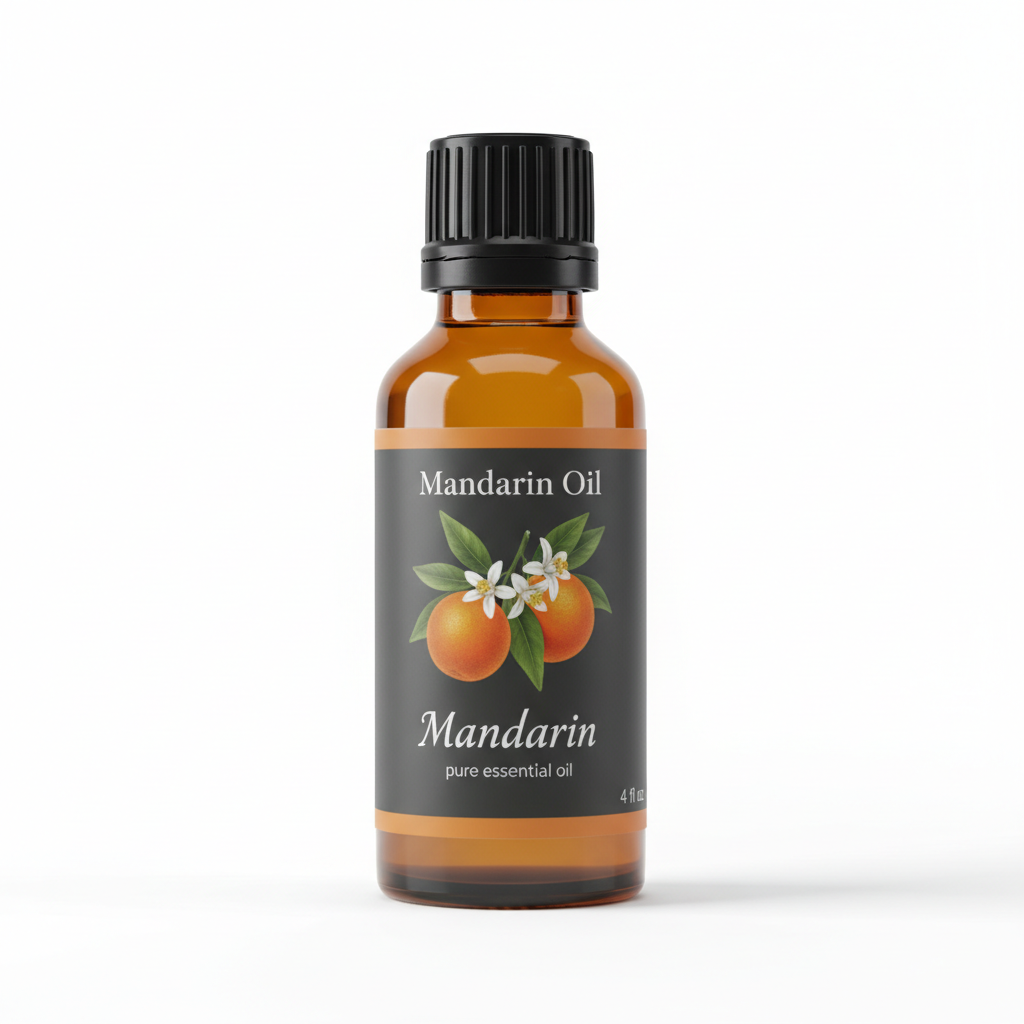
Mandarin Essential Oil
Our own Mandarin Essential Oil, in sizes from 0.5 oz to bulk.
From $12.99
Shop Now →Where the "food grade" idea comes from
Title 21 of the Code of Federal Regulations, section 182.20, is headed "Essential oils, oleoresins (solvent-free), and natural extractives (including distillates)". It lists, for use in food as "generally recognized as safe", about 150 entries. Among them are mandarin and tangerine, both given as Citrus reticulata Blanco, along with other citrus oils. So the regulation does name this oil. The confusion comes from what the listing is attached to.
First, the general section on that part, 21 CFR 182.1, ties every listed substance to "good manufacturing practice", which it defines with three conditions I read in the text. The quantity added to food must not exceed the amount reasonably required to achieve its technical effect. The substance must meet an appropriate food-grade standard. And it must be handled as a food ingredient. Second, FDA's own GRAS page says a substance must be adequately shown to be safe "under the conditions of its intended use". The listing is about a flavouring ingredient in a manufactured food at a technical level. It is not a statement that a bottle of neat oil is something to take by the dropper.
A listing also cannot reach a product that is not offered as food. We sell Mandarin Essential Oil for aroma and skin use, and the COA we publish for batch MANLUCCRBRC003A is an aroma-quality document: it gives appearance, smell, relative density 0.852, refractive index 1.471 and optical rotation +69.80 degrees. It has no food-grade claim, no flavour-use statement and no composition data. Someone who wants a food-labelled citrus flavouring should buy one that is sold as food, from a grocery or baking supplier.
The arithmetic that makes "just a drop" a bad idea
Take our figures: 1 ml of the oil weighs about 0.852 g, and a dropper delivers about 20 drops per ml (droppers vary; weighing is more reliable). One drop is then about 0.043 g, or 43 mg. A 0.5 oz bottle holds about 12.6 g, roughly 296 drops. These are arithmetic, not a toxicity threshold, and I am not giving a toxic dose because I found no mandarin-specific source to cite for one.
Here is the contrast the listing hides. Flavour work is measured in milligrams of flavouring per kilogram of food. As an illustration (my number, not a regulatory limit): at 10 ppm, which is 10 mg per kg, one 43 mg drop would flavour about 4.3 kg of food. Put the same drop in a 250 ml glass of water and the concentration is about 170 ppm, roughly seventeen times that illustration, delivered as an undiluted droplet of oil, not dispersed in a food matrix. The home version is not a scaled-down version of the factory version.
The bottle matters too. A 0.5 oz bottle holds about 12.6 g, which is about 296 of those drops, and a 1 oz bottle about twice that. Poison.org's advice to keep oils and scented products where children and pets cannot reach them, or to discard them if young children are present, is written for exactly this concentration. Our own safety copy says to keep the oil away from children and pets.
What poison centres publish about swallowed oils
The National Capital Poison Center's essential oils article says some oils can be poisonous if absorbed through the skin or swallowed, that aspirating an essential oil can cause pneumonia, and that children "have thin skin and immature livers", which might make them more susceptible than adults. It describes two child cases, a 22-month-old with a prolonged seizure after camphor (four days in hospital) and an 18-month-old who became drowsy and confused after swallowing lavender extract (recovered in about six hours). Neither involved mandarin, and the page does not name mandarin. They show the range of what the oils category can do, not what mandarin does.
On volume, the Tennessee Poison Center at Vanderbilt reported in May 2016 that essential-oil exposure cases had roughly doubled between 2011 and 2015 and that children were involved in about 80 percent. It called out tea tree as the most often cited and listed camphor, clove, lavender, eucalyptus, thyme, tea tree and wintergreen as highly toxic. Most calls fell in an "other" bucket because there are hundreds of oils. That is a regional press release, not a peer-reviewed paper, and it carries no mandarin number.
Searches I ran on 28 October 2026: PubMed, titles and abstracts, mandarin or Citrus reticulata with "essential oil", combined with poisoning, ingestion, overdose or toxicity, combined with human, patient or child. Zero records. I also found no human trial of swallowing mandarin oil for any purpose. Mouse studies that dose citrus oils by mouth exist, but they are not dosing guides for people.
If someone has swallowed it
Poison.org's instruction is to use its webPOISONCONTROL online tool or call the poison center at 1-800-222-1222, which is open around the clock. Do what the poison specialist tells you rather than improvising. Our suggestion is to have the product name, the time, the amount you think was swallowed and the person's age and weight ready before you call. Poison.org also says any allergic reaction involving trouble breathing is a medical emergency. Keep the bottle capped and out of reach of children and pets, as our own safety copy says.
What to use for flavour instead, and who to ask
Use a flavouring sold as a food: citrus zest, juice, or an extract or flavouring labelled for food from a grocery or baking-supply shop. We do not sell any of those. A pharmacist can answer whether an oil interacts with a medicine you take, and a poison specialist or clinical toxicologist can answer exposure questions. Neither question is one a retailer should answer.
Why we make no flavour or wellness claim
FDA's cosmetic or drug page (current as of 11 September 2024) says intended use is judged from labelling, advertising and other promotion. A cosmetic is something rubbed, poured, sprinkled or sprayed on the body to cleanse or beautify. Nothing in that definition covers swallowing. So our pages stay with fragrance and skin use, and they carry the line that the oil is not intended to diagnose, treat, cure or prevent any disease.
For safe-handling basics (dilution, patch tests, storage) see the safety basics post, the FAQ, and storage. To read a bottle's label claims, use the label guide. Other food-labelled sources are the right place for cooking.
Mandarin Essential Oil
Mandarin Essential Oil from our own shop, in sizes from 0.5 oz to bulk.
From $12.99
Shop Now →Sources & Further Reading
- US Government, 21 CFR 182.20. Essential oils, oleoresins (solvent-free), and natural extractives (including distillates). ecfr.gov/current/title-21/section-182.20
- US Government, 21 CFR 182.1. Substances that are generally recognized as safe. ecfr.gov/current/title-21/section-182.1
- US FDA, 2026. Generally Recognized as Safe (GRAS). fda.gov GRAS
- National Capital Poison Center. Essential oils. poison.org/articles/essential-oils
- Vanderbilt University Medical Center / Tennessee Poison Center, 10 May 2016. Essential oil exposure news item. news.vumc.org
- US FDA, current as of 11 September 2024. Is it a cosmetic, a drug, or both? (Or is it soap?). fda.gov