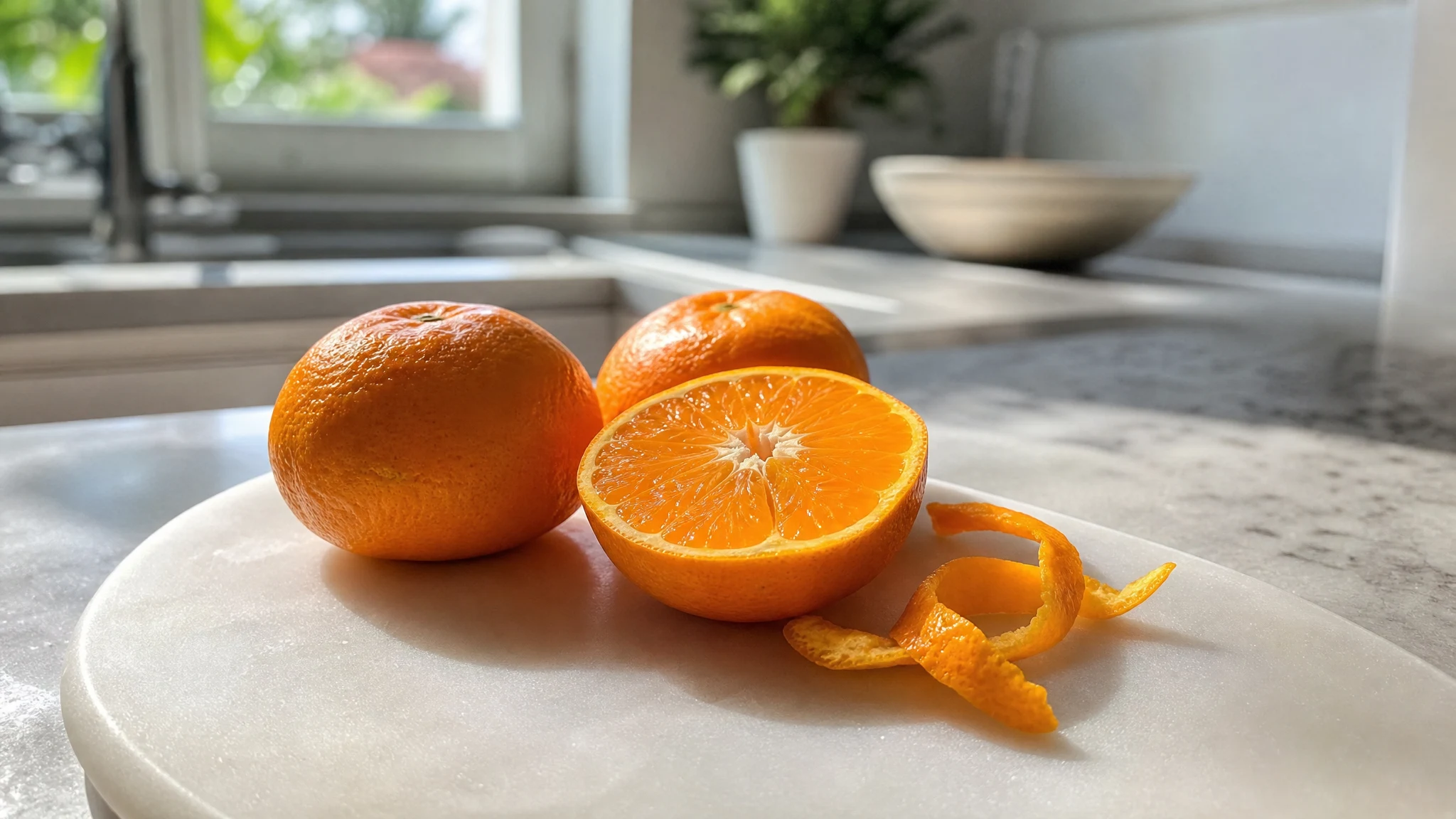
Mandarin Oil Chemical Composition: What Six Sources Report
Limonene is the first number any mandarin oil composition page quotes, and it is the one that tells you least about whether an oil is what it claims to be. The published papers put limonene anywhere from the low 30s to the mid 90s in percent, depending on cultivar, extraction and instrument. This article lays the papers side by side, shows how far apart honest numbers can sit, and says what that means when you are handed a report.
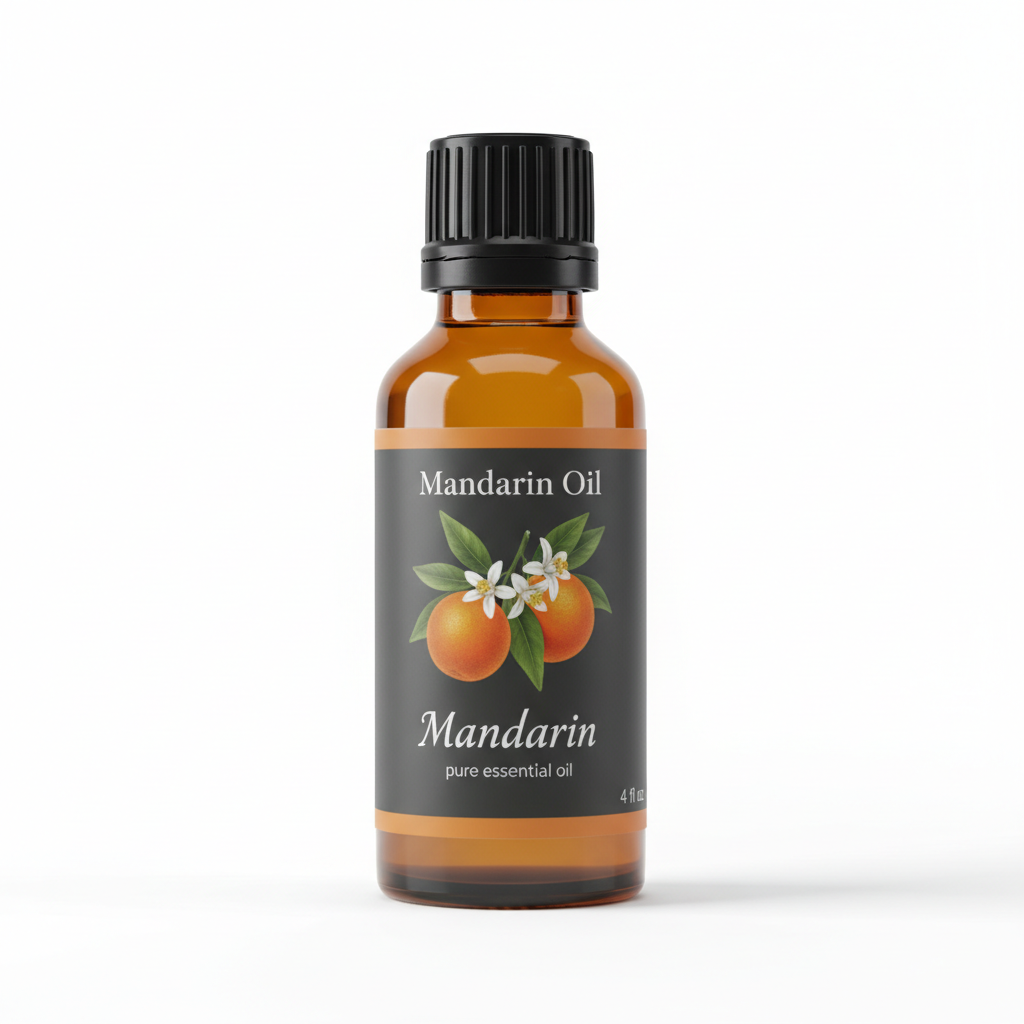
Mandarin Essential Oil
Our own Mandarin Essential Oil, in sizes from 0.5 oz to bulk.
From $12.99
Shop Now →What six sources actually measured
Every figure below is a percentage of GC peak area, which is how gas chromatography reports composition. It is close to, but not the same as, percent by weight. The rows are not interchangeable: they differ in material, method and sample count, and that is the point.
| Source | Material and n | Limonene | gamma-Terpinene | Methyl N-methylanthranilate |
|---|---|---|---|---|
| EFSA FEEDAP panel, 2021 | Expressed (cold-pressed) mandarin oil, 10 batches: 5 green, 5 red; 9 from Italy, 1 green from Brazil; GC-MS | mean 65.63 (56.4 to 68.6) | mean 21.85 (20.5 to 24.7) | mean 1.04 (0.51 to 1.59) |
| Sawamura et al., 2004 | Cold-pressed ponkan oil (Citrus reticulata Blanco); sample count not given in the abstract | 80.3 | not in abstract | not in abstract |
| Elmaidomy et al., 2026 | Hydrodistilled peel oil, 5 mandarin and tangerine cultivars from Egypt, one oil each | 32.87 to 81.13 | 7.00 to 22.23 | detected in 1 of 5 (1.67); not detected in the other 4 |
| Elmaidomy et al., 2023 | Hydrodistilled peel oil, one Egyptian oil from one harvest | 71.72 in the table (73.32 in the text) | 1.60 | not reported |
| Castro et al., 2026 (review) | 49 articles, 2014 to 2024, peel oils where stated | 60.74 to 95.65 across cited studies | 0.24 to 6.7 in the two sources it gives | no range given |
| Cannizzaro et al., 2025 | 63 authentic mandarin oils; chiral and carbon-isotope profiling | no figures in the abstract | no figures in the abstract | no figures in the abstract |
Sources: EFSA FEEDAP, 2021; Sawamura et al., 2004; Elmaidomy et al., 2026; Elmaidomy et al., 2023; Castro et al., 2026; Cannizzaro et al., 2025.
Read the table for what separates the rows
The EFSA panel is the only row built on expressed oil, the way our oil is made, with a defined batch set. Its document states that expressed mandarin oil is obtained by cold expression from the peel of Citrus reticulata Blanco, and it describes the green type as a green to green-brown liquid. It bases its product specification on ISO 3528:2012, the standard titled Essential oil of mandarin, Italian type (Citrus reticulata Blanco), though the panel adapted the ranges and does not quote ISO's own, and I could not read the paywalled standard.
The two Egyptian rows are hydrodistilled in a Clevenger apparatus for two hours at 75 C, which is a different process from pressing. Reasoning from that, not from a source that says so: methyl N-methylanthranilate is a heavy molecule that a cold press carries over from the peel and a distillation may leave behind, which would fit its absence in four of the five distillates. Treat that as a hypothesis. What the rows do show without argument is that one species name can sit over limonene values from 32.87 to 81.13 percent.
The sharpest lesson is inside the EFSA document itself. The same ten batches were checked two ways. By GC-FID, the method the specification is written in, all ten complied. By GC-MS, used for the full characterization, the mean methyl N-methylanthranilate was 1.04 percent against a specification ceiling of 0.7, and the document notes that GC-MS underestimates d-limonene. One oil, two instruments, two pictures. A composition number without its method is half a number.
Why limonene decides so little
Take an ounce of oil, 25.2 g at the relative density of 0.852 on our published COA. Each percentage point of peak area is about 0.25 g (a rough conversion, since area is not weight). The EFSA batches span 56.4 to 68.6 percent limonene by GC-MS, about 14.2 to 17.3 g per ounce: a spread of 3.1 g between batches the panel accepted. The full methyl N-methylanthranilate range, 0.51 to 1.59 percent, is 0.13 to 0.40 g per ounce, a spread of 0.27 g. The big component moves by grams while the minor one that the specification pins to a narrow band moves by a quarter of a gram. Limonene sets the bulk smell of any citrus peel oil, and the Sawamura group found that the characteristic odor of ponkan oil came from octanal and decanal, with limonene as background. That is the practical meaning of "the minor markers decide it": a report that gives you only limonene cannot tell one mandarin oil from another oil with similar limonene.
Authenticity work in the literature goes further than percentages. Cannizzaro and colleagues measured the chiral distribution and carbon isotope ratios of selected compounds in 63 authentic oils and reported clear seasonal and geographic trends; their abstract describes the method as useful for authenticity assessment. Even authentic oils move with season and place, which is why a single reference range, anyone's, is a guide and not a verdict.
What this means for our oil
We do not publish a GC-MS report, and we state no limonene, gamma-terpinene or methyl N-methylanthranilate figure for our oil. The COA we publish for batch MANLUCCRBRC003A gives appearance, smell, relative density 0.852, refractive index 1.471 and optical rotation +69.80 at 20 C. Those three constants describe the oil as a bulk liquid. They cannot tell you which of the roughly 47 identified constituents the EFSA work found (88 peaks were detected, and the identified ones made up about 99.7 percent of peak area) are in your bottle or in what share. The COA reading guide goes through each line.
If your use needs composition (a regulated product, an IFRA calculation, an allergen declaration), ask the seller in writing for a GC report on the lot you are buying, with the method named, the minor compounds listed and the date of analysis. Ask before you order and keep the answer. Methyl N-methylanthranilate is also the reason compliance people care about composition: IFRA restricts it by name, so its share in a specific lot changes how much oil a leave-on product can carry.
Where the other questions live
What mandarin oil is and how it differs from its neighbours is covered in the guide to Citrus reticulata peel oil. How it smells is in the scent profile, and the quick checks a buyer can do are in the quality-check guide. This piece covers only the chemistry: read the method before the number, and distrust any report that offers limonene alone.
Mandarin Essential Oil
Mandarin Essential Oil from our own shop, in sizes from 0.5 oz to bulk.
From $12.99
Shop Now →Sources & Further Reading
- EFSA FEEDAP Panel, 2021. Safety and efficacy of mandarin oil (Citrus reticulata Blanco) for all animal species, EFSA Journal 19(6):e06625. pmc.ncbi.nlm.nih.gov/PMC8190682
- Sawamura M. et al., 2004. Characteristic odor components of Citrus reticulata Blanco (Ponkan) cold-pressed oil. Biosci Biotechnol Biochem 68(8):1690-1697. jstage.jst.go.jp/bbb/68/8/1690
- Elmaidomy A.H. et al., 2026. Volatile composition of essential oils from major Egyptian Citrus cultivars, Sci Rep 16:20746. pmc.ncbi.nlm.nih.gov/PMC13338266
- Elmaidomy A.H. et al., 2023. Egyptian mandarin peel oil's anti-scabies potential: GC-MS and PPI network studies, Sci Rep. pmc.ncbi.nlm.nih.gov/PMC10469216
- Castro J.W.G. et al., 2026. Citrus reticulata Blanco: a review on chemical composition and biological activities, Chem Biodivers. pmc.ncbi.nlm.nih.gov/PMC12780937
- Cannizzaro F. et al., 2025. Comprehensive analysis of mandarin essential oils by enantio-selective multidimensional GC-IRMS, J Chromatogr A 1754:466026. iris.unime.it/11570/3342437
- ISO, 2012. ISO 3528:2012 Essential oil of mandarin, Italian type (Citrus reticulata Blanco), catalogue entry. boutique.afnor.org/ISO 3528:2012