
How to Read a Mandarin Oil COA, Using Ours as the Example
A certificate of analysis for mandarin oil that lists density, refractive index and optical rotation is a consistency check, not a proof of identity, and the one we publish has a best-by date that has already passed. Both facts matter before you order a pound. Below is our own COA, line by line: what each test measures, what it cannot show, and what to ask for in writing before you buy.
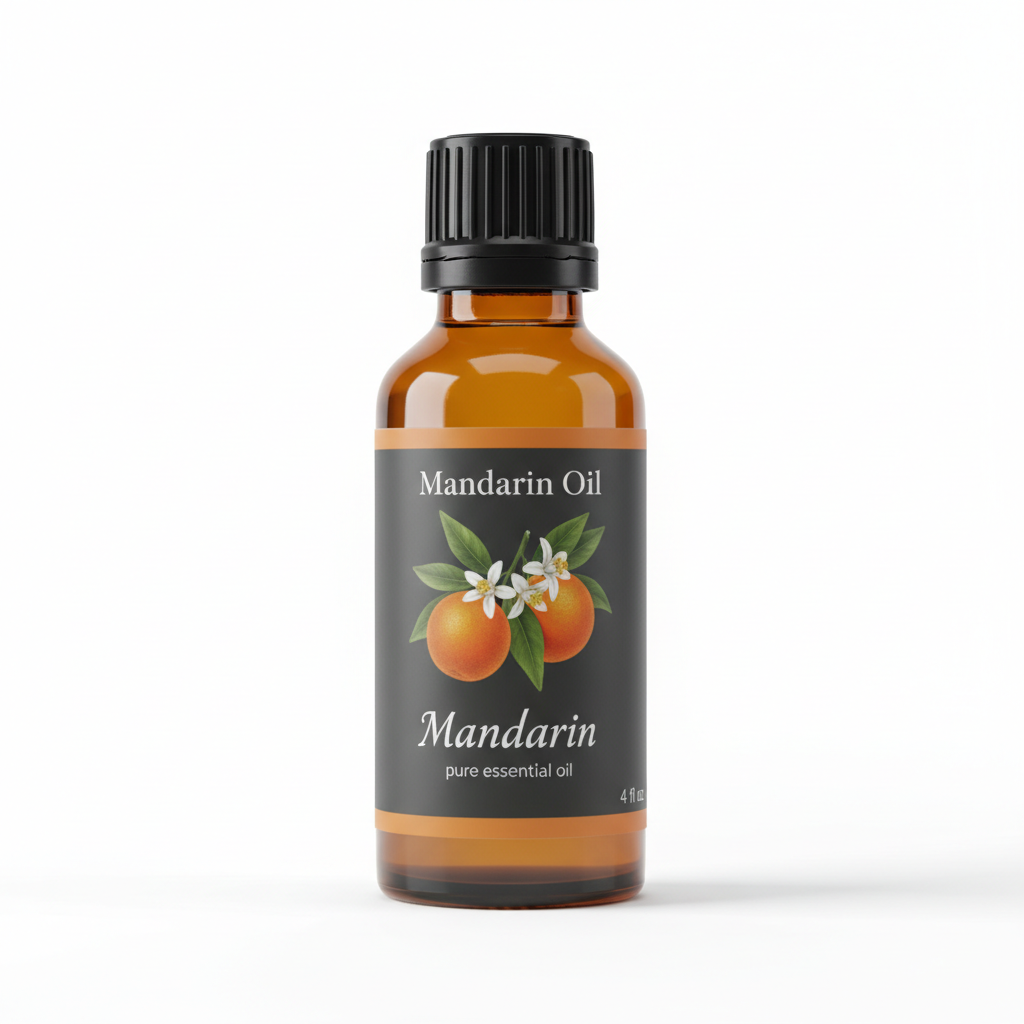
Mandarin Essential Oil
Our own Mandarin Essential Oil, in sizes from 0.5 oz to bulk.
From $12.99
Shop Now →Check the date and the lot first
The posted COA is for batch MANLUCCRBRC003A and prints a best-by date of 11/14/2025. As of late October 2026 that date is past. A COA describes one batch. Whether the oil in a bottle you are about to receive matches this sheet is something the sheet cannot say, so ask for the COA of the lot actually shipping, in writing, with the lot code that will be on your container. Do not try to decode the batch code: the sheet does not explain it, and letters in a code are not evidence of anything. Our label-reading guide covers the wording on bottles; this article covers the certificate.
The sheet, line by line
| Line on the COA | Printed result | What it measures | What it cannot tell you |
|---|---|---|---|
| Botanical name, parts used, extraction | Citrus reticulata; peel; cold pressed | A declaration by the issuer, not a measurement | The sheet does not say any test sits behind these three lines |
| Appearance | Green liquid | Color and clarity by eye | Composition. The EFSA panel describes expressed green mandarin oil as green to green-brown and red mandarin oil as orange to red-amber, so color is a type label, not a quality grade |
| Smell | Unique aroma of mandarin | A sniff test | Anything a nose cannot catch, and no panel size or method is stated |
| Relative density at 20 C | 0.852 | Mass of the oil against water at the same temperature | Which compounds produce that mass |
| Refractive index at 20 C | 1.471 | How strongly light bends in the liquid | The same blind spot: different mixtures can bend light alike |
| Optical rotation at 20 C | +69.80 degrees | How far the oil turns polarized light, driven mostly by the handedness of its terpenes | Which terpenes; and without a tube length the number is incomplete |
The sheet names no laboratory, no test method and no test date, and it does not say which pharmacopoeia its conclusion refers to: it states that all tested parameters comply with "pharmacopoeia standards" for mandarin oil. The standard methods for the three constants do exist. Pl@ntUse lists ISO 279 (relative density at 20 C), ISO 280 (refractive index) and ISO 592 (optical rotation) as the ISO methods for essential-oil properties. Whether the lab on our sheet followed them is not stated on the sheet.
What the three constants are good for
A buyer gets two uses from them. The first is conversion. A relative density of 0.852 means 1 ml weighs about 0.852 g, so one ounce (29.57 ml) is about 25.2 g and a pound (453.6 g) is about 532 ml, or 18 fluid ounces. That is the arithmetic that lets you buy by the ounce and formulate by the gram, and it only holds for the batch measured. The second is a consistency screen: if a later lot reads far from these numbers, something changed. The printed windows are narrow. The density window runs 0.847 to 0.853, six thousandths wide, and 0.852 sits one thousandth below its top. The refractive index window runs 1.470 to 1.477 and 1.471 sits one thousandth above its bottom. Close to an edge is not a defect, but it tells you how little room the batch had.
The limit is that three bulk properties can be matched by more than one mixture. They are checks that a sample behaves like mandarin oil, not that it is made only of mandarin oil. I did not find a fetched source that quantifies how well any of the three detects a specific adulterant, so I make no such claim in either direction.
The optical rotation number needs its tube
Rotation grows with the length of liquid the light travels through, so a figure like +69.80 degrees means one thing in a 1 dm tube and something ten times smaller in a 0.1 dm cell. An instrument maker's summary of the European Pharmacopoeia revision (Rudolph Research) says the revised essential-oil monographs require measurement in a 0.1 dm cell from April 2022 for oils destined for the European market; that is a trade summary, not the monograph. Our sheet gives neither tube length nor monograph. So when you read any COA, ask which path length produced the rotation and which monograph's limits apply, because a rotation compared against the wrong window will look wrong or look right by accident.
What a GC-MS report adds, and a COA like ours does not
Gas chromatography separates the oil into its compounds and mass spectrometry names them. In the EFSA panel's work on ten batches of mandarin oil, up to 88 constituents were detected and 47 identified, covering about 99.7 percent of peak area, and the document notes that GC-MS underestimates d-limonene. A GC report is where limonene, gamma-terpinene and methyl N-methylanthranilate would show up with their shares; see our composition article for what six studies found. Research on authenticity goes beyond percentages: Cannizzaro et al. (2025) profiled the chiral distribution and carbon isotope ratios of compounds in 63 authentic mandarin oils and saw seasonal and geographic trends. That is laboratory work no certificate of three constants approximates.
Our COA contains no GC-MS data, no constituent percentages, no origin, no flash point, no allergen data and no residue data, and we do not publish a safety data sheet or an IFRA certificate. If you need any of them, ask in writing before you order and get the answer in writing; do not assume a document exists because the site discusses the subject.
What an SDS is, and what it is not
A safety data sheet is a hazard-communication document with 16 sections. In OSHA's quick card, the Hazard Communication Standard requires chemical manufacturers, distributors or importers to provide SDSs for hazardous chemical products; Section 3 covers composition, Section 9 the chemical's physical characteristics, and OSHA does not enforce Sections 12 to 15. An SDS is a workplace document. Whether a particular seller must issue one for a particular sale is a question for a regulatory consultant, not for a product page.
What to write in the order email
- The COA for the lot that will ship, with the lot code and its best-by date.
- The test method for each constant and the optical-rotation path length.
- If you need composition: a GC report for that lot, naming the method and listing the minor compounds, not limonene alone.
- If you sell a finished product: an SDS and an IFRA statement naming the Amendment number, covered in the IFRA article.
Ask for each item by name and keep the reply with your batch records. If you are ordering larger quantities, the bulk buyer's guide covers sizes, samples and the wholesale form. The posted COA is a starting point for that conversation, not the end of it.
Mandarin Essential Oil
Mandarin Essential Oil from our own shop, in sizes from 0.5 oz to bulk.
From $12.99
Shop Now →Sources & Further Reading
- EFSA FEEDAP Panel, 2021. Safety and efficacy of mandarin oil (Citrus reticulata Blanco), EFSA Journal 19(6):e06625. pmc.ncbi.nlm.nih.gov/PMC8190682
- Pl@ntUse, PROSEA. Physical properties of essential oils (lists ISO 279, 280, 592). plantuse.plantnet.org
- Rudolph Research Analytical. European Pharmacopoeia essential oils (trade summary of the 0.1 dm cell change). rudolphresearch.com
- Cannizzaro F. et al., 2025. Comprehensive analysis of mandarin essential oils, J Chromatogr A 1754:466026. iris.unime.it/11570/3342437
- OSHA, 2016. Quick Card: Hazard Communication, Safety Data Sheets (OSHA 3493-01R). govinfo.gov/GOVPUB-L35-PURL-gpo127475