
IFRA and Mandarin Oil: What the Standards Do and Don't Say
There is no IFRA usage limit for mandarin oil to quote, and nobody can calculate one for our oil from what we publish. I searched the text of the IFRA Standards through the 51st Amendment, and no standard is titled mandarin oil. Mandarin comes under IFRA in three indirect ways, through limonene, through a compound called methyl N-methylanthranilate, and through the citrus furocoumarin standard. All three depend on composition data we do not publish. This article says what each standard says and what a maker selling product has to get first.
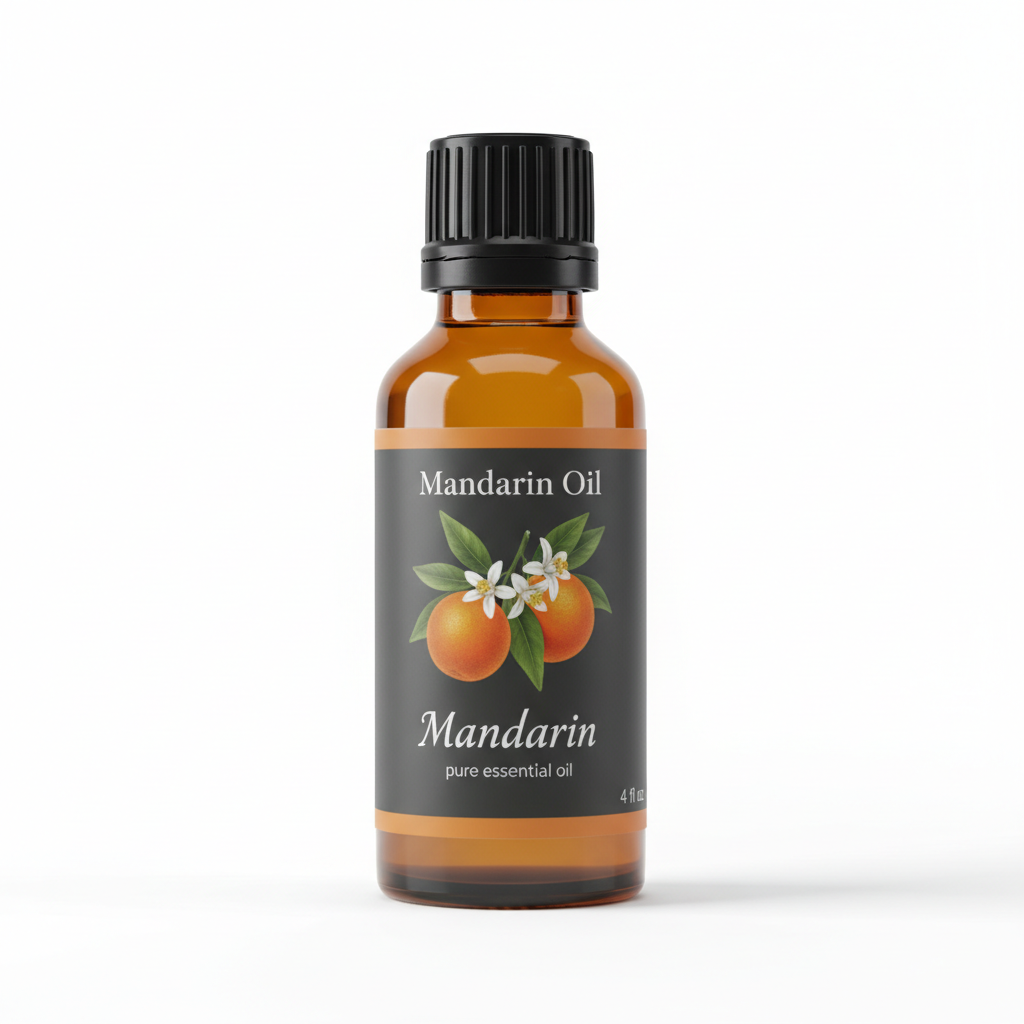
Mandarin Essential Oil
Our own Mandarin Essential Oil, in sizes from 0.5 oz to bulk.
From $12.99
Shop Now →What I could read, and what I could not
I read the complete IFRA Standards, up to and including the 51st Amendment (January 2024), all 726 pages, and IFRA's Guidance for the use of IFRA Standards (30 June 2023). In a text search of that compilation, the word "mandarin" turned up in one place: the citrus standard. I did not open IFRA's separate Annex of typical constituent levels in natural materials, so I cannot say whether mandarin peel oil appears there. IFRA publishes amendments over time and the library may now hold newer text than I read. Treat every figure here as dated, and confirm against the current library before you rely on it.
The three places mandarin touches IFRA
| Standard | Type, date | What it says |
|---|---|---|
| Limonene | Specification, 1995 (Amendment 29) | Oxidation products of limonene, especially hydroperoxides, "have been demonstrated to be potent sensitizers". Limonene and natural products containing substantial amounts of it should be used only when peroxides are kept as low as practical, for instance by adding 0.1% BHT or alpha-tocopherol, with a peroxide value under 20 millimoles per liter by IFRA's method |
| Methyl N-methylanthranilate | Restriction and specification, 2023 (Amendment 51) | Maximum 0.10% in the finished product for Categories 1 to 5 (including 5A body lotion and 5D baby products), 8, 7B, 10B and 11B; 0.50% for Categories 6, 7A, 9 and 10A; no restriction for 11A and 12. Basis: phototoxicity and systemic toxicity. Downstream users must be told of its potential to form nitrosamines in nitrosating systems |
| Citrus oils and other furocoumarin-containing essential oils | Restriction, 2020 (Amendment 49) | Names lemon, lime, bergamot, bitter orange and grapefruit expressed oils among those needing restriction. Lists petitgrain mandarin oil and tangerine oil cold pressed at a typical 50 ppm of phototoxic furocoumarins, "not high enough to require special restrictions if used alone", with the sum rule when combined with others and a 15 ppm bergapten ceiling for UV-exposed skin |
Sources: IFRA Standards 51st Amendment compilation, 2024 (limonene, p. 481; methyl N-methylanthranilate, p. 284) and IFRA STD 089 (citrus oils). The citrus standard does not list a plain mandarin oil entry, and the nearest named entry is tangerine oil cold pressed. Whether a supplier files a given mandarin peel oil under that entry is for the supplier to document, not for me to assume.
How a limit is actually computed
IFRA limits are expressed as a maximum acceptable concentration of the ingredient in the finished consumer product. The Guidance works one example: a fragrance mixture used in fine fragrance at 20 percent, a natural ingredient containing 8 percent of a restricted compound, a category limit for that compound, and the arithmetic that follows. It also says that if the company holds analytical data for the specific lot of a natural material, that data should be used instead of IFRA's typical levels. The calculation needs two inputs: the share of the restricted compound in the oil, and the category the product falls in.
Here is that calculation with borrowed numbers. The EFSA panel found methyl N-methylanthranilate in ten mandarin oil batches at a mean of 1.04 percent, with a range of 0.51 to 1.59 percent (see the composition article). That is a different material from our oil, so this is an illustration of the method and not a number for us. For a product limited to 0.10 percent, the oil can make up 0.10 divided by 1.59, about 6.3 percent of the product at the top of that range, 9.6 percent at the mean and 19.6 percent at the bottom. At 2 percent oil, a body lotion would carry between 0.010 and 0.032 percent of the compound. Same oil share, a threefold swing, entirely from composition. Without the lot's number, you cannot know where you sit.
Where the shop's 0.5 to 2 percent fits
Our own safety copy says to dilute to 0.5 to 2 percent in a carrier oil, roughly 3 to 12 drops per ounce of carrier. At about 0.0426 g a drop (0.852 g per ml, about 20 drops per ml), 12 drops is 0.51 g in 25.2 g of carrier, which is roughly 2 percent (the carrier's own density shifts it a little). That is a skin-dilution rule for a home user. It is not an IFRA calculation, and it was not derived from one. The shop's dilution range and a compliance limit answer different questions.
The categories, and the two compliance questions that sit beside IFRA
The Guidance's category table places body lotion, applied by the palms and primarily left on, in Category 5A, face moisturizer in 5B, hand cream in 5C, and baby creams, baby oils and baby talc in 5D. Products applied with fingertips are Category 3, fine fragrance is Category 4, rinse-off body and hand products are Category 9, and household care products are Category 10. Since the 49th Amendment there are twelve numbered categories, some with sub-letters. A product that straddles two uses is assigned the more restrictive one.
Two other regimes matter for sellers. In the European Union, fragrance allergens must be declared once present above 0.001 percent in leave-on products and 0.01 percent in rinse-off products, Regulation 2023/1545 expands the list, and Austria's food-safety agency AGES gives 31 July 2026 for new products and 31 July 2028 for those already on the market. Limonene is on the list. Using the EFSA mean of 65.63 percent as an illustration only, a leave-on product reaches the 0.001 percent threshold at about 0.0015 percent oil, a fraction of a drop in 100 g. At 0.5 percent oil the limonene is roughly 330 times the threshold. In the United States, FDA's MoCRA page requires a responsible person to hold safety substantiation records, lists fragrance allergen labeling as a requirement FDA must still establish by regulation, and exempts certain small businesses from some duties without stating the threshold on that page. FDA also decides on intended use: its aromatherapy page treats a product meant only to cleanse or beautify as a cosmetic and claims such as easing pain or relieving anxiety as drug claims.
What a maker needs in writing before selling anything
- A GC report for the lot, naming the method, with methyl N-methylanthranilate, limonene and the allergen-list compounds quantified.
- A furocoumarin or bergapten figure for the lot, if the product is leave-on on skin exposed to light.
- A peroxide value with its date, since the limonene standard sets 20 millimoles per liter as its ceiling and the number changes as the oil ages.
- An IFRA statement that names the Amendment number, so you know which limits it was calculated against.
We publish none of these. Our COA, which the COA reading guide goes through, gives appearance, smell, relative density, refractive index and rotation for one batch. Ask in writing before you order and keep the reply. Then bring the documents to a regulatory consultant or cosmetic chemist, who can compute your limits for your formula, your categories and your markets. That is professional judgment this article cannot replace.
If you are making one batch for yourself and not selling it, IFRA's limits are a useful picture of the risks and not an obligation on you; start from the safety basics and the lotion formulation worked example. For purchasing sizes and samples, see the bulk buyer's guide.
Mandarin Essential Oil
Mandarin Essential Oil from our own shop, in sizes from 0.5 oz to bulk.
From $12.99
Shop Now →Sources & Further Reading
- IFRA, 2024. The complete IFRA Standards, up to and including the 51st Amendment (January 2024): Limonene (1995), Methyl N-methylanthranilate (2023). ifra-standards-51st-amendment.pdf
- IFRA, 2020. IFRA Standard: Citrus oils and other furocoumarins containing essential oils (Amendment 49). IFRA_STD_089.pdf
- IFRA, 2023. Guidance for the use of IFRA Standards, 30 June 2023. ifra-51st-amendment-guidance-for-the-use-of-ifra-standards.pdf
- EFSA FEEDAP Panel, 2021. Mandarin oil (Citrus reticulata Blanco) composition data, EFSA Journal 19(6):e06625. pmc.ncbi.nlm.nih.gov/PMC8190682
- AGES (Austrian Agency for Health and Food Safety). New fragrance regulation in cosmetics. ages.at
- FDA. Modernization of Cosmetics Regulation Act of 2022 (MoCRA). fda.gov/MoCRA
- FDA. Aromatherapy (cosmetic or drug by intended use). fda.gov/aromatherapy