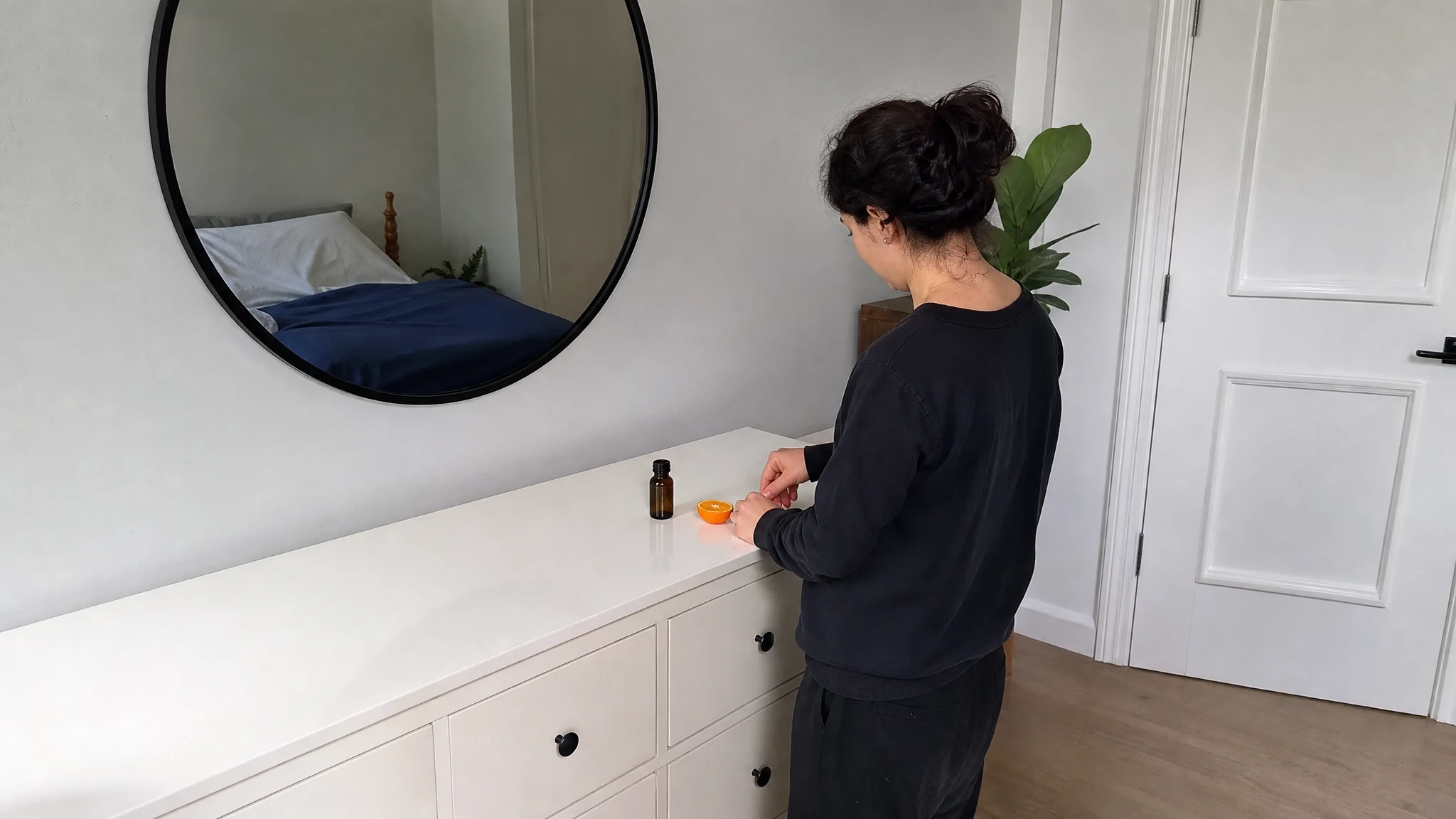
Mandarin Roller Bottle Blends: Drops, Grams, and Three Ratios
A 10 ml roller at 1% needs two drops of mandarin oil, and that is the whole problem: at this scale a dropper is too coarse a tool. A roller bottle is also a leave-on skin product, so the arithmetic matters more than the blend names. Here is the arithmetic first, then three ratio ideas. We have not made any of them, and you should treat them as formulations on paper.
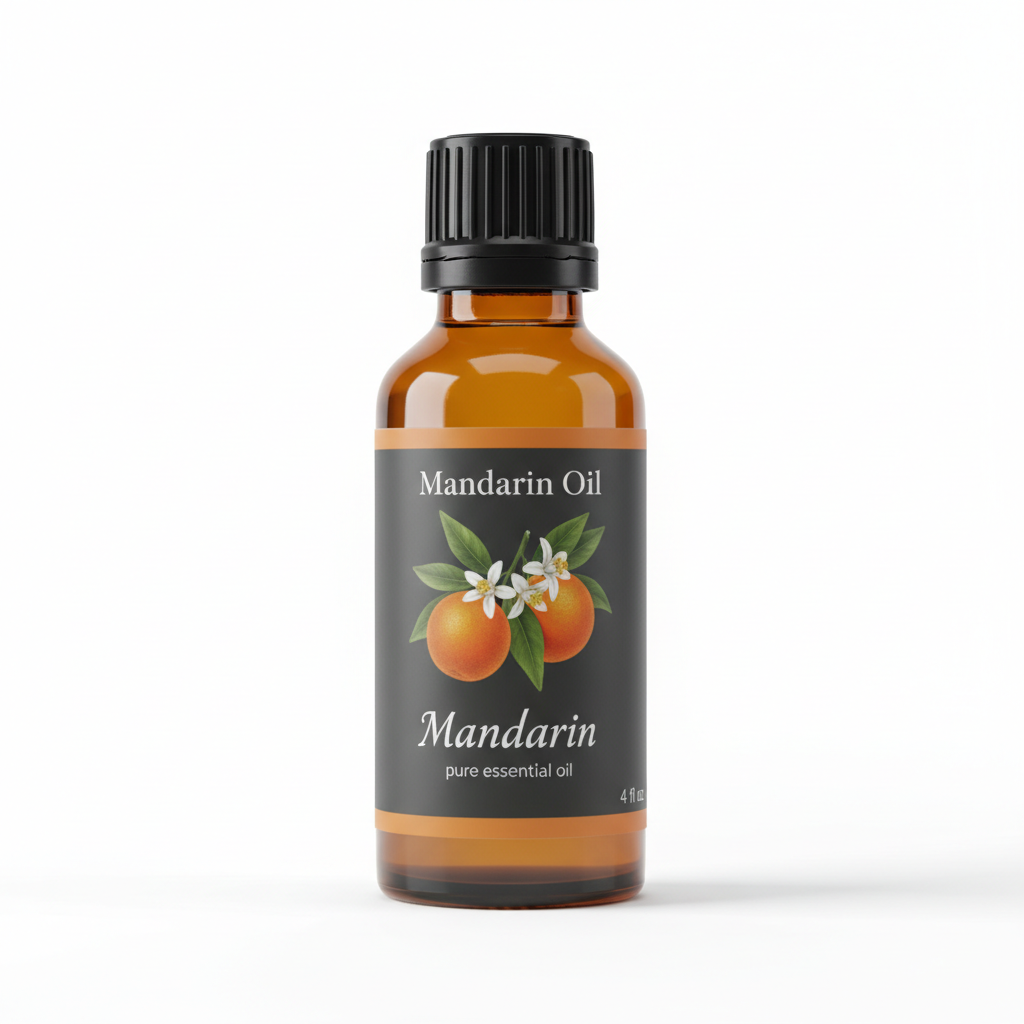
Mandarin Essential Oil
Our own Mandarin Essential Oil, in sizes from 0.5 oz to bulk.
From $12.99
Shop Now →The conversion, with the rounding problem stated
Our shop sells mandarin oil in ounces, from 0.5 oz up, and rollers are commonly 10 ml, so the unit change is yours to do. With about 20 drops per ml (droppers vary) and a relative density of 0.852 from the batch on the COA we publish, 10 ml of carrier at each share of our stated 0.5% to 2% range works out as follows.
| Share | Oil by volume | Drops | Oil by weight |
|---|---|---|---|
| 0.5% | 0.05 ml | 1 | about 0.04 g |
| 1% | 0.10 ml | 2 | about 0.09 g |
| 2% | 0.20 ml | 4 | about 0.17 g |
Look at the first row: one drop is the whole target, and the next step up is two drops, which is 1%. Whole drops move the share in jumps of 0.5% at this size, so you cannot land on 0.7% or 1.5% at all. A dropper that gives 30 drops per ml instead of 20 is a second error: two of its drops are 0.067 ml, or 0.67% of 10 ml, a third under the 1% you meant. Two workarounds follow from the arithmetic. Make a bigger batch and fill the roller from it: in one ounce of carrier (29.57 ml) a single drop moves the share by only about 0.17%, so 1% is 6 drops (about 0.3 ml, 0.25 g) and 2% is 12. And weigh the oil, which removes the dropper error: 0.25 g is readable on a scale that reads to 0.01 g. A 1 oz batch fills two 10 ml rollers and most of a third.
For any other size the sum is the same: batch volume in ml, times the share (1% is 0.01), gives ml of oil; times 20 gives drops; times 0.852 gives grams. A 5 ml sample roller at 1% needs 0.05 ml of oil, which is one drop, so a batch of that size is not worth counting at all.
Why we hold the low end
Robert Tisserand's dilution guide lists "pain and 'feel good' rollerballs" at 3% to 10% and notes the range assumes use on a small area of skin; it also suggests putting oil on clothing, or using a jewellery diffuser, if skin is sensitive (Tisserand Institute, undated). In drops per 10 ml that is 6 to 20 drops, three to ten times the top of our own range. We do not adopt it. Our copy says 0.5% to 2% in a carrier, a patch test first, and the low end if you are new to citrus oils, and our oil's contents beyond the COA are undisclosed, with no IFRA certificate or allergen declaration published, so no outside limit can be calculated for it. A roller is also a product that stays on the skin. The limonene in citrus oils forms hydroperoxides on contact with air, and a dermatologist's summary says these are much stronger sensitisers than limonene and that about 10% of people tested for suspected contact dermatitis reacted to them (DermNet, Coulson, 2021). That is a clinic population, not everyone. A single case report describes a roll-on product that had darkened when left open and a man who tested positive to limonene hydroperoxides (Kwong and Lim, 2020); it is one patient and gives no frequency. The practical rule is the shop's: buy small, reorder often, cap the bottle, keep it cool and dark.
Three ratios, by drops of the total oil
These are ratios for a 1 oz batch at 1% total essential oil, which is 6 drops in all. The mandarin oil is therefore at or below 1%. Our oil is only one of the ingredients; the other oils come from other suppliers, we do not sell them, and each has its own limits that we have not verified, so read your seller's guidance for each. Weigh instead of counting where you can.
- Mandarin and lavender: 4 drops mandarin, 2 drops lavender. A pairing the shop names; lavender is a different supplier's product.
- Mandarin and frankincense: 4 drops mandarin, 2 drops frankincense. Check the species and extraction your seller lists, since the name covers several.
- Mandarin, neroli and vanilla: 3 drops mandarin, 2 drops neroli, 1 drop vanilla. Vanilla is sold as an absolute, an extract or a CO2 product in different strengths, so ask the seller what it is before you count a drop of it.
We have left bergamot out of the recipes even though the shop lists it as a blend partner, because we have not read an authority on leave-on use of a cold-pressed citrus oil other than our own, and a roller combines the two things we are least able to vouch for: leave-on skin contact and citrus. For the broader pairing list, see What Blends Well with Mandarin Oil.
Filling and keeping the roller
Use a glass roller bottle, preferably amber, since the shop sells its oil in amber glass and its bulk page says sunlight and heat speed oxidation. For the carrier see our carrier oil guide. On plastic: we did not find a fetched source that tests limonene against the roller ball or cap materials, so this is reasoning only: citrus oils are strong solvents and some plastics may soften or swell. Ask the supplier which resin the ball and cap are made of and whether it suits citrus oil, and look at the cap after a week. Mix the oil into the carrier in a clean glass cup, pour through a small funnel, push the ball in, cap it, and write the date and the percentage on the label.
Patch test, then wear
Where you apply it is part of the decision. Tisserand's range for rollers assumes a small patch of skin, so a roller dragged across a whole forearm or neck is a larger exposure than the number implies. Keep the first use to one small spot, away from the face and from any skin that is broken or already irritated.
Patch test the finished roller, not just the oil. The steps are in Mandarin Oil Safety Basics; do them on the inner forearm and leave the roller aside until they are done. Keep the roller away from eyes, children and pets, as our copy says. For a solid format of the same idea, the solid perfume balm post is separate, and we do not repeat it here. We make no claim that a roller does anything for mood, sleep or any other condition, and we do not list one.
Make the batch bigger than the bottle, weigh the oil, stay at the low end for the first batch, and date the label. A roller is a small thing to make and an easy one to overdo.
Mandarin Essential Oil
Mandarin Essential Oil from our own shop, in sizes from 0.5 oz to bulk.
From $12.99
Shop Now →Sources & Further Reading
- Tisserand R. Dilution for essential oils. Tisserand Institute. tisserandinstitute.org/dilution-essential-oils
- Coulson I, 2021. Contact allergy to limonene and linalool. DermNet. dermnetnz.org
- Kwong HL, Lim SPR, 2020. Pigmented contact dermatitis in the axillae caused by hydroperoxides of limonene. JAAD Case Reports 6(6):476-478. pmc.ncbi.nlm.nih.gov/articles/PMC7256231