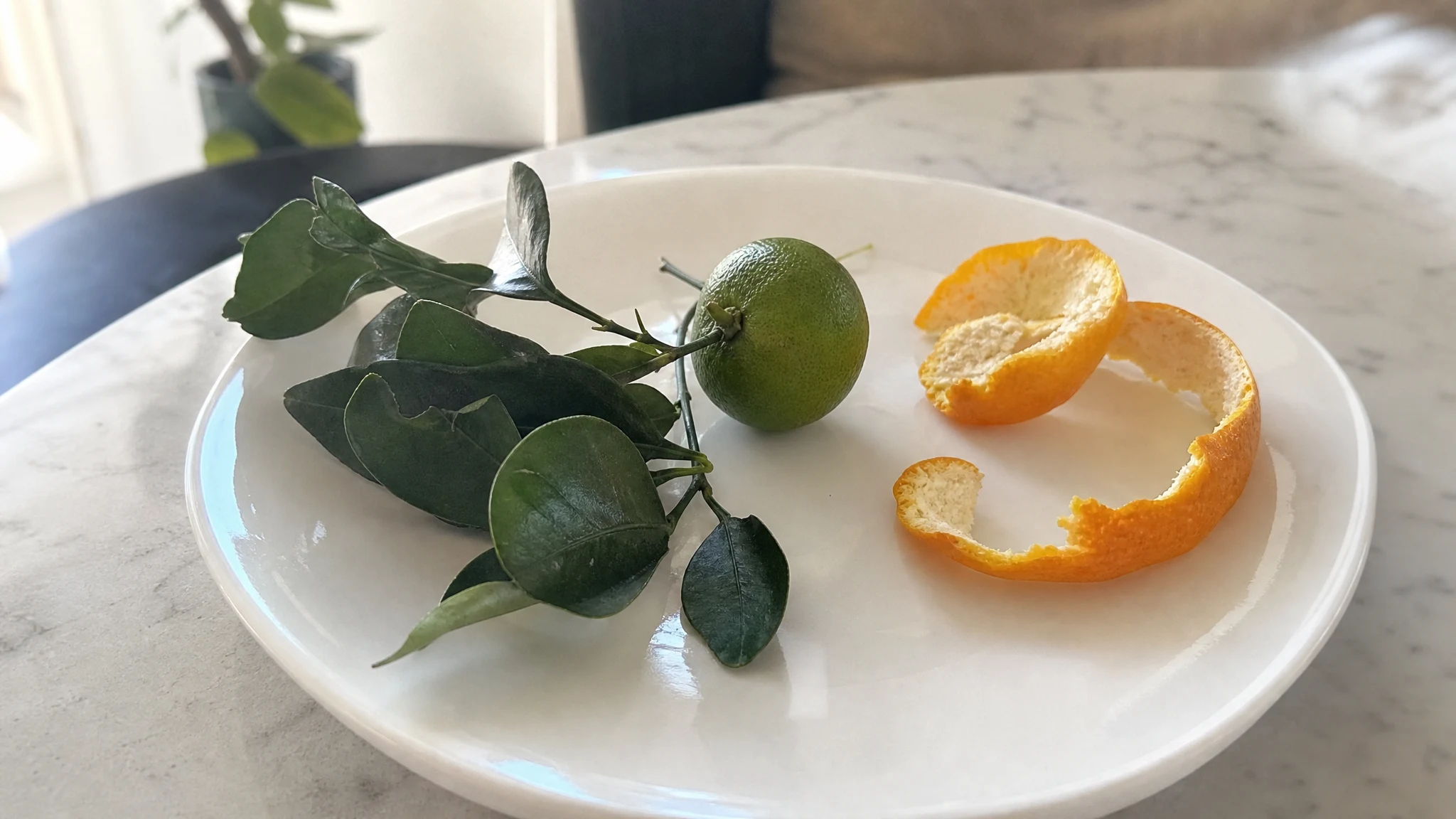
Mandarin Petitgrain vs Mandarin Peel Oil: Leaf or Fruit?
Three different materials get called "mandarin oil," and only one of them comes from the fruit. Mandarin peel oil is pressed from the rind; mandarin petitgrain is distilled from leaves and twigs; and a third, less common product is peel that has been distilled instead of pressed. The mandarin oil we sell is the first: the certificate of analysis we publish says parts used "Peel" and extraction "Cold Pressed," and we do not sell petitgrain.
Mandarin Essential Oil
Our own Mandarin Essential Oil, in sizes from 0.5 oz to bulk.
From $12.99
Shop Now →Read the label in this order
Two words on a bottle settle it: the plant part and the method. The table sets out what the sources we read say about each.
| Material | Part and method | What studies report as the main constituents |
|---|---|---|
| Mandarin peel oil, cold pressed | Rind, expressed mechanically | Limonene dominant: 74.9% with 9.7% gamma-terpinene in one Ponkan sample (Lu et al., 2019); 76.6% to 96.2% limonene across seven Turkish cultivars (Golukcu et al., 2025) |
| Mandarin peel oil, distilled | Rind, hydrodistilled | Same hydrocarbons: 68.2% limonene and 9.7% gamma-terpinene in the Ponkan hydrodistilled oil; limonene was not significantly different between pressed and distilled in either study |
| Mandarin petitgrain | Leaves and twigs, steam or hydrodistilled | Varies by tree: methyl N-methylanthranilate (MMA) is the named major component of petitgrain oils, but some leaf oils are led by linalool, sabinene or gamma-terpinene instead |
The middle row matters for buyers: "distilled mandarin" can mean peel or leaf, so the plant part has to be on the label too. Our companion posts cover the production side, how pressing is done and pressed versus steam-distilled; this page is about the leaf.
What the leaf studies actually found
The cleanest statement of the confusion is in a 2010 paper by Kasali and colleagues in Records of Natural Products, who hydrodistilled leaf oils from six Citrus reticulata cultivars grown in Nigeria and identified 57 constituents, 88.2% to 96.7% of each oil. Their introduction records two things we would otherwise have stated from memory. Mandarin petitgrain oils are known to contain MMA as the major component, valued because the compound "does not discolor or form condensation products in the presence of aldehydes." And attempts to make petitgrain by distilling mandarin leaves and twigs "occasionally resulted in essential oils without a trace" of MMA. The same paper summarises an earlier survey in which leaf oils fell into three chemotypes (sabinene and linalool; linalool and gamma-terpinene; MMA) while peel oils fell into two (limonene; limonene and gamma-terpinene). We have not read that earlier survey, so we report it only as Kasali's summary of it. In their own Nigerian oils, sabinene, gamma-terpinene, p-cymene, delta-3-carene and (E)-beta-ocimene varied most.
A 2021 Brazilian study in the Journal of Essential Oil Research (Sulzbach et al.) distilled leaves of seven citrus cultivars by steam and by hydrodistillation. Its abstract reports higher MMA and gamma-terpinene in the C. deliciosa mandarins and linalool and terpinen-4-ol predominating in Ponkan, 'URSBRS Hada' and Murcott, and concludes that extraction method mainly affected compound contents while genetics drove composition. The extreme case in the literature is a single leaf oil analysed by Elkousy and colleagues (2022): 89.93% MMA, 6.25% gamma-terpinene and 1.35% limonene. That was one oil from one lab, in a paper about a microbial assay, and we cite it only for its composition table.
The practical reading, as reasoning: "petitgrain mandarin" is a trade name for a type of oil, not a guaranteed chemistry. Two bottles carrying the name can differ a great deal, which is why a standards body publishes a method just to measure the marker. The AFNOR catalogue lists NF T75-421 (January 1988), a gas-chromatographic method for determining MMA in mandarin petitgrain oil. If MMA is why you want petitgrain, ask for the measured value on the lot.
Where peel oil and petitgrain part ways
- Chemical family. Peel oil is mostly terpene hydrocarbons; petitgrain, where MMA is high, is dominated by one ester with a nitrogen in it. They are not diluted versions of each other.
- Furocoumarins. IFRA's furocoumarin standard (Amendment 49, 2020) lists "Petitgrain Mandarin oil (50 ppm)" and "Tangerine oil cold pressed (50 ppm)" as oils with small amounts of phototoxic furocoumarins, "not high enough to require special restrictions if used alone." It does not name cold-pressed mandarin peel oil either way. Our certificate carries no furocoumarin figure, so for sun-exposed leave-on products ask for one in writing.
- Standards. ISO 3528:2012 (published July 2012, current in the AFNOR catalogue) specifies "Essential oil of mandarin, Italian type (Citrus reticulata Blanco)." It is a peel-oil specification for the Italian type, and we have not read its text. Nothing on our certificate says our oil is Italian type, and we state no origin.
- Naming. Under the species name Citrus reticulata Blanco, the Wu et al. genomic study in Nature (2018) identifies mandarin as one of three ancestral citrus species. Both leaf and peel come from the same species group, which is part of why the names collide.
What our certificate can and cannot settle
The certificate for the batch we published reports appearance, smell, relative density 0.852, refractive index 1.471 and optical rotation, and states peel and cold pressed. Those are the producer's declarations of part and method. We found no leaf-oil values for those three constants in the sources we read, so we cannot claim the constants tell peel from leaf, and the certificate contains no constituent data (no limonene, no MMA). Someone who must prove which part an oil came from should ask in writing for gas-chromatography data for the lot and a statement of botanical part, and not rely on the three constants.
That also covers the claim in the opposite direction. We do not state that our oil contains any petitgrain or any MMA. For what scent to expect, see our scent profile, and for the planned composition write-up see mandarin oil chemical composition.
Buying petitgrain, if the leaf is what you want
We do not sell petitgrain; a perfumery or aromatherapy supplier does. Ask for the plant part (leaf, or leaf and twig), the method, the botanical name and cultivar if known, an MMA figure by GC for the lot, and the IFRA amendment its documents cite. Treat a missing MMA figure as missing information, not as a pass or a fail. We have not tested any petitgrain, and nothing here is a statement about its scent or performance.
Mandarin Essential Oil
Mandarin Essential Oil from our own shop, in sizes from 0.5 oz to bulk.
From $12.99
Shop Now →Sources & Further Reading
- Kasali A.A. et al., 2010. Citrus Essential Oils of Nigeria Part IV: leaf oils of mandarins (Citrus reticulata Blanco) from Nigeria. Rec Nat Prod 4:156. acgpubs.org/RNP-0907-130
- Sulzbach M. et al., 2021. Effect of distillation methods on the leaf essential oil of some Citrus cultivars. J Essent Oil Res 33:452. repositorio.unesp.br
- Elkousy R.H. et al., 2022. GC/MS analysis and potential synergistic effect of mandarin and marjoram oils on Helicobacter pylori. J Enzyme Inhib Med Chem 37:1610. pmc.ncbi.nlm.nih.gov/PMC9176704
- Lu Q. et al., 2019. Peel oils from three Citrus species. J Food Sci Technol 56:4492. pmc.ncbi.nlm.nih.gov/PMC6801276
- Golukcu M., Bozova B., Giuffre A.M., 2025. Peel essential oils of mandarin cultivars grown in Turkiye. AIMS Agriculture and Food 10(3):679. aimspress.com/agrfood-10-03-034
- IFRA, 2020. Standard: Citrus oils and other furocoumarins containing essential oils, Amendment 49. ifrafragrance.org/IFRA_STD_089
- AFNOR catalogue, ISO 3528:2012, Essential oil of mandarin, Italian type. boutique.afnor.org/ISO-3528
- AFNOR catalogue, NF T75-421:1988, Oil of mandarin petitgrain, determination of methyl N-methylanthranilate. boutique.afnor.org/NF-T75-421
- Wu G.A. et al., 2018. Genomics of the origin and evolution of Citrus. Nature 554:311. nature.com/nature25447