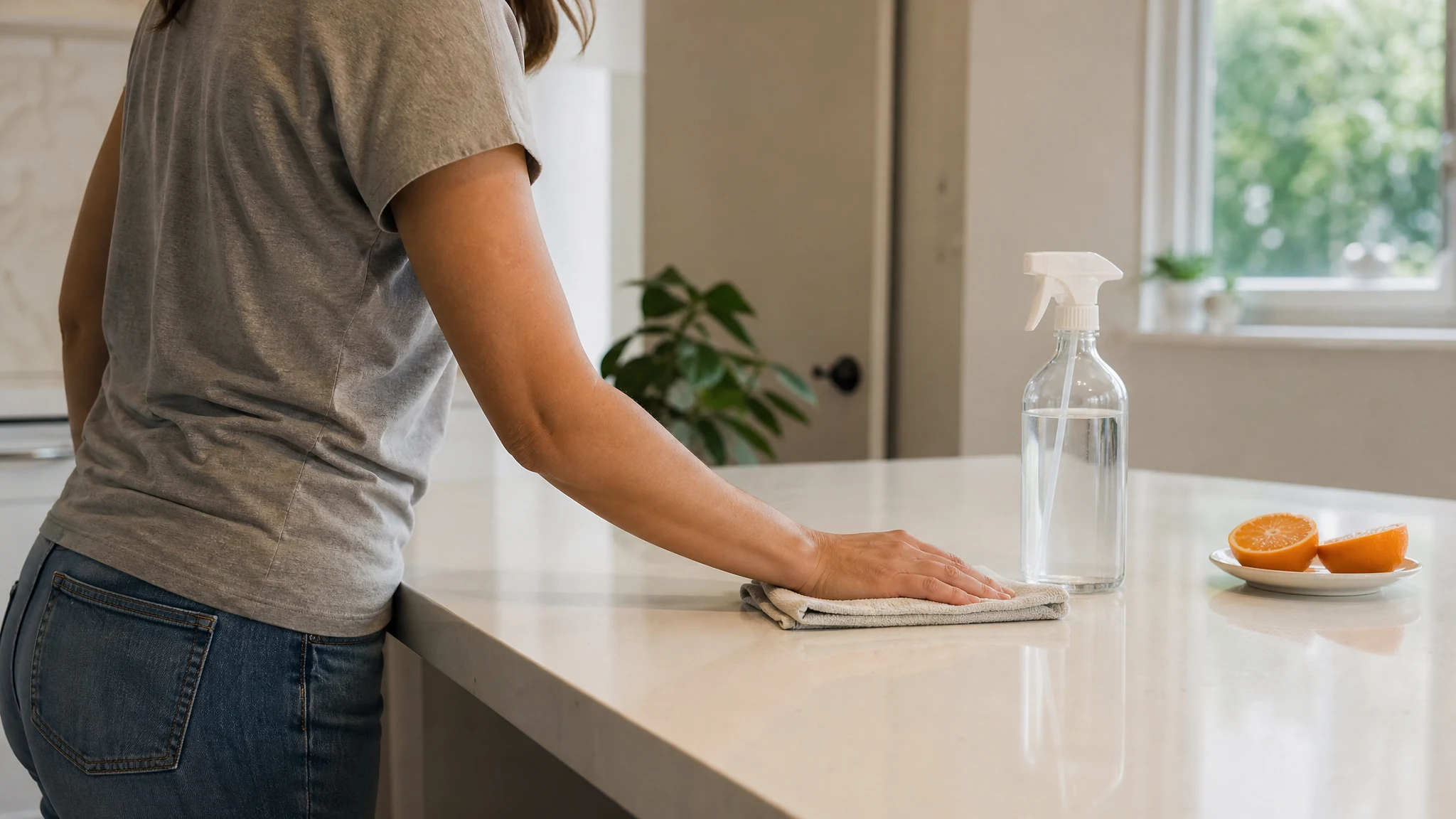
Mandarin Oil Cleaning Spray: Arithmetic, Surfaces, and Limits
Mandarin peel oil is a hydrocarbon-rich citrus oil, and the one cleaning-related thing it can plausibly do is dissolve grease the way other citrus oils do. It is not a disinfectant, it does not replace soap, and we make no cleaning claim for it. What follows is a spray worked out on paper for people who want a citrus-scented surface cleaner and want the arithmetic and the warnings before they start.
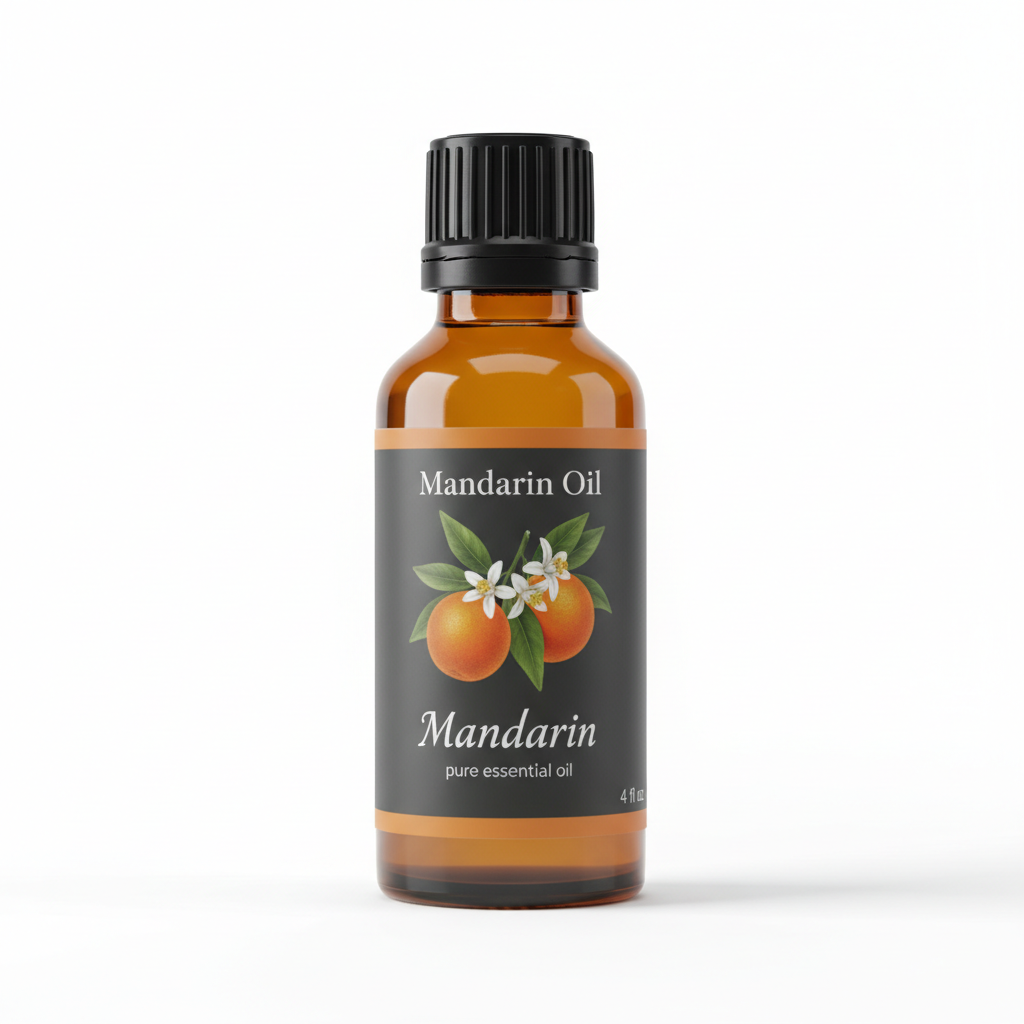
Mandarin Essential Oil
Our own Mandarin Essential Oil, in sizes from 0.5 oz to bulk.
From $12.99
Shop Now →What the oil can and cannot do in a spray bottle
The only mechanism worth naming is solvency. Limonene, the main hydrocarbon in citrus peel oils, is miscible with alcohol (PubChem/HSDB, citing the Merck Index, 2013) and has a listed water solubility of 7.57 mg/L at 25 C (same record, citing Miller and Hawthorne, 2000). A fat-like substance that barely dissolves in water will dissolve other greasy material, which is the usual explanation for citrus degreasers. That record is for limonene as a compound. The batch on the COA we publish has a relative density of 0.852, a refractive index of 1.471 and an optical rotation of +69.80 degrees, and nothing else: no constituent percentages. So how much limonene is in our oil is not something we can state, and the solvent point is an inference from the compound, not a property we have measured.
The same number tells you why a cleaner needs more than oil and water. Put 5 g of oil (about 5.9 ml, roughly 117 drops at 20 drops per ml) into 500 ml of water and you have asked for about 10,000 mg of oil per litre against a listed solubility of about 7.6 mg per litre, roughly 1,300 times over. The excess floats. Without a surfactant you get a slick that lands in blobs on the first spray and nothing on the tenth.
Where we draw the line on claims
In the United States the line between a cleaner and a disinfectant is a regulatory one. An EPA enforcement notice describes products that claimed to be "effective against bacteria such as E. coli" and says products making germ-control claims are treated as pesticides and must be registered, and that public health claims can only be made for products that have been properly tested (EPA, Grocery Outlet enforcement release; the release is undated in the text we read). An essential oil in a spray bottle has no such registration. So the recipe below is a scented grease-and-grime spray for light jobs. If you need a surface to be disinfected (a sickroom, a cutting board after raw meat), use a product whose label carries an EPA registration number for that use, and follow its label.
The spray: three decisions before you mix
We have not made this spray and no one here has tested it. It is a formulation built from the arithmetic above and the cited warnings. Make 100 ml first, spot-test a hidden patch of each surface, and wear gloves if your hands will be wet with it for more than a moment.
- The load. One percent by weight is a sensible first step on paper: it sits in the 0.5% to 2% window our own safety copy gives for skin, which says nothing about cleaners but keeps the number modest. Per bottle size, 1% works out as follows.
| Bottle (water-based mix, about 1 g per ml) | Oil at 1% | Drops (20 per ml) |
|---|---|---|
| 100 ml | 1 g, about 1.2 ml | about 23 |
| 250 ml | 2.5 g, about 2.9 ml | about 59 |
| 500 ml | 5 g, about 5.9 ml | about 117 |
Droppers vary, so weigh: tare the bottle on a kitchen scale and add oil by grams.
- The carrier of the oil. Mix the oil into a small amount of liquid soap or other surfactant first (a teaspoon of an unscented liquid dish soap is the reasoned starting point, not a tested ratio), then add water and shake. We do not sell soap or sprayers; the grocery aisle and the hardware store do. Shake before every use, because this is a loose dispersion and will separate.
- What you leave out. No vinegar, no bleach, no ammonia. The first is a stone problem, the other two are a lung problem.
Surfaces: where it goes wrong
Vinegar and lemon juice are acids, and acids dull polished marble and other calcium-rich stone. A stone-care manufacturer says they damage the shine and leave opaque marks, from matte patches to rough white ones (FILA Solutions, product guidance, a seller of stone-care products). The reason to keep vinegar out of the recipe is therefore stone: a mandarin-scented spray that is acid-free is the one you can test on a countertop corner. For oiled or waxed wood, plastics, and anything with a coating, we found no primary source that tests citrus oil against finishes, so we cut the wood-polish idea the topic called for. Reasoning only: a solvent that dissolves grease can also soften some coatings. Test an inconspicuous spot, wait a day, and look.
Never mix in the same bottle or on the same surface
This is the part to follow exactly. CDC's survey of 502 US adults in May 2020 found that only 35% knew bleach should not be mixed with vinegar and 58% knew it should not be mixed with ammonia, and the report notes that such mixing "can generate chlorine and chloramine gases" that may damage lung tissue when inhaled (CDC MMWR, 2020). The survey was an opt-in internet panel, so the percentages describe those respondents, not the country. The practical rule is plain: if a surface was just cleaned with a bleach product, do not follow it with this spray, and do not add the oil to any cleaner that contains bleach or ammonia.
Old oil in a cleaner
Limonene that has sat open to air forms hydroperoxides, which are much stronger skin sensitisers than fresh limonene, and a dermatologist's summary lists household products such as washing-up liquids and detergents among the places people meet them (DermNet, Coulson, 2021). That summary says about 10% of people tested for suspected contact dermatitis reacted to the hydroperoxides, a clinic population and not the general public. Our own advice on storage is the shop's: buy small, reorder often, keep the bottle tightly capped in a cool, dark place, and decant a working amount. For a cleaner this means mixing a bottle you will use up rather than a litre that sits under the sink. A person with a known fragrance allergy or hand dermatitis should ask a dermatologist before putting any citrus oil in a cleaner.
Where to read next
If your goal is only scent, the room spray recipes cover that, with a different set of trade-offs: see DIY Mandarin Room Spray. For a broader list of what the oil can do around the house, Mandarin Oil Uses is the place, and How to Store Mandarin Oil covers keeping the bottle fresh. Handling the oil on skin while you mix is covered in Mandarin Oil Safety Basics.
Treat the oil here as a scent and a mild solvent for light grime, mixed small and used soon. If you need a clean that has to be germ-free, buy a registered product and read its label.
Mandarin Essential Oil
Mandarin Essential Oil from our own shop, in sizes from 0.5 oz to bulk.
From $12.99
Shop Now →Sources & Further Reading
- NCBI, n.d. PubChem compound record, Limonene (experimental solubility entries citing the Merck Index, 2013, and Miller and Hawthorne, 2000). pubchem.ncbi.nlm.nih.gov/compound/Limonene
- US EPA. EPA enforcement release on Grocery Outlet: products claiming to be "sterilizing" without testing or registration. epa.gov/node/284954
- CDC, 2020. Knowledge and Practices Regarding Safe Household Cleaning and Disinfection for COVID-19 Prevention, United States, May 2020. cdc.gov/mmwr/volumes/69/wr/mm6923e2
- FILA Solutions. Acid etching: vinegar, lemon, cola, wine, limescale removers. filasolutions.com
- Coulson I, 2021. Contact allergy to limonene and linalool. DermNet. dermnetnz.org