Mandarin Oil, Anxiety and Mood: What the Studies Measured
I could not find a human trial of mandarin peel oil on its own that measured anxiety or mood. What exists is a handful of trials where mandarin was one ingredient or one comparison arm, animal studies, and a larger body of trials on other citrus oils. "Uplifting" is a perfumery adjective, not a result, and we use it only for scent. Below is each piece of evidence with its design, size and limits, so you can see how far it goes.
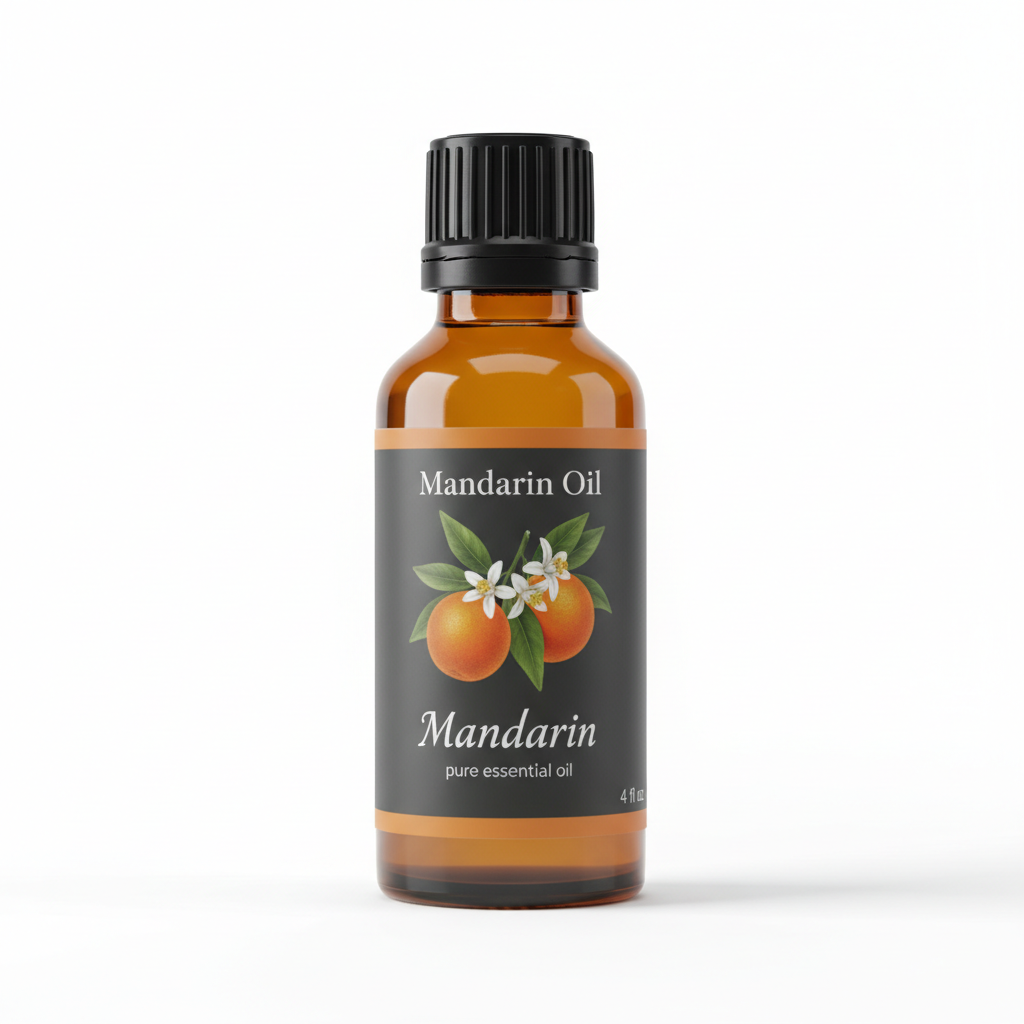
Mandarin Essential Oil
Our own Mandarin Essential Oil, in sizes from 0.5 oz to bulk.
From $12.99
Shop Now →The searches, and what they returned
On 28 October 2026 I ran PubMed searches in titles and abstracts. Mandarin, tangerine or Citrus reticulata with "aromatherapy" returned 14 records. The same three names in the title, with anxiety, mood or relaxation and oil or aroma, returned 5 records, and I read all five: a zebrafish study of mandarin leaf (petitgrain) oil, a zebrafish study of tangerine oil, two mouse studies (one on a variety called Hirami lemon, listed as C. reticulata var. depressa) and a rat EEG study. All five are non-human. A wider human-limited search on the same names with anxiety or mood and aromatherapy, inhalation or olfactory returned 58 records, which I did not review one by one. The human studies below come from the 14-record search. This is a search log, not proof that nothing exists.
What each study did
| Study | Who or what | Oil | Measured | As reported |
|---|---|---|---|---|
| de Jong et al., 2012 | Randomised trial, 60 children aged 3 to 36 months after craniofacial surgery | Mandarin oil in massage vs massage with carrier oil vs usual care | Observer-rated behaviour, pain, distress; heart rate, blood pressure | No significant difference between groups; the authors concluded no benefit was shown |
| Choi and Kim, 2013 | 60 women after laparoscopic hysterectomy (30 per group) | Blend of lavender, mandarin and marjoram, inhaled 5 minutes twice | Psychological and physiological stress, cortisol, sleep, nausea | Psychological stress did not differ; the other outcomes favoured the blend. Mandarin cannot be isolated |
| Johnson et al., 2016 | Retrospective record review, 10,262 admissions, 10 hospitals | Several oils; mandarin was 9.4% of use | Self-rated pain, anxiety, nausea (0 to 10), before and after | Headline results concern lavender, marjoram and ginger; no control group |
| Ueki et al., 2014 | 60 aromatherapy and 61 control mothers waiting during a child's infusion | Yuzu (a different citrus) | State anxiety (STAI) | Lower state anxiety in the diffuser group; authors asked for larger randomised or double-blind trials |
| Lehrner et al., 2005 | 200 dental patients in four groups | Orange and lavender odours, music, no-odour control | Anxiety and mood in the waiting room | Orange and lavender groups reported lower anxiety and better mood than control |
| Tan et al., 2023 | Network meta-analysis, 44 randomised trials, 3,419 patients | Ten oils; the abstract names jasmine, Citrus aurantium, rose, lavender, lemon | State and trait anxiety scores | State anxiety score difference of -6.63 pooled; the abstract does not mention mandarin or report a certainty rating |
Read the top two rows twice. The only trial where mandarin was its own arm, de Jong, used infants, who cannot report how they feel, and found nothing. The authors suggested the massage may have come too soon after general anaesthesia, that young children feared being touched by strangers, and that they were unused to massage. Those are limits of the setting, not proof about adults at home. Choi and Kim's blend result is the opposite problem: some outcomes moved, but three oils were in the bottle and the abstract does not name the design.
The Johnson row deserves one more sentence. Mandarin was the fourth most-used oil in that hospital programme, which tells you hospitals use it. It does not tell you what it did; the abstract's reported effects are for other oils, and there was no comparison group.
The animal and bench studies
These are the studies that mention mandarin by name and anxiety or mood, and none involves a person. A 2021 rat study in Biomedical Journal exposed male Wistar rats to 200 microlitres of a CO2-extracted C. reticulata peel oil (95.7% d-limonene) on cotton wool and recorded brain waves and sleep against water and oral diazepam. Group sizes were 7 to 9 rats. It changed EEG power and REM sleep, but anxiety and mood were not measured. A 2022 zebrafish light-dark test found roman chamomile oil anxiolytic while tangerine oil showed a tendency that was not statistically significant. A 2024 mouse and network-pharmacology study found the whole C. reticulata oil (25 mg/kg intranasal) showed only an antidepressant-like effect, while a five-compound mixture showed both. A 2020 study in Molecules recorded EEG in 20 adults inhaling tangerine oil at four concentrations; the abstract describes no placebo group, and the oil is labelled Citrus tangerina there, so it may not be the same material as ours.
Why these do not transfer: the doses are per kilogram of animal or on cotton wool in a rat cage, the oils were extracted differently (supercritical CO2 in the rat study) and analysed as different materials, and a mouse behaviour test is not a person's worry.
How to read the odour trials, as reasoning
This section is my reasoning, not a cited finding. In every trial above except the animal ones, the person knows whether they smell citrus. A control group that smells nothing, or a different odour, differs in more than the molecule, and the outcome (a self-rated anxiety score) is the kind that responds to expectation. The network meta-analysis pooled 44 trials, but the abstract reports no certainty rating, so I would not read its -6.63 as a size you could expect from a particular bottle. The NCCIH aromatherapy page (updated January 2020) is more cautious than most shops: it describes one study of stressed people in which lemon improved mood while neither lemon nor lavender changed stress indicators.
Where a bottle of mandarin oil fits
We sell the oil for fragrance. Our evening diffuser page and the everyday routines page describe scent use, and our shop copy describes it as sweet and juicy with a faint floral hum. We make no medical claim. FDA's cosmetic or drug page (current as of 11 September 2024) says intended use is read from claims in labelling and advertising, and gives scent that "will help the consumer sleep" as a drug-type claim. Anxiety and mood claims sit in the same territory, which is why you will find none here.
If you are living with anxiety, low mood or trouble sleeping that gets in the way of life, the person to see is a physician or a mental-health clinician, and a scented oil is not a substitute for that conversation. If you are in distress or thinking about harming yourself, the 988 Lifeline says you can call, text or chat 988, that it is available around the clock, and that conversations are free and confidential.
If you simply like the smell, use the usual precautions: dilution, patch test and sun notes are in the safety basics post, and diffuser setup is in the home-use guide. The oil is not for internal use. The shop page has current sizes.
Mandarin Essential Oil
Mandarin Essential Oil from our own shop, in sizes from 0.5 oz to bulk.
From $12.99
Shop Now →Sources & Further Reading
- de Jong M et al., 2012. Does postoperative 'M' technique massage with or without mandarin oil reduce infants' distress after major craniofacial surgery? J Adv Nurs. PMID 22050553
- Choi J, Kim YM, 2013. Effects of aromatherapy on stress, sleep, nausea and vomiting during patient controlled analgesia treatment of patients with hysterectomy. Korean J Women Health Nurs. PMID 37684766
- Johnson JR et al., 2016. The effectiveness of nurse-delivered aromatherapy in an acute care setting. Complement Ther Med. PMID 27062964
- Ueki S et al., 2014. Effectiveness of aromatherapy in decreasing maternal anxiety for a sick child undergoing infusion in a paediatric clinic. Complement Ther Med. PMID 25453522
- Lehrner J et al., 2005. Ambient odors of orange and lavender reduce anxiety and improve mood in a dental office. Physiol Behav. PMID 16095639
- Tan L et al., 2023. Essential oils for treating anxiety: a systematic review of randomized controlled trials and network meta-analysis. Front Public Health. PMID 37325306
- Kwangjai J et al., 2021. Modification of brain waves and sleep parameters by Citrus reticulata Blanco cv. Sai-Nam-Phueng essential oil. Biomed J. PMC8847839
- Silveira V et al., 2022. Anxiolytic effect of Anthemis nobilis L. and Citrus reticulata Blanco essential oils using the light-dark test in zebrafish. J Ethnopharmacol. PMID 35926778
- Antidepressant and anxiolytic potential of Citrus reticulata Blanco essential oil: a network pharmacology and animal model study, 2024. Front Pharmacol. PMID 38567354
- Effects of tangerine essential oil on brain waves, moods, and sleep onset latency, 2020. Molecules. PMID 33096890
- NCCIH, updated January 2020. Aromatherapy. nccih.nih.gov/health/aromatherapy
- US FDA, current as of 11 September 2024. Is it a cosmetic, a drug, or both? (Or is it soap?). fda.gov
- 988 Suicide and Crisis Lifeline. 988lifeline.org