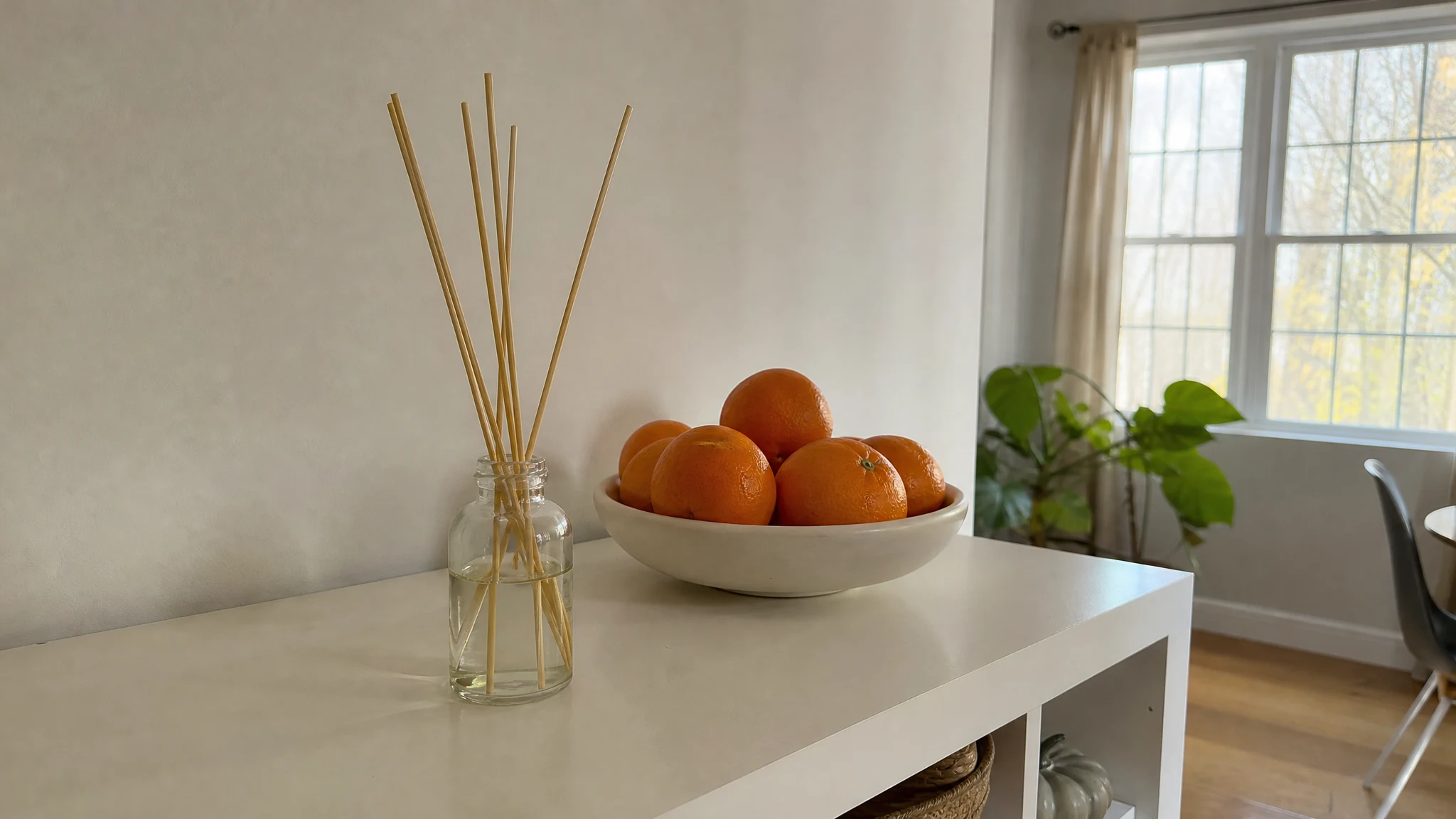
DIY Mandarin Reed Diffuser: Where It Stands, What It Holds
A reed diffuser is a bottle of scented liquid with sticks in it, and the most important decision is where it will stand, not what goes in it. Poison centres across two countries have recorded hundreds of calls about toddlers who drank the liquid. If a child or a pet can reach the shelf, skip this project and use something else. If they cannot, the formula below is a small, worked-out starting point for mandarin oil.
Mandarin Essential Oil
Our own Mandarin Essential Oil, in sizes from 0.5 oz to bulk.
From $12.99
Shop Now →Decide the shelf first
The US poison-centre network says some reed diffuser liquids contain up to 70% isopropyl alcohol, that essential oils in them can cause drowsiness, tremors, seizures, stomach upset and mouth irritation if swallowed, and that its case reports include toddlers admitted to hospital with possible lung inflammation after getting into the oil (America's Poison Centers, undated page). A New Zealand Medical Journal review published in June 2026 counted 94 reed diffuser exposures reported to the national poisons centre in 2019, of which 77 (82%) were children aged 0 to 2, and 600 further calls across 2019 to 2024; it also cites a UK series of 754 exposures where 80% of cases had no symptoms and none were severe (Cressey, NZMJ, 2026). Those figures describe commercial products, not a home mix of mandarin oil, and the reassuring UK result does not make a toddler drinking one a non-event. Our own safety copy says to keep the oil away from eyes, children and pets, and the oil is not for internal use. Put the bottle high, on a surface you would not mind losing finish on, and if a child swallows any liquid, call poison control (1-800-222-1222 in the US) or your local equivalent.
What the liquid is made of
Reed diffuser liquid is a carrier that climbs the reeds plus a scent. We sell only the mandarin oil, so the base is a partner purchase: craft and candle suppliers sell ready-made reed diffuser base, usually a glycol-type solvent, and ask the seller for its safety data sheet before you buy. Two glycol suppliers' sheets that we looked up for this article would not load as readable text, so we give no hazard classification for any base here; the sheet that comes with the one you buy is the document to read. A cooking oil is the other common idea. Reasoning only: a thick oil climbs reeds slowly and tends to clog them, which is why diffuser bases are thin liquids. Do not use rubbing alcohol as a base, given the 70% figure above.
The arithmetic
One supplier's how-to states a fragrance oil it sells "can be used in diffusers up to 25%" and uses 1.5 oz of oil in a 6 oz fill with 6 to 8 rattan reeds (CandleScience, how-to guide). That 25% belongs to one fragrance oil that the supplier has assessed. Mandarin oil is a different material: no IFRA limit can be calculated for our oil, because no certificate or allergen declaration is published for it, so the 25% tells you what one product allows, not what ours does. Our one stated ceiling is 0.5% to 2% on skin, which does not translate to air. As a starting point we suggest 10% by weight, chosen as well under the supplier's figure. It is a reasoned choice, not a tested one.
| Oil share, per 100 g liquid | Oil by weight | Oil by volume | Drops (20 per ml) |
|---|---|---|---|
| 5% | 5 g | 5.9 ml | about 117 |
| 10% | 10 g | 11.7 ml | about 235 |
| 15% | 15 g | 17.6 ml | about 352 |
The volume column uses a relative density of 0.852 from the batch on our published COA. For scale, a 0.5 oz bottle holds about 12.6 g, so 10% of a 100 g mix uses most of one 0.5 oz bottle. Weigh the oil on a scale: tare the jar, pour 90 g of base, add 10 g of oil.
Mixing and setting up
We have not made this diffuser, and have no duration or scent-throw figures. Do a small batch first. Mix the oil into the base by stirring or gently swirling until clear. Pour into a narrow-necked glass bottle, add about six reeds for a 6 oz fill following the supplier's example, and flip the reeds after a day so the top end is wet. A diffuser with more reeds gives more scent and uses the liquid faster, which is reasoning from how wicks work, not a measurement.
Reeds, and what a stalled diffuser usually means
Reeds are a wick, and a wick can only move liquid that is thin enough and free of anything that blocks its pores. Reasoning from that: if the scent seems to have stopped while the bottle is still full, the likely causes are a base that is too thick, an oil share set too high, or reeds that have dust or residue in them, and the fix is new reeds and, if needed, a lower oil share, not a larger one. Do not reuse reeds from an old fragrance in a new mix, because they carry the old scent and cannot be cleaned. We have no measurement of how long a mandarin mix lasts and will not guess a number; set a date on the bottle and judge by nose.
Why to mix small
Citrus oils change in the air. Limonene exposed to air forms hydroperoxides, and DermNet's dermatologist summary says they are much more potent skin sensitisers than limonene itself (DermNet, Coulson, 2021). A reed diffuser is an open surface by design, so it is the format most exposed to the air. A case report from Singapore describes a man whose roll-on antiperspirant bottle had darkened when left open and who was patch-test positive to limonene hydroperoxides (Kwong and Lim, JAAD Case Reports, 2020); it is one patient and says nothing about how common this is. The practical rule matches the shop's own: buy small, store the main bottle tightly capped in a cool, dark place, and mix a small batch you will use up. Keep the diffuser out of direct sun and away from heaters, since the bulk page on our site says heat and sunlight speed oxidation in citrus oils.
If it spills
Wipe it up at once. Citrus solvents can mark some finishes, which is reasoning rather than a cited fact; test a cloth on a hidden corner of the table and avoid putting the diffuser on lacquered, waxed, or plastic surfaces. Skin contact: America's Poison Centers advises rinsing with running water, and for the eyes at least 15 minutes under running water then seeking help.
Where this fits
For ultrasonic diffusing and drop counts per session, see How to Use Mandarin Essential Oil at Home. A different scent-without-electronics format is DIY Mandarin Room Spray, and storage advice is in How to Store Mandarin Oil. The wider idea list is Mandarin Oil Uses.
A reed diffuser is a slow, passive way to scent a room. It suits an adult-only room with a high shelf, and it is the wrong tool for a home with a crawling toddler or a curious cat.
Mandarin Essential Oil
Mandarin Essential Oil from our own shop, in sizes from 0.5 oz to bulk.
From $12.99
Shop Now →Sources & Further Reading
- America's Poison Centers. Reed Diffusers: Household Risk. poison.org/articles/reed-diffusers-potential-household-risk
- Cressey P, 2026. Reed diffusers: a potential cause of poisoning in young children in New Zealand. NZ Medical Journal 139(1637). nzmj.org.nz
- CandleScience. How to make reed diffusers. candlescience.com
- Coulson I, 2021. Contact allergy to limonene and linalool. DermNet. dermnetnz.org
- Kwong HL, Lim SPR, 2020. Pigmented contact dermatitis in the axillae caused by hydroperoxides of limonene. JAAD Case Reports 6(6):476-478. pmc.ncbi.nlm.nih.gov/articles/PMC7256231