
Mandarin vs Lemon Essential Oil: Composition and Sun Limits
"Gentle" is the word our shop uses for mandarin's aroma, and it is a description of smell, not a hazard class. Neither mandarin nor lemon oil is exempt from dilution and patch testing, and they differ in documented ways that have nothing to do with how mellow they smell: lemon has a published phototoxicity ceiling and a citral content, and for mandarin peel oil the standards we read name neither. Here is what the sources say, and where they stop.
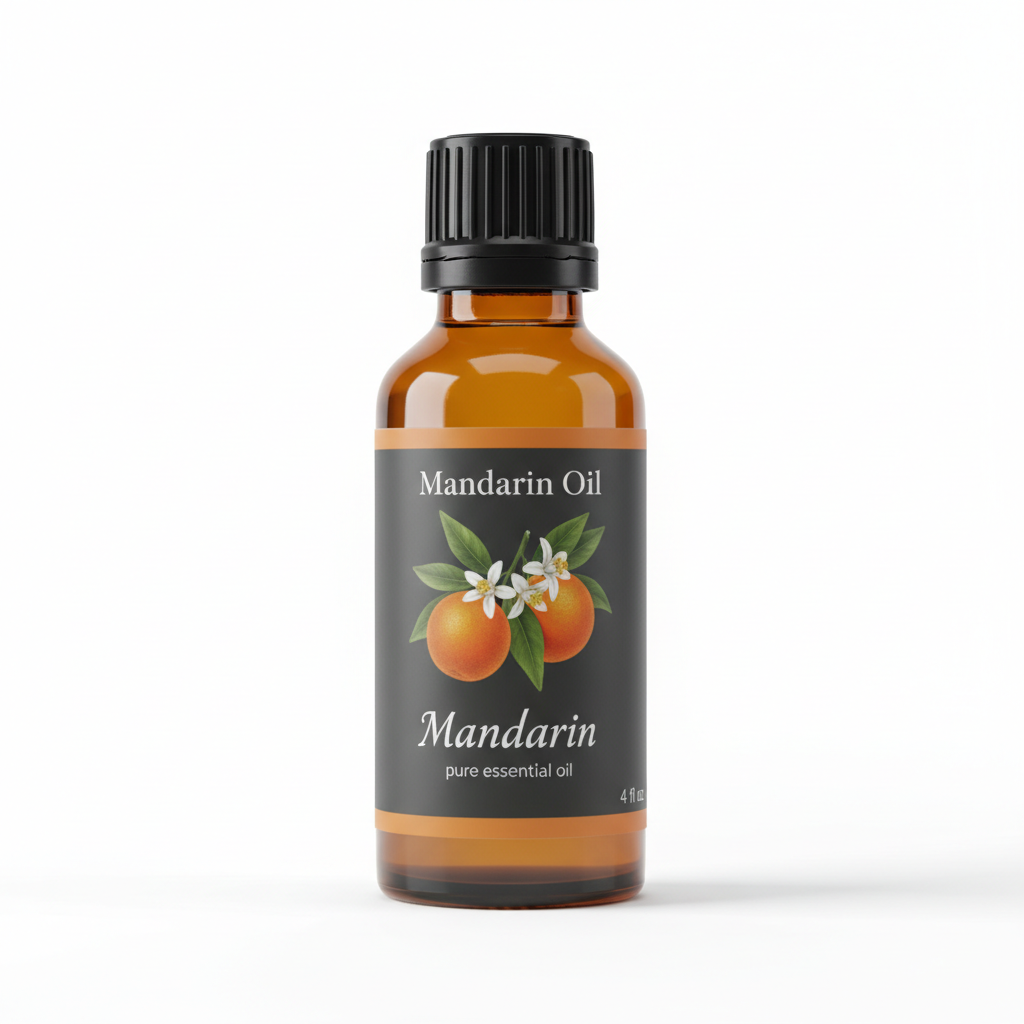
Mandarin Essential Oil
Our own Mandarin Essential Oil, in sizes from 0.5 oz to bulk.
From $12.99
Shop Now →The document that separates them: IFRA's lemon standard
The IFRA standard for cold-pressed lemon oil (Amendment 49, 2020) restricts it to 2.0% of the finished product in most categories, with no restriction in a handful of others. It says the standard is set because of phototoxicity and gives its basis: RIFM phototoxicity testing of cold-pressed lemon oil, its low bergapten content, and "the observed no-effect level of pooled samples in tests using the animal model." If the furocoumarin level of your lemon oil is unknown, that 2.0% limit applies, and if the oil is a terpene-reduced (concentrated) quality the limit is reduced in proportion to the concentration.
That is a different kind of number from bergamot's. Lemon's 2.0% rests on low bergapten and an animal no-effect level; bergamot's 0.40% rests on older human and animal phototoxicity literature. For the gap between them see mandarin versus bergamot and the table in our citrus comparison.
For mandarin, the IFRA furocoumarin standard does not list cold-pressed mandarin peel oil among its eight restricted oils. It names petitgrain mandarin and cold-pressed tangerine at a typical 50 ppm of furocoumarins and calls that not high enough to need special restrictions alone. Our published certificate of analysis has no furocoumarin figure, so we cannot say where our batch sits; it lists only appearance, smell, relative density, refractive index and optical rotation. Someone making a sun-exposed leave-on product should request the figure in writing and have a regulatory consultant or cosmetic chemist read it.
What is actually different in the bottle
Lu and colleagues analysed cold-pressed peel oils from three citrus species in the Journal of Food Science and Technology (2019), with three replicate extractions per oil. The two relevant rows:
| Cold-pressed peel oil | Limonene | Beta-pinene | Gamma-terpinene | Citral |
|---|---|---|---|---|
| Ponkan mandarin (C. reticulata) | 74.9% | 1.3% | 9.7% | no value listed (0.11% in the hydrodistilled oil) |
| Eureka lemon (C. limon) | 55.5% | 16.9% | 11.8% | 1.1% |
These are one fruit lot each (the lemons were harvested in December 2014 in Yichang, Hubei, China, and the Ponkan fruit was obtained from Huazhong Agricultural University in Wuhan), so they describe how the species can differ, not a specification for any commercial oil. Note the beta-pinene gap: 16.9% against 1.3%, a thirteenfold difference. The same paper found that hydrodistillation gave lemon more citral (1.66%) and more oxygenated compounds (18.23%) than cold pressing, which retained more terpene hydrocarbons. If you buy "lemon" from a distiller rather than a presser, you are buying a different oil.
Reasoning from the table, and not from any smell panel: lemon's sharpness is plausibly carried by citral and a large pinene share (alpha-pinene is 5.8% in the lemon and 1.8% in the mandarin), while mandarin is a limonene oil with a smaller secondary share. Citral is the sort of compound regulators watch, so run the arithmetic. The IFRA citral standard allows 0.032% in category 2 products up to 0.60% in category 4, and 0.15% in categories 5A to 5C. Lemon oil at its own 2.0% limit with 1.1% citral would contribute 0.022% citral (0.02 x 0.011), under the category 2 figure. A lemon oil with about 1.6% citral or more would reach 0.032% at 2.0% oil, so the citral number, not the phototoxicity number, would bind first. Which category applies to your product is for a consultant to decide.
What both share
Both are limonene-rich pressed oils, so both oxidise. In the European scientific committee's tables of patch tests on consecutive dermatitis patients, oxidised limonene gave positive reactions in about 0.8% to 2.8% of patients across the rows, and limonene with no reported oxidation status gave none of 1,200 to under 1%. Those are patients sent for dermatitis, not shoppers, and they show why fresh oil is not the same material as oil left half-empty on a warm shelf. Our own advice follows: buy small, reorder often, decant a working amount, store the main bottle sealed, cool and dark. We state no shelf-life number.
Vapour pressure puts both in the same fast-fading group. NIH's PubChem lists limonene at 1.55 mmHg at 25 C, gamma-terpinene at 1.09 and beta-pinene at 2.93, and a Procter and Gamble patent from 2017 defines top notes as anything above 0.1 Torr. By that definition every major peel-oil constituent here is a top note. Neither oil is a fixative or a base, and in a perfume or a room scent both will leave before the heart of the blend does. See mandarin in natural perfumery for the arithmetic.
A short decision order
- Leave-on product that will meet sunlight? Lemon needs its 2.0% ceiling (and its citral sum) checked; mandarin needs a furocoumarin figure from whoever supplies it, because the standard we read is silent on peel oil.
- Rinse-off or a non-skin product? The scent decides. Lemon for sharpness, mandarin for a sweeter, rounder top.
- Blending both? Keep the lemon at or under half its ceiling in any leave-on blend so that adding a second restricted oil does not breach the 100% sum.
Diffuser and room use: where the choice does not come from a hazard table
The IFRA skin limits describe product applied to skin, so they are not the governing document for a diffuser or a spray. What the sources do not give us is any test of how either oil behaves in a particular diffuser, so we make no claim about strength, throw or duration. Practically: dose by the manufacturer's instruction for your diffuser, ventilate, and take questions about pets, birds, infants, asthma or pregnancy to a veterinarian or physician; the generic points are in our safety basics post and the diffuser method is in the home-use guide. We do not claim that either oil treats or relieves anything.
If you are choosing for scent alone, the shop copy describes our mandarin as sweet, mellow and juicy with a faint floral hum, and that is a statement about aroma. Lemon is a different job, bright and sharp; that is a reasoned reading of the composition above, not a result from any smell panel, because we have none.
If you buy lemon too
We sell mandarin only, cold-pressed from the peel, from 0.5 oz to 400 lb. We do not sell lemon, so buy it from an aromatherapy or soap supplier and ask: cold-pressed or distilled, the citral figure for the lot, whether it is terpene-reduced, and which IFRA amendment its documents cite. Everything above is arithmetic and reading, not a tested recipe; patch test anything that goes on skin.
Mandarin Essential Oil
Mandarin Essential Oil from our own shop, in sizes from 0.5 oz to bulk.
From $12.99
Shop Now →Sources & Further Reading
- IFRA, 2020. Standard: Lemon oil cold pressed, Amendment 49. ifrafragrance.org/IFRA_STD_092
- IFRA, 2020. Standard: Citrus oils and other furocoumarins containing essential oils, Amendment 49. ifrafragrance.org/IFRA_STD_089
- IFRA, 2020. Standard: Citral, Amendment 49. ifrafragrance.org/IFRA_STD_021
- Lu Q. et al., 2019. Peel oils from three Citrus species. J Food Sci Technol 56:4492. pmc.ncbi.nlm.nih.gov/PMC6801276
- European Commission, SCCS summary tables 5-1 and 5-2, Fragrance allergens in cosmetic products. ec.europa.eu/table-5-1
- NIH PubChem, vapor pressure entries for limonene (CID 22311), gamma-terpinene (7461), beta-pinene (14896). pubchem.ncbi.nlm.nih.gov/22311
- Procter and Gamble, 2017. US patent 9,814,661 B2, Fragrance compositions. patents.google.com/US9814661