Mandarin vs Bergamot Essential Oil: Bergapten, FCF and Swaps
Start with one piece of arithmetic. The IFRA standard for expressed bergamot oil caps it at 0.40% of a finished product in most categories, and our own skin-dilution copy for mandarin runs from 0.5% to 2%. At the top of that range, mandarin is used at five times bergamot's ceiling, so a recipe that swaps one for the other drop for drop is wrong in one direction or the other. Everything below explains why the two numbers differ and what to do about it.
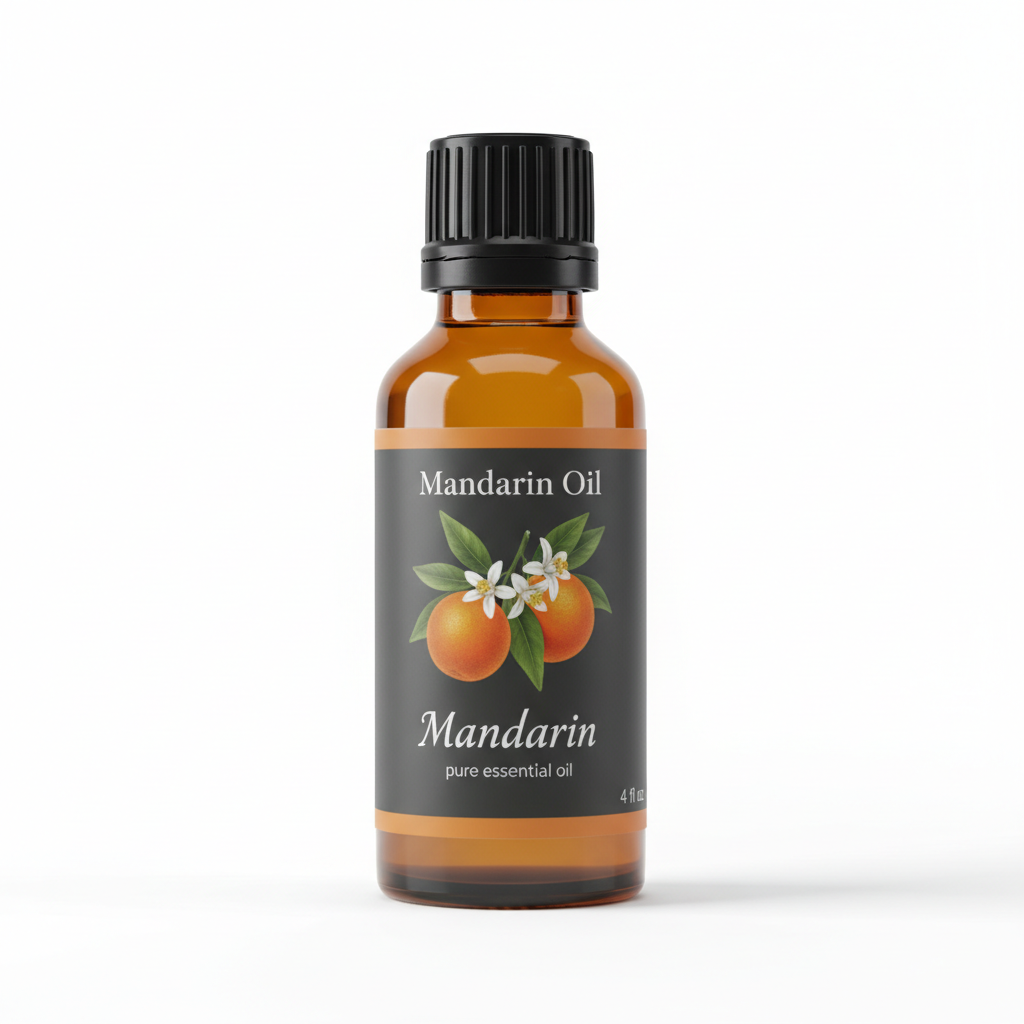
Mandarin Essential Oil
Our own Mandarin Essential Oil, in sizes from 0.5 oz to bulk.
From $12.99
Shop Now →Why bergamot has the smaller number
The reason is furocoumarins. The IFRA bergamot standard (Amendment 49, 2020) states that it is "set due to the phototoxic effects of Bergamot oil expressed," and it rests on phototoxicity literature from 1973 and 1977. A review of bergamot oil by Navarra and colleagues in Frontiers in Pharmacology (2015) reports a non-volatile fraction of 4% to 7% of the oil that contains psoralens, bergapten (5-methoxypsoralen, or 5-MOP) among them at "about 0.2%."
Put those figures together as arithmetic, not as a measurement of any bottle. Bergapten at 0.2% of the oil, with the oil at the 0.40% ceiling, is 0.0008% bergapten in the product, or 8 ppm. IFRA's separate bergapten limit for skin exposed to UV light is 0.0015% (15 ppm), which that same oil would reach at 0.75% (0.0015 divided by 0.002). The oil cap of 0.40% therefore leaves room under the bergapten number. At the other end, 2% of that same bergamot would give 0.004%, or 40 ppm, about 2.7 times the bergapten limit.
The 0.2% figure is a review's summary of another group's analysis, and it is the weak link, so redo the sum with your own lot's number. The oil percentage at which a bergapten level reaches 15 ppm is simply 0.0015 divided by the bergapten fraction:
| Bergapten in the oil | Oil level that reaches 15 ppm bergapten | Binding limit |
|---|---|---|
| 0.1% | 1.5% | 0.40% oil cap |
| 0.2% | 0.75% | 0.40% oil cap |
| 0.4% | 0.375% | 15 ppm bergapten, just under the oil cap |
Those rows are our arithmetic using the IFRA numbers, and the third row shows why a supplier's measured value matters: an oil richer in bergapten than the review's figure would hit the bergapten limit before the oil cap.
For mandarin the standard is less direct. Cold-pressed mandarin peel oil is not one of the eight restricted oils in the IFRA furocoumarin standard. That text names petitgrain mandarin and cold-pressed tangerine with a typical level of 50 ppm furocoumarins and says these "are not high enough to require special restrictions if used alone." If an oil with 50 ppm of furocoumarins were used at 2%, the oil would supply 1 ppm, but that is illustration using IFRA's figure for tangerine and petitgrain, not a number for ours. The certificate of analysis we publish has no furocoumarin value. A buyer making a sun-exposed leave-on product should ask for one in writing, and a regulatory consultant should read the answer.
"FCF" is a process claim you can ask about
FCF stands for furocoumarin-free. The Navarra review says a bergamot oil free of 5-MOP is prepared for perfumery and cosmetic use by vacuum distillation of the peels, giving an oil "chemically comparable" to the cold-pressed one (a conclusion it attributes to a 2007 study we did not read). Two consequences, both reasoning rather than findings:
- The label describes how the oil was made, so the supplier should say the method and give a measured bergapten result by lot. "Free" on a bottle is a claim, and the figure is the evidence.
- The IFRA furocoumarin standard says that where the bergapten content of all the oils in a compound has been determined, the total bergapten in the product should not exceed 15 ppm for skin exposed to UV light; where it has not been determined, the oil-specific limit applies. A documented low-bergapten oil is therefore judged against a different test than an undocumented one. Which test applies to your product, and in which IFRA category, is a regulatory consultant's call.
Neither the review nor the standard says an FCF oil is free of other hazards. It would still contain limonene, which oxidises in air (see our citrus comparison for the patch-test figures).
The two oils do different jobs in a blend
The review gives bergamot's range as limonene 25% to 53%, linalyl acetate 15% to 40% and linalool 2% to 20%, and cites a 2004 paper for the claim that linalool, citral and linalyl acetate provide much of citrus oils' characteristic flavour. Mandarin peel oil, in the cold-pressed Ponkan sample analysed by Lu and colleagues (2019), was 74.9% limonene and 9.7% gamma-terpinene, with no linalool or linalyl acetate reported. A seven-cultivar Turkish study found mandarin limonene from 76.6% to 96.2%.
The sensible reading is that bergamot's profile has an ester and an alcohol that mandarin's lacks in those samples, and mandarin's is mostly limonene with gamma-terpinene. Our shop copy describes our oil as sweet, mellow and juicy with a faint floral hum, and lists bergamot among the oils that blend well with it. That pairing is the practical answer to "which one": they are neighbours in a blend, not substitutes.
If you must swap one for the other
- Bergamot out, mandarin in. Expect to lose the ester and floral edge. Dose mandarin to our 0.5% to 2% copy and to your own patch test, not to the bergamot number, and keep the dilution maths in the safety basics post.
- Mandarin out, bergamot in. Cut the dose to bergamot's ceiling if the product stays on skin in sunlight and the oil is not documented FCF. A recipe at 12 drops of mandarin per ounce is 2%; 0.4% of 29.57 ml is 0.118 ml, about 2 drops at roughly 20 drops per millilitre. Weigh, because the drops differ between oils.
- Using both. The IFRA sum rule applies to restricted oils: express each at its percentage of its own ceiling, and the total cannot pass 100. Because mandarin peel oil is not on the restricted list, it adds nothing to that sum in the text we read, which is not the same as having no furocoumarins. Treat that gap as a reason to ask for data, not a clearance.
The full blending logic for mandarin lives in the pairing guide, and a close comparison of the sweet-orange family sits in mandarin versus orange.
What we sell, and what to ask whoever sells you bergamot
We sell mandarin only: cold-pressed from the peel, sold neat, from 0.5 oz to 400 lb. We do not sell bergamot, FCF or otherwise. When you buy it elsewhere, ask four things: expressed or furocoumarin-free, by what process, the bergapten figure for your lot, and the IFRA amendment the supplier's documents refer to. Then read the answer against the 15 ppm figure above.
We have not tested any blend or ratio on this page. Treat every figure as arithmetic from a cited standard, patch test any leave-on product, and take product-safety questions about a product you plan to sell to a regulatory consultant.
Mandarin Essential Oil
Mandarin Essential Oil from our own shop, in sizes from 0.5 oz to bulk.
From $12.99
Shop Now →Sources & Further Reading
- IFRA, 2020. Standard: Bergamot oil expressed, Amendment 49. ifrafragrance.org/IFRA_STD_087
- IFRA, 2020. Standard: Citrus oils and other furocoumarins containing essential oils, Amendment 49. ifrafragrance.org/IFRA_STD_089
- Navarra M. et al., 2015. Citrus bergamia essential oil: from basic research to clinical application. Front Pharmacol 6:36. frontiersin.org/fphar.2015.00036
- Lu Q. et al., 2019. Peel oils from three Citrus species. J Food Sci Technol 56:4492. pmc.ncbi.nlm.nih.gov/PMC6801276
- Golukcu M., Bozova B., Giuffre A.M., 2025. Peel essential oils of mandarin cultivars grown in Turkiye. AIMS Agriculture and Food 10(3):679. aimspress.com/agrfood-10-03-034